
Proof points in B2B ads: the six kinds that count and the ones that only look like proof
Nimblet teamUpdated 31 min read
Short answer
Proof in a business-to-business (B2B) ad is evidence that a buyer can check without you and a colleague can repeat in a meeting. Six kinds count: a named customer, a customer result number, a customer quote, a badge, award or review score, an adoption number and an outside voice. This page ranks them as our reading, shows what only looks like proof, and gives you a one-page card, a proof register, a customer permission message and two prompts to paste.
On this page9 sections
- 01What counts as proof in a B2B ad?
- 02Which six kinds of proof do B2B ads use?
- 03What looks like proof but is not?
- 04Which proof does a risk-averse buyer believe first?
- 05How do you pair proof with the angle and the ask?
- 06What do you use when you have no customer to name?
- 07How do you keep proof clean and approved?
- 08How do you read a competitor's proof?
- 09Frequently asked questions
What counts as proof in a B2B ad?
Proof is evidence for a claim that the buyer can check without you and a colleague can repeat in a meeting. Evidence that fails the first test stays a claim. Evidence that fails the second test stays with one person.
A business-to-business (B2B) buyer carries a risk, and the ad must lower it. LinkedIn's Buyability study asked 750 senior B2B buyers what drives a decision. The Drum reports that the ability to defend the decision if it goes wrong ranked first of five emotional factors. It also reports that recommendations from peers were three times more influential than a lower price or a claim of better performance. That is LinkedIn's own research, and we read the coverage, not the study. Gartner found buying groups of five to 16 people across up to four functions (survey of 632 buyers, August to September 2024). So one person sees your ad and must carry its proof to the rest.
LinkedIn's advertising policy sets the floor: "Any claims in your ad must have factual support."
This page rests on our reading of the ad rules of LinkedIn and Meta, the terms of the analyst and review sites, two agency guides and 61 public ads. We hand-coded the 61 ads: 41 from the LinkedIn Ad Library and 20 from the Meta Ad Library, from 22 brands, pulled with a Germany filter on 22 October 2026. We coded the text and the still image of each ad, not the films. The sample is not random. It shows what some ads do, not how often the market does it. Where a claim is measured, a vendor's own number or our reading, the sentence says so.
Paste this card into the thread where your team reviews the ad. The rest of the page explains each line.
PROOF CARD FOR AD REVIEW

Proof is evidence for a claim that the buyer can check without us and a colleague can repeat in a meeting. The proof register is one sheet with one row per approved claim: exact wording, source, permission, date.

Six kinds that count, strongest first (our ranking from practice, not a measurement)
1. Named customer: a company the buyer can look up and call
2. Customer result number: what changed, for whom, over what period, from which source
3. Customer quote: word for word, with a name and a role
4. Badge, award or review score: from a third party, with the year or season and the owner's wording
5. Adoption number: how many, counted when, counting what
6. Outside voice: someone who does not work for us, in their own words, marked if we pay or give access

What only looks like proof (the four we see most)
Partner logos. Our own survey or report. A statistic about the problem. A number that no customer or source stands behind.

Gate before the ad ships (every answer must be yes)
1. Does every name, logo, quote and number have a row in the proof register?
2. Does every number say what was counted, over what period and for whom?
3. Do we hold written permission for paid ads on this channel?
4. Is every quote word for word?
5. Does every exceptional result say what is typical?
6. Is every badge current, with its year or season and the owner's wording?
7. Would the buyer in this ad see a company or a role like their own?
8. Does every register row have a review date?
Which six kinds of proof do B2B ads use?
B2B ads use six kinds of proof: named customer, customer result number, customer quote, badge or award or review score, adoption number and outside voice. The descriptions below cover the common cases, which is enough for most reviews. Nimblet applies a fuller set of rules when it sorts the proof in your ads and in your competitors' ads, in the app or in Claude or ChatGPT over the Nimblet MCP server.
Of the 61 ads, 14 show at least one of the six kinds. Sixteen show only things that look like proof (next section). Thirty-one show neither. These are our hand counts. A borderline case, such as a logo bar or a quote block on an image, counted as a kind.
| What the ad showed | LinkedIn (41 ads) | Meta (20 ads) | Together (61 ads) |
|---|---|---|---|
| At least one of the six kinds | 12 | 2 | 14 |
| Only things that look like proof | 15 | 1 | 16 |
| Neither | 14 | 17 | 31 |
By kind, a named customer appears in nine ads, a customer quote in four, a badge, award or review in three, a result number in two, an adoption number in two and an outside voice in none. One ad can show several kinds. Nine ads show a number and name no source for it in the ad. We left out numbers that come from a survey, report or study that the ad names or offers. We read the ads, not the landing pages, so a source may sit one click later.
Named customer
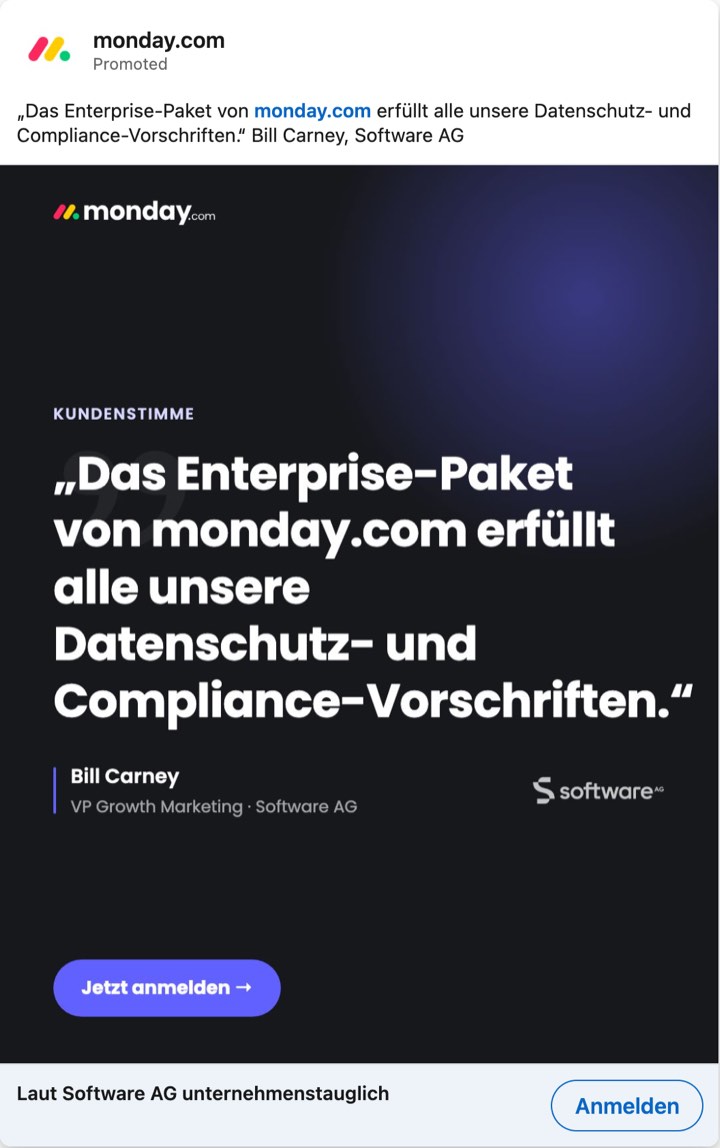
A named customer is a real company that uses your product, shown by its name or logo. The buyer can look it up and call someone there. In monday.com's ad the headline reads "Laut Software AG unternehmenstauglich" (our translation: enterprise-ready according to Software AG). It comes with a quote about data protection from a named contact with a job title.
Customer result number
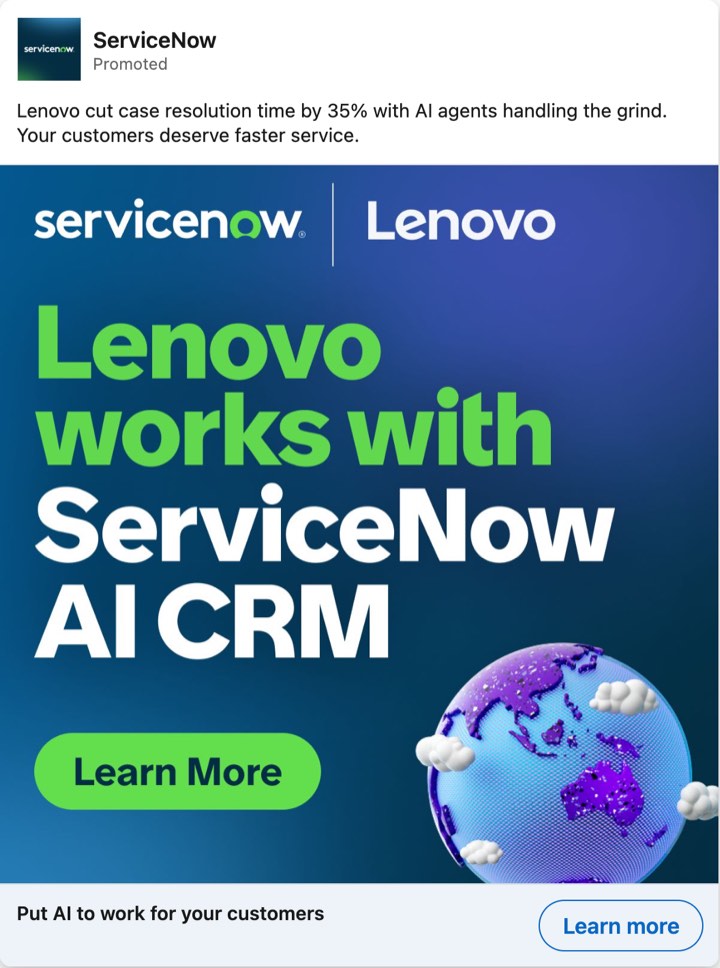
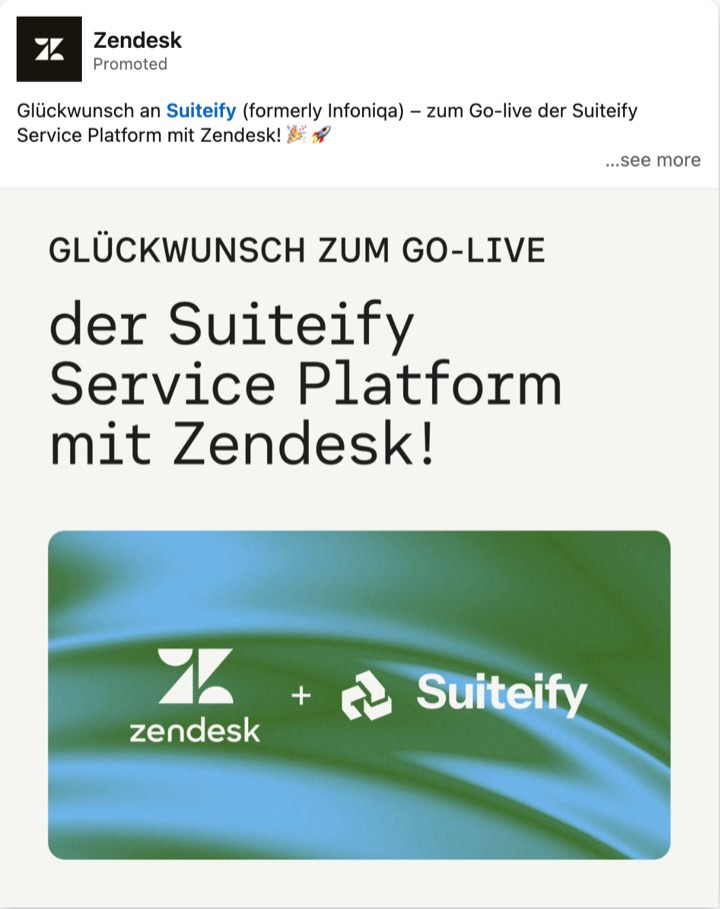
A customer result number states, with a figure, what a customer got. ServiceNow's ad opens with "Lenovo cut case resolution time by 35% with AI agents handling the grind." It names the customer and gives a number. It names no period, no method and no source, so the 35% is the advertiser's own claim. A percentage also needs its base: write the measure, such as median or mean, and whether it covers all cases or one team's. Only two of the 61 ads give a number for what a named customer got. The other is Zendesk's go-live ad, with 157 days, seven teams and more than 7,000 articles for one customer.
Customer quote
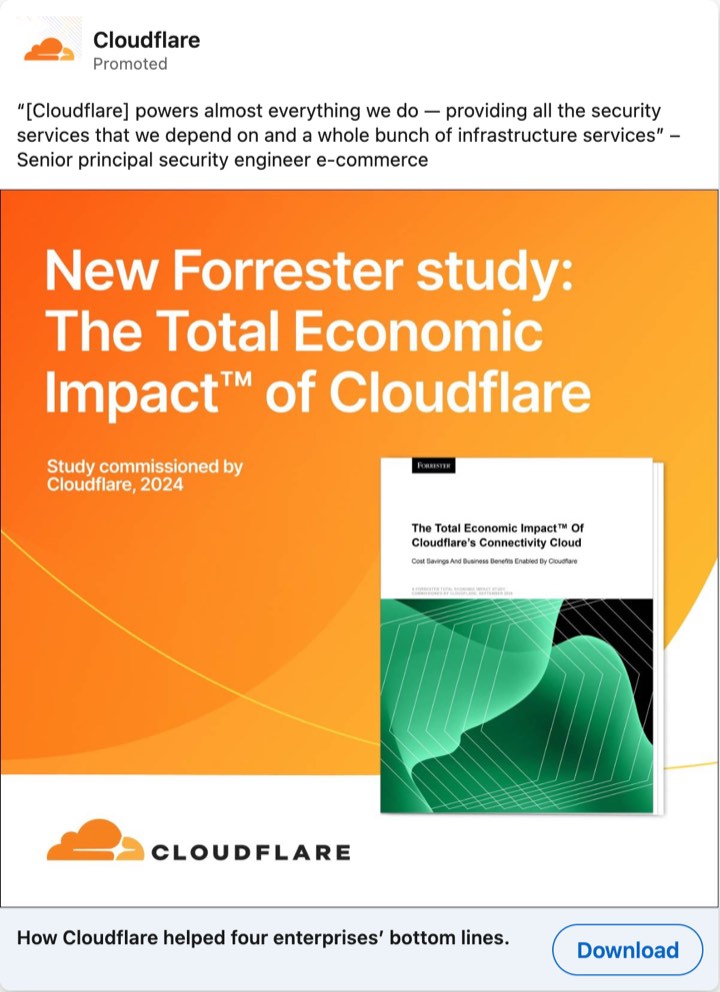
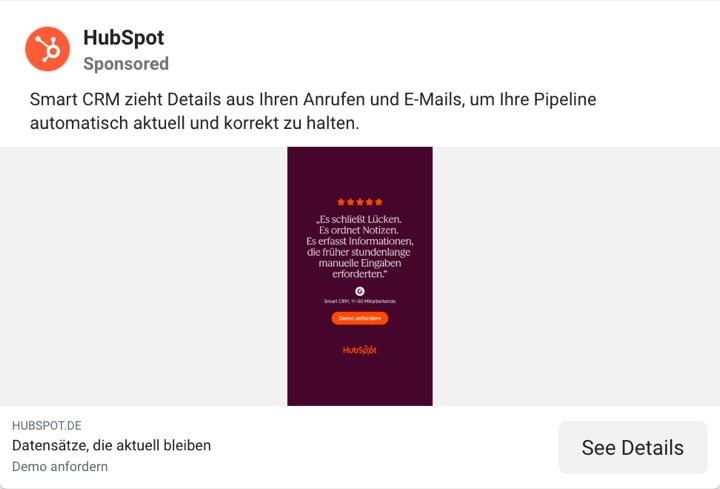
A customer quote is a sentence in the words of a customer or user. With a name and a role, the buyer can check it. With a role alone, nobody can. Cloudflare's ad shows a quote from a "Senior principal security engineer e-commerce" with no name, next to the cover of a Forrester study. HubSpot's Meta ad shows a star rating and a quote block on the image. A quote must stay word for word. A quote cut to say more than the customer said misleads the reader.
Badge, award or review score
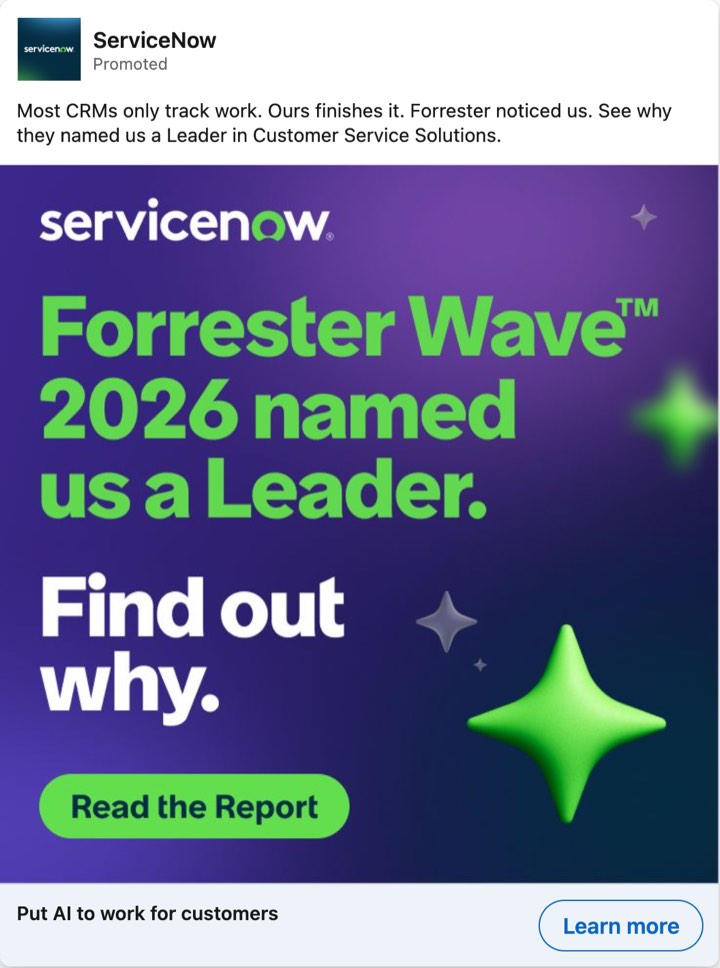
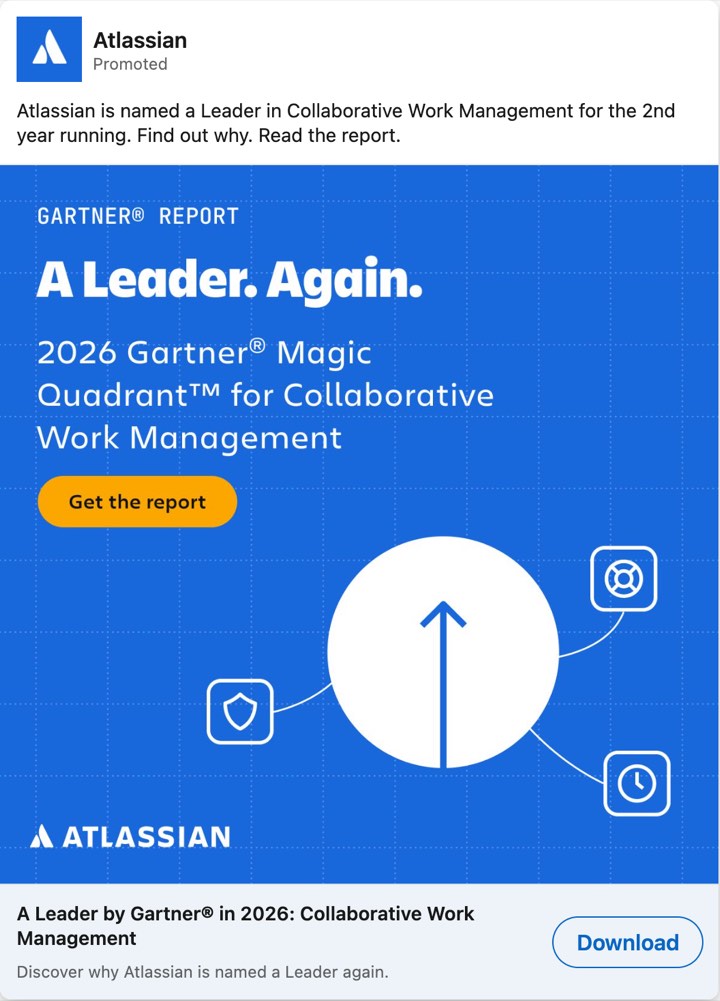
Someone outside the vendor rates the product or gives it an award. Analyst rankings, awards, certifications and review scores all belong here. ServiceNow writes "Forrester noticed us. See why they named us a Leader in Customer Service Solutions." Atlassian writes "Atlassian is named a Leader in Collaborative Work Management for the 2nd year running." Both name the analyst. Ask three things of any badge: which year or season it belongs to, who owns it and what their terms say, and how many reviews stand behind a score. The terms are in the section on approval.
Adoption number
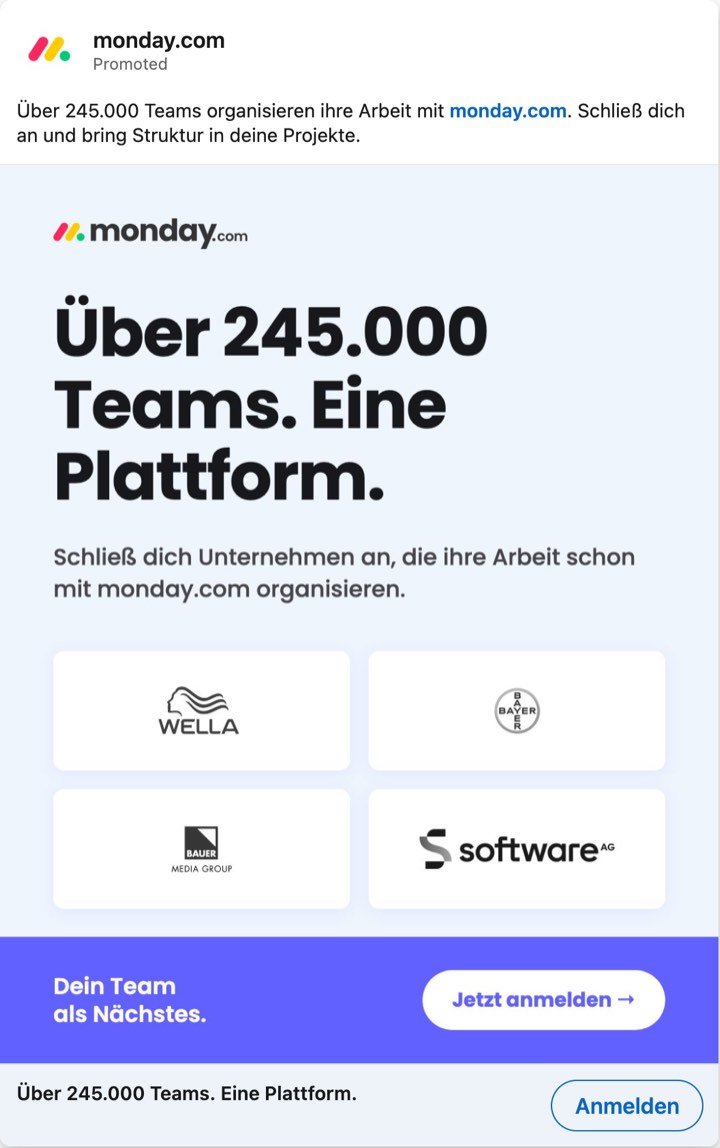
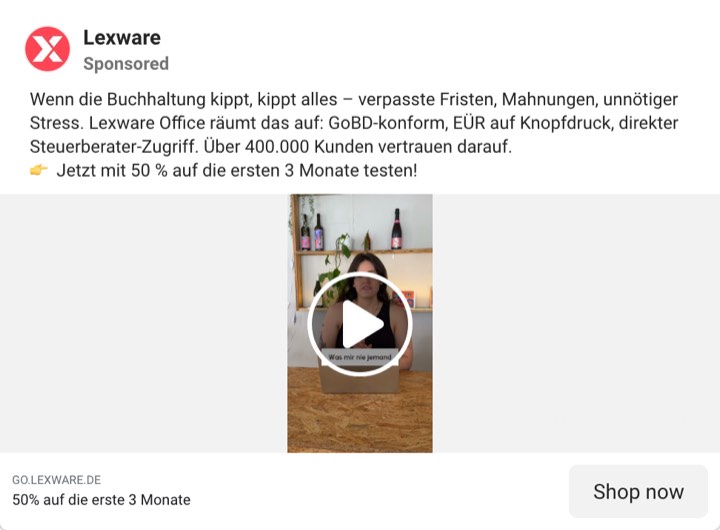
An adoption number counts who uses the product. monday.com writes "Über 245.000 Teams organisieren ihre Arbeit mit monday.com" (our translation: more than 245,000 teams organize their work with monday.com). Lexware's Meta ad writes "Über 400.000 Kunden vertrauen darauf" (more than 400,000 customers trust it). Neither ad says who counted or when, so both are the vendor's own number. A count for the buyer's own segment says more than a total. That is our reading.
Outside voice
An outside voice is a person who does not work for you and talks about the product in their own words. A post by your founder is still your own voice, even when it runs as a thought leader ad. If you pay the speaker or give free access, say so. LinkedIn's policy asks advertisers to "disclose any pertinent partnerships". Meta's Advertising Standards require ads that promote branded content to tag the business partner with the branded content tool.
None of the 61 ads shows this kind in its text or still image. Two video ads say in their copy that a customer's staff speak (Personio and Salesforce), and we did not watch the films. The nearest text case is an ad built from an outside author's post, promoted by the advertiser and marked #ad. The lines visible in the library do not yet say that the author uses the product. For the choice of poster, see LinkedIn thought leader ads.

What looks like proof but is not?
Many things look like proof and are not. Each answers a question the buyer did not ask. The buyer asks whether this works for someone like them. Sixteen of the 61 ads lean on things like these and show none of the six kinds. The table holds the four we saw most often.
| Looks like proof | Why it is not proof | Public example |
|---|---|---|
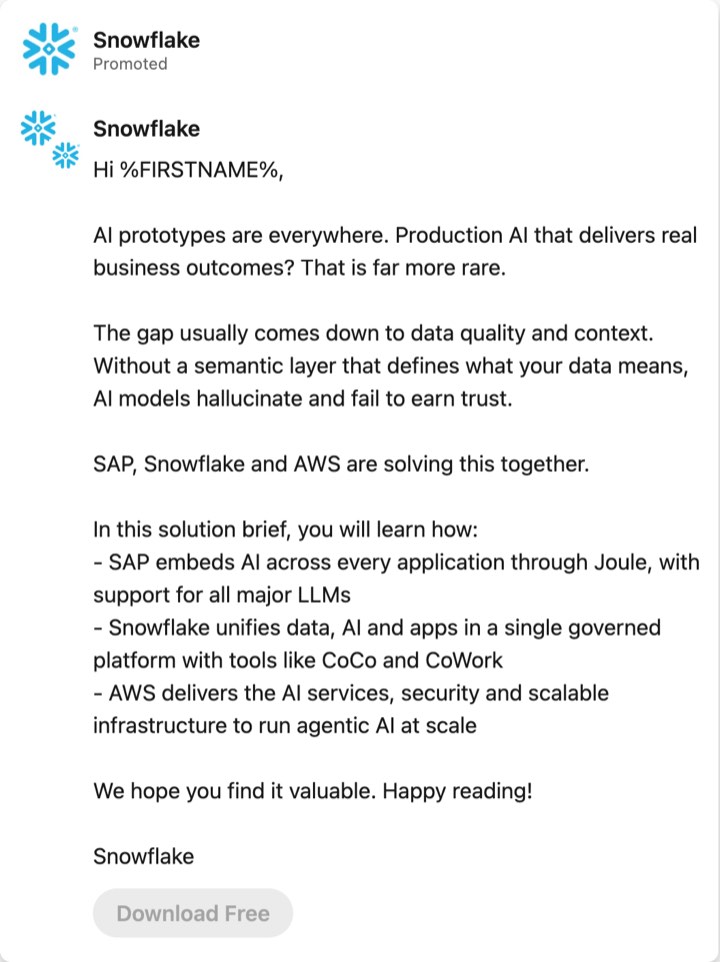
| Partner, integration or reseller logos | They show who you work with, not who got a result. | Snowflake's message ad names SAP and AWS as partners in a joint solution brief. |
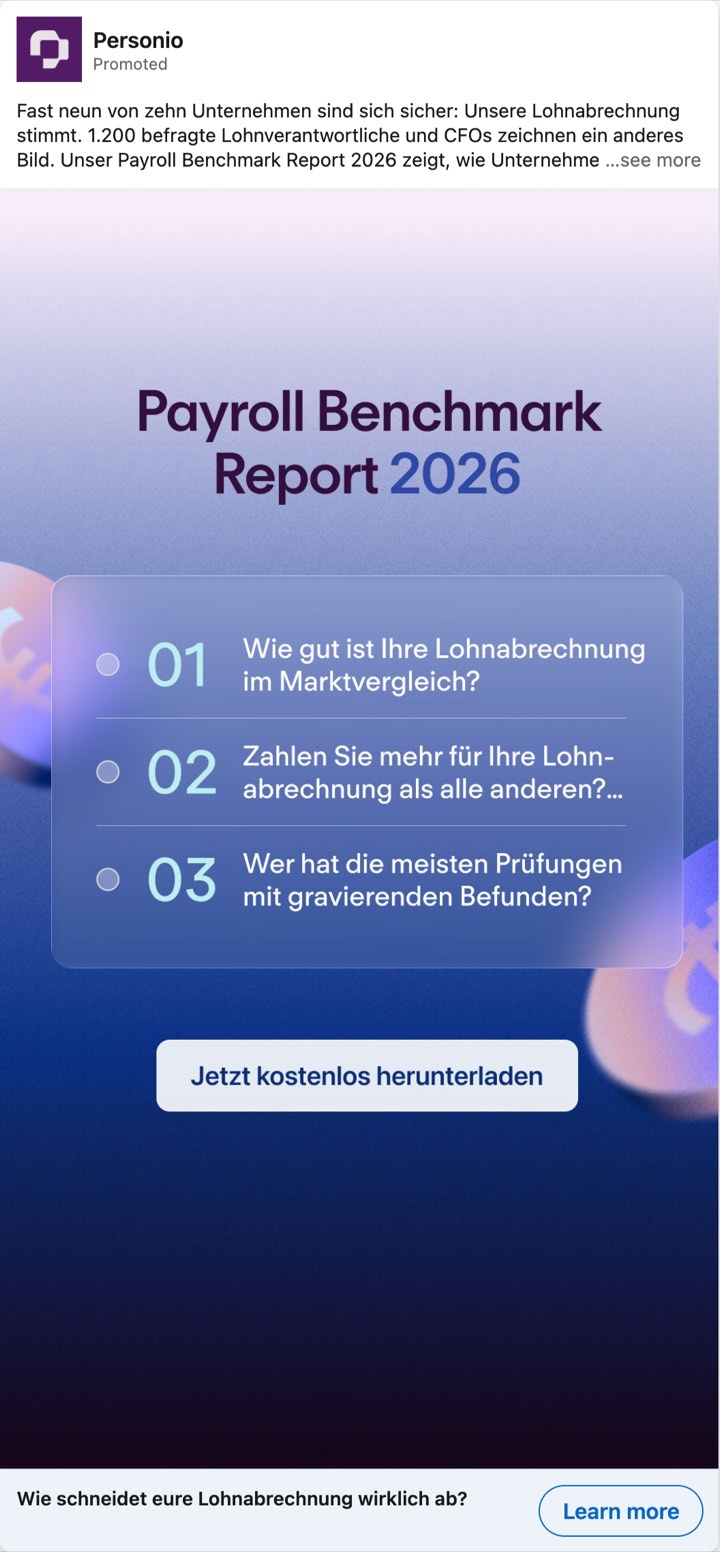
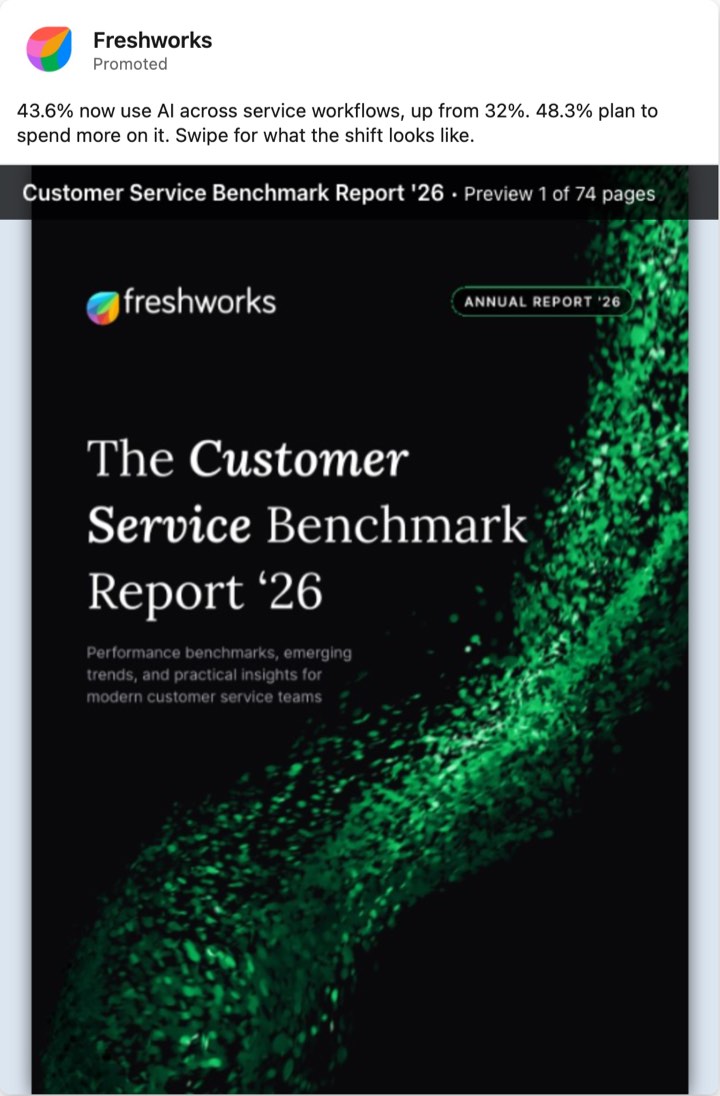
| Your own survey or report | It is evidence about the market, collected by you. It supports "the problem exists", not "our product works". | Personio cites "1.200 befragte Lohnverantwortliche und CFOs" (1,200 payroll owners and chief financial officers surveyed). Freshworks leads with "43.6% now use AI across service workflows, up from 32%." |
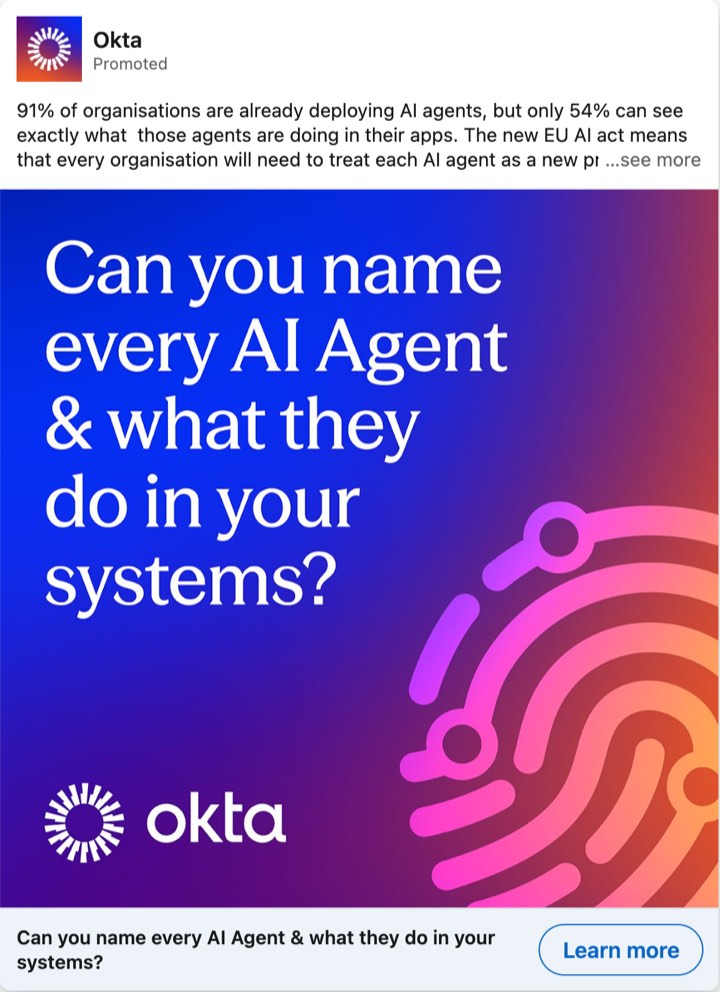
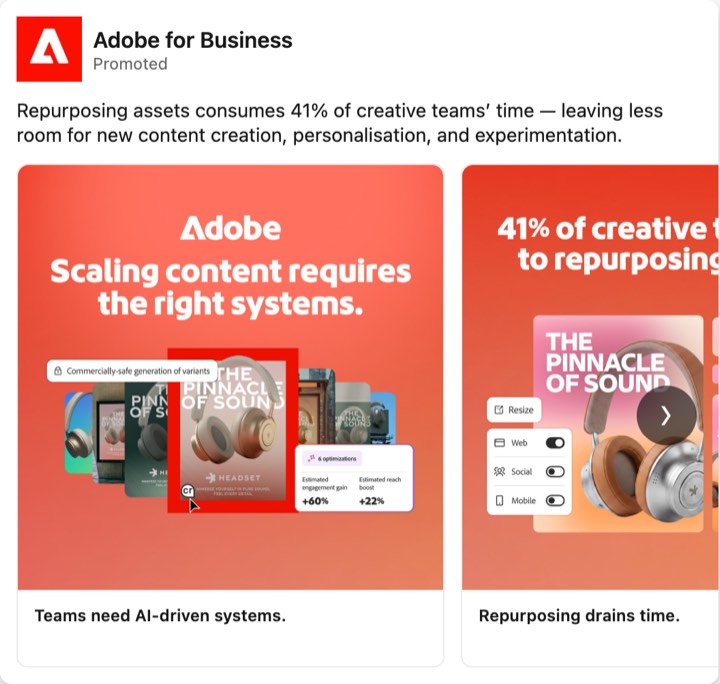
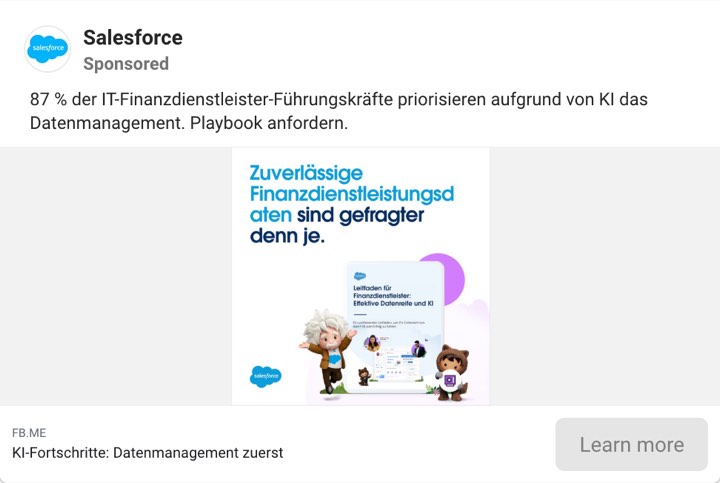
| A statistic about the problem or the buyers | It shows the problem is real. It says nothing about your fix. | Okta: "91% of organisations are already deploying AI agents, but only 54% can see exactly what those agents are doing in their apps." Adobe: "Repurposing assets consumes 41% of creative teams’ time". Salesforce on Meta: "87 % der IT-Finanzdienstleister-Führungskräfte priorisieren aufgrund von KI das Datenmanagement." (our translation: 87% of executives at IT financial service providers prioritize data management because of AI) |
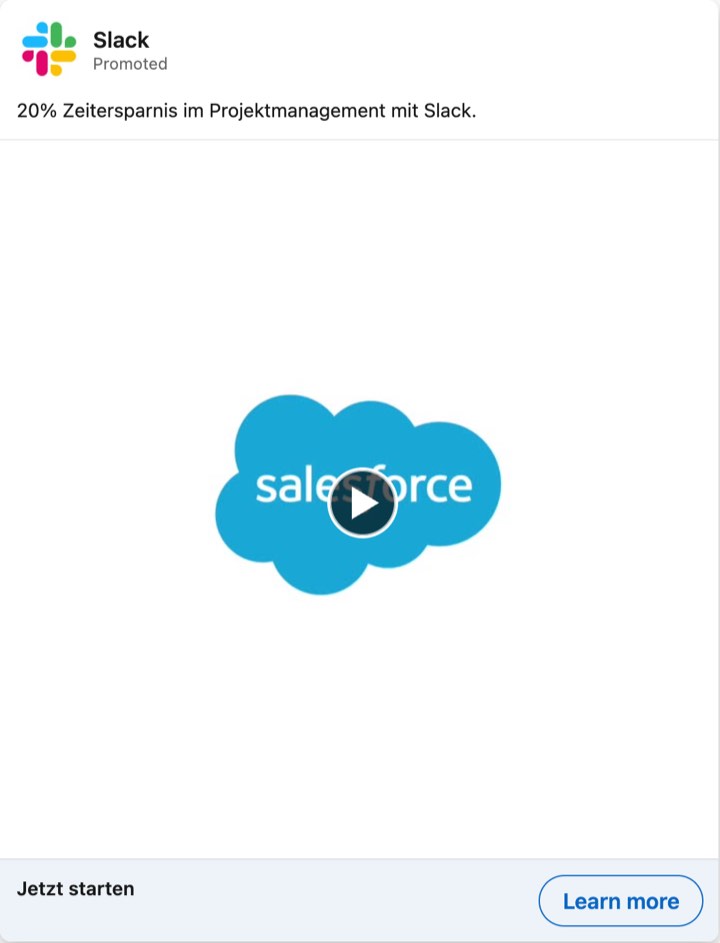
| A number with no owner | No customer, no base and no source stand behind it. | Slack: "20% Zeitersparnis im Projektmanagement mit Slack" (20% time saved in project management with Slack). |
Two grey cases need a label. Shopify's ad shows "31%" with small print about commissioned research, and Cloudflare's ad shows a Forrester study cover. A study the vendor paid for is not independent, even when the analyst did the work. If you use one, write "commissioned by us" in the ad. Blue Seedling calls commissioned research such as the Forrester Total Economic Impact report "often one of the highest-ROI investments" for an early-stage startup, depending on the category. We agree that it can help, if the ad says who paid.
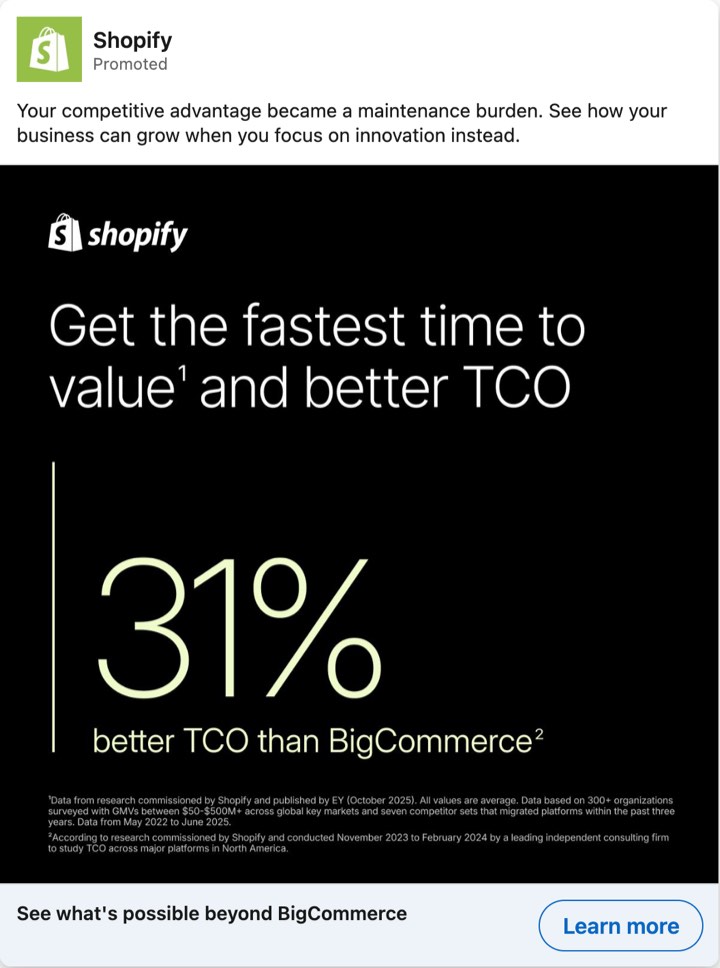
Do not throw these away. A statistic about the problem makes a good hook (see B2B ad hooks). Use each one as a hook or as context. Do not let it stand in for evidence that the product works.
Which proof does a risk-averse buyer believe first?
A risk-averse buyer believes a named customer who looks like them, with a number that this customer would confirm. This ranking is our reading, not a measurement. It rests on two tests. Test 1: the buyer can check the proof without you. Test 2: a colleague can repeat it in a meeting and get a nod.
| Rung | Kind | Why a buyer believes it | Where it breaks |
|---|---|---|---|
| 1 | Named customer | The buyer can look the company up and find someone in the same job. | The customer is unlike the buyer, or it is only a logo with no claim attached. |
| 2 | Customer result number | A colleague can repeat a number. It is the one kind that answers "what did they get?" | No name, no period, no base, or an exceptional result shown as typical. |
| 3 | Customer quote | A person with a name and a role says it in their own words. | No full name, praise with no fact, or words cut to say more. |
| 4 | Badge, award or review score | A party outside the vendor rates the product, and the reader can check that party's page. | An old year or season, a score with no count, or a badge used without the owner's license. |
| 5 | Adoption number | The buyer is not the first to try it. | No source, users counted as customers, or a segment unlike the buyer's. |
| 6 | Outside voice | Someone who does not work for the vendor speaks in their own words. | The speaker does not use the product, or payment is hidden. |
The strongest single frame holds rungs 1 and 2 together: a named customer with the number it got. Add one line from rung 4 as small print. Keep one claim per frame. Two claims that share one number leave the reader unsure which claim the number backs. This is our reading. In the 61 ads, monday.com pairs a named customer with a quote, and Zendesk pairs a named customer with a list of results. None pairs a named customer with a number and its source.
The evidence is thin. We found no study that tests which of the six kinds a B2B buyer believes first, so we do not call the ladder measured. Three sources help, and none settles it.
- LinkedIn's head of marketplace innovation told The Drum that recommendations from "people like me" were the single most influential factor in the Buyability study. It is LinkedIn's own study, reported second-hand.
- Terho and Jalkala (2017) link customer reference marketing to selling performance in a paper in Industrial Marketing Management. We read the abstract. It says knowledge about the effective application of references in business "remains scant".
- Ooms, Hoeks and Jansen (2019) ran an experiment on health stories with 582 people. A protagonist of the same age raised identification and the intention to donate for students. The authors report nearly no difference for older adults. They suggest that earlier mixed results may come from similarity that was not relevant to the topic of the story. It is a study of health stories, not of ads. Our reading for an ad: match the buyer on what the decision turns on, such as sector, company size or job, and not on everything.
Two agency guides land in the same place. SaaS Hero's social proof guide (updated 18 July 2026) says to tie each proof to one buyer doubt, to show only logos of real paying customers and to match logos to the buyer's segment. Its testimonial guide (updated 10 August 2026) asks for a full name, job title and company on every quote, and for a quote from the same job as the buyer. Both guides give lift percentages. The text names no study for most of them, so we do not repeat them. The two guides are better than this page on layout and image sizes, such as where the quote sits next to the button.
Social proof is the lever behind most of the ladder. Cialdini states the principle this way: "Especially when they are uncertain, people will look to the actions and behaviors of others to determine their own." His example is a hotel card that pointed to what "comparable previous guests" did and raised towel reuse by 33%. It is a consumer example. The lever fits B2B because the buyer is uncertain and exposed. It does not tell you which evidence to show. The levers are in the psychology of B2B ads.
How do you pair proof with the angle and the ask?
Start from the doubt the angle creates, then choose the proof that answers it. The ask follows the proof. Each row below is one pairing, with a public ad that does it.
| The doubt | Proof that answers it | Ask it can carry | Public example |
|---|---|---|---|
| "Will the rollout hurt me?" | A named customer with a time to go live | Demo, rollout guide | Zendesk: "In nur 157 Tagen" (in only 157 days) from kickoff to one support platform for seven teams. |
| "Is the saving real?" | A customer result number with period and base | Case study, learn more | ServiceNow pairs the doubt with the Lenovo figure. The figure still lacks a period and a source. |
| "Will legal or IT block this?" | A quote from a peer in a regulated company, or a certification | Sign-up, security page | monday.com: a named customer says the product meets its data protection and compliance rules. |
| "Is this a credible player in the category?" | An analyst badge with the year | Read the report | Atlassian and ServiceNow. |
| "Does it work for a company like mine?" | A named customer in the buyer's own segment | Customer story | Personio names a manufacturer in a customer video headed "Ein HR-System für die Fertigung" (one HR system for manufacturing). |
| "Am I behind my peers?" | Your own survey as the hook, with sample, date and method one click later. Proof for the product comes after. | Report download | Freshworks leads with two survey figures and the words "Swipe for what the shift looks like." |
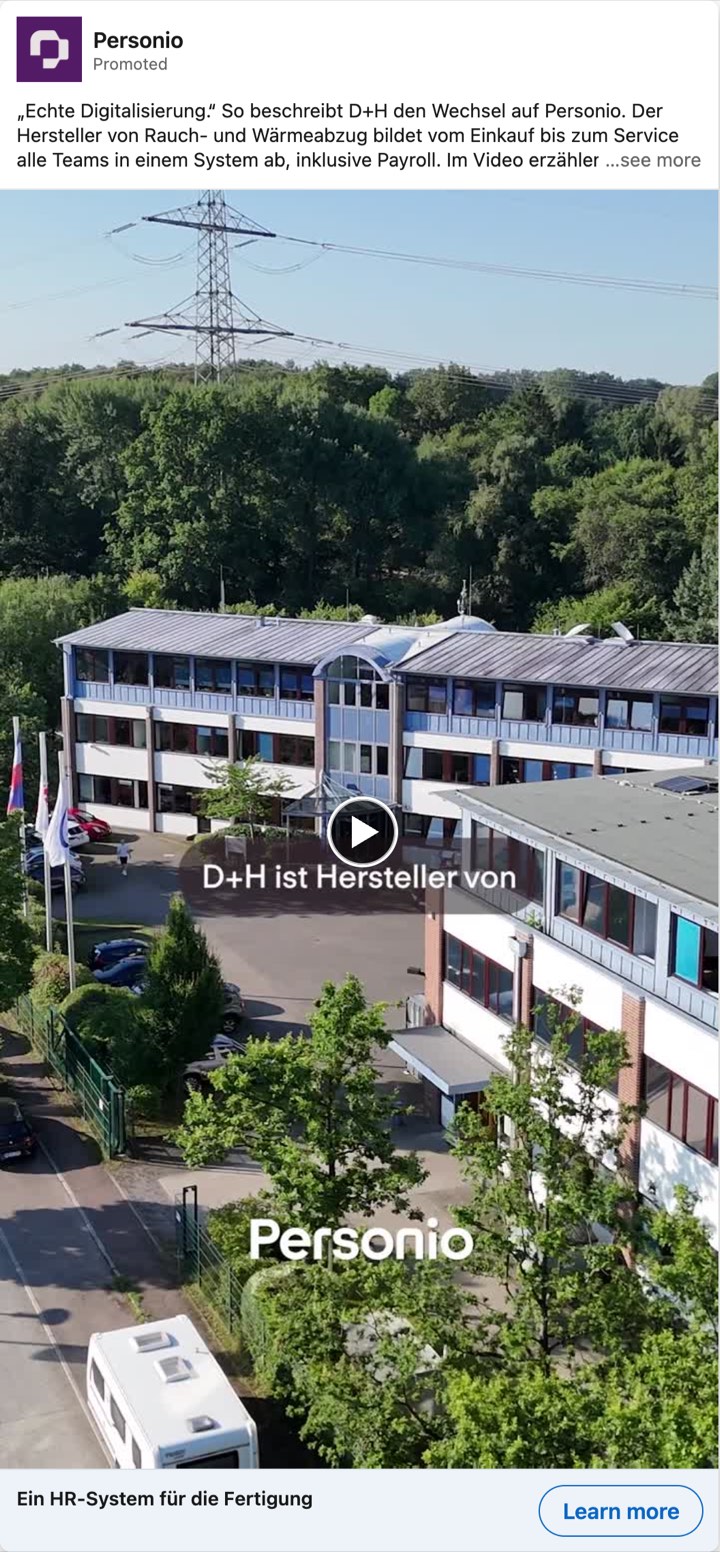
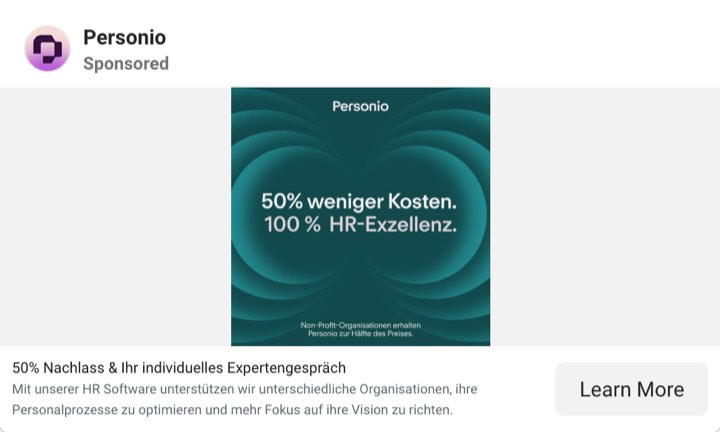
The size of the ask follows the strength of the proof. This is our reading. A large ask, such as a discount plus a call with an expert, asks the buyer to bet their name, so it needs a rung 1 or rung 2 proof near it. A small ask, such as reading a report, can run on a rung 4 or rung 5 proof. Among the 61 ads, the one with the largest ask by our coding, Personio's half-price offer with an expert call, shows no proof in the ad. We read the ad, not the page, so the page may carry it. If the ad carries none, the page must.
Proof can open the ad. The ServiceNow ad above starts with a customer and a number. The first line is the job of B2B ad hooks. The reason to act is the job of B2B ad angles.
Some angles need no proof. A shared annoyance or a plain look at the product makes no claim that needs evidence. The brief template has a line for this: "No proof available for angle". Use it and pick angles that need none.
Here is the pairing on an invented product. Approvely is invented, and every proof slot is a placeholder. The draft says: "Approvely makes invoice approval faster. Trusted by finance teams everywhere. Book a demo." The first sentence is a promise. The second is an adoption claim with no count. The third is a demo ask with no proof next to it. The doubt the draft creates is whether the saving is real. The fix has three parts. Pair the doubt with a result number: "[Customer] cut [median approval time for invoices over X] from [before] to [after] in [period]. Source: [link]." Replace the vague adoption claim with a counted one or cut it: "[N] finance teams use Approvely. Counted on [date]." Keep the demo ask, because the result number now stands beside it.
Write each proof line in one fixed pattern, and fill the brackets only from your register (see the approval section below).
PROOF LINES: one pattern per kind. Use only items from the proof register.

Named customer
[Customer] runs [what the product does for them] on [Product]. Source: [link or report]

Customer result number
[Customer] cut [what was counted] from [before] to [after] in [period]. Counted by [who] from [source]. [If the result is exceptional: Typical result: [typical].]

Customer quote
"[Exact words.]" [Name], [role], [Customer]

Badge, award or review score
[Product] is [exact designation] in the [year or season] [report or category]. [Owner's required wording or link]

Adoption number
[N] [teams or companies in the buyer's segment] use [Product]. Counted on [date]. A user is [definition].

Outside voice
"[Exact words.]" [Name], [role], [company]. Tie to us: [customer or none]. [If we pay or give access, say so.]
What do you use when you have no customer to name?
Use proof you can source without a customer, and say what it is. Five options work. They are listed in the order we would try them. Never borrow a name.
- A design partner, named with written permission. Horizon Capital's guide to design partners advises three to seven partners, measurable success criteria before you start and an agreed method for how success is measured. The guide lists testimonials and case studies among the benefits of design partners. Call them design partners, not customers.
- A pilot result with a measure you agreed in advance. Pattern: "In a [number]-day pilot with [design partner, named with permission], [what was counted] went from [before] to [after]. Counted by [who] from [source]." This is a result number, and the label shows its size.
- The product doing the job on screen, labeled as a demonstration. A recorded run shows the mechanism. It shows no result, so do not caption it as one.
- A review score, once you have enough reviews. G2 states that the Users Love Us badge, the one badge open to all vendors, needs 20 or more reviews and a rating of 4 or higher. Below that count, we would show no score. That is our reading.
- Research you commission, labeled as commissioned. Blue Seedling recommends it for early-stage startups in its guide to enterprise deals. It costs money, and the label stays in the ad.
A founder's voice shows that the problem is understood. It is the advertiser's own voice, so it is not proof. It fits the authority lever in the psychology of B2B ads.
Do not show the logo of a prospect or a partner as if it were a customer. SaaS Hero says that getting caught with fake logos destroys trust faster than having no logos, which is its claim. LinkedIn's trademark rule also bars using logos or company names in a way that would "imply an affiliation or endorsement when there is none".
How do you keep proof clean and approved?
Keep one proof register with one entry per approved claim. Let no ad name a customer, quote a person or show a number that is not in it. GrowthSpree's LinkedIn creative guide puts the reason in one line: "invented numbers erode trust and violate platform rules."
SaaS Hero's testimonial guide adds two rules we keep. First, get written permission for every quote in a paid ad, including public reviews on G2 or Trustpilot. We did not read a platform text that says this for reviews, so we treat it as careful practice. Second, pick your most representative customers, not your most enthusiastic ones. The "typical or exceptional" field in the register checks for that. The table shows what the rules we read say, and what each one adds to the register.
| Source | What it says | What goes in the register |
|---|---|---|
| LinkedIn Advertising Policies (revised 18 November 2025) | The page has no separate rule on testimonials or before-and-after claims, so the general rules apply. "Any claims in your ad must have factual support." "Do not make deceptive or inaccurate claims about competitive products or services." "Do not imply you or your product are affiliated with or endorsed by others without their permission." Advertisers must "disclose any pertinent partnerships". | The source on file. Written permission. A flag for paid or free access. Evidence for every claim about a rival. |
| Meta Advertising Standards and the standard on prohibited commercial practices | The pages we read have no testimonial rule that is specific to B2B. The standard bans "content that uses deceptive tactics to mislead people or businesses for commercial or financial gain". Ads for branded content must tag the partner. | The paid flag. The wording that matches the source. |
| European Union (EU) Directive 2006/114/EC on misleading and comparative advertising | It protects traders. Comparative advertising is allowed when several conditions are met. One is that it "objectively compares one or more material, relevant, verifiable and representative features". Your national law may add rules. | Evidence for every claim about a rival. |
| UK CAP Code, section 3 (rules 3.47, 3.50 and 3.52) | "Marketers must hold documentary evidence that a testimonial or endorsement used in a marketing communication is genuine ... and hold contact details for the person who, or organisation that, gives it." No testimonial "without permission", with exceptions for accurate statements from a published source. No trust mark "without the necessary authorisation". The Code is written around consumers. We cite it as a model of what to keep on file. | Contact details and a document, not a memory. |
| US Federal Trade Commission (FTC) Endorsement Guides | "An endorsement must reflect the honest opinion of the endorser." A specific result "usually will be interpreted to mean that the endorser’s experience reflects what others can also expect", and "Results not typical" does not change that. The examples are consumer ads. | A typical or exceptional field. A re-check of the quote. |
| Analyst sites: Gartner usage policy, Gartner reprint checklist, Forrester reprint rules | Gartner asks for prior written approval or a reprint license before you share its content outside your company. Its reprint checklist (dated 17 December 2025) allows exact quotes only. For a landing page that promotes a report, it asks for a disclaimer that Gartner "does not endorse any vendor, product or service". Forrester says badges are "only available with a Reprints license". Its ad rules bar "language or imagery that reflects an award, validation, or endorsement". | The license, the approval date, the exact wording, the link to the authorized reprint. |
| Review sites: G2 badge guide, Gartner Peer Insights | G2 requires a paid subscription for all badges except Users Love Us. Its full rules sit in the G2 Community Guidelines for Businesses, which we did not read. Gartner calls Peer Insights content "the opinions of individual end users" that "should not be construed as statements of fact". | The subscription. The season. The review count. |
We are not lawyers. Ask yours to check the register fields and the permission message once. Then reuse them.
A register entry looks like this. Keep one per claim in a shared sheet, with the field names as column headers, and put the entry ID in the name of every ad that uses it.
PROOF REGISTER ENTRY
ID: [P-001]
Kind: [named customer / customer result number / customer quote / badge, award or review score / adoption number / outside voice]
Approved wording (word for word, as it may appear in the ad):
"[exact words]"
About: [customer company, speaker name and role, segment and size]
What was counted: [the measure, the base and the period, for example "median approval time, invoices over X, Q1 to Q2". For a badge: the category, the year or season and the review count. For a quote: "not a number".]
Source the buyer can open: [link, report title, review page, date]
Evidence we hold: [recording, signed email, export, certificate: file name and place]
Permission: [who agreed, when, how (email or signed form), for which uses (name, logo, photo, number), on which channels, until when]
Customer approved this exact wording: [yes or no, date]
Date the proof was true: [date]
Typical or exceptional: [typical or exceptional. If exceptional, write what is typical.]
Owner: [name]
Review again by: [date]
Do not stretch to: [claims this proof does not support, for example "all customers", "guaranteed", "since launch"]
Used in: [ad names or IDs]
Status: [approved / paused / withdrawn]
Set a review date on every entry. G2 awards its badges each quarter, so name the season in the ad. SaaS Hero proposes a rolling 90-day refresh for proof. Its text gives no source for 90 days. Pick your own cycle and write it down.
To get the permission, send the customer one message that shows the exact wording and the exact use. The message below does this.
Subject: Can we use your words in our ads, [Customer name]?

Hi [first name],

[Product] helped [Customer] with [one plain sentence on what changed]. We would like to share that in paid ads on [LinkedIn and/or Meta].

This is the exact wording we plan to use:
"[exact quote or claim, word for word]"
[Name], [role], [Customer company]

What we will show: [name / role / company name / logo / photo / the number]
Where: [LinkedIn ads, Meta ads, our website]
For how long: [from date to date, or "until you tell us to stop"]
The number: [what it counts, the period and the base, for example "median approval time for invoices over X, Q1 to Q2"]

You can change the wording, remove any part, or say no. Please reply to this email with "approved" and the date, or send your changes. If someone at [Customer company] must approve this first, please pass it on. If you ask us to stop, we remove the ad within [number] working days. If we use a different number later, we ask you again first.
[If you offer any benefit for this, state it here and in the ad where the rules ask for it. Otherwise delete this line.]

[Your name]
Last, check each draft against the register before it ships. The prompt below does the check. It works without a register, and then it marks every item of the six kinds as unsourced. Paste it into Claude or ChatGPT. Do not paste secrets or customer data you may not share.
You are a careful reviewer of proof in B2B ads on LinkedIn and Meta. Review only the proof. Do not rewrite the ad. Do not add any customer, quote, number or badge that I did not give you.

My ad:
Channel: [LinkedIn or Meta]
Format: [single image, video, carousel, document, thought leader post]
Buyer in this ad: [role, company size, sector]
Words in the ad (headline, primary text, text on the picture, spoken words): [paste]
What the picture or video shows (logos, faces, badges, charts, small print): [describe]
Today's date: [date]

My proof register (one entry per approved proof; write "none" if I have no register):
[paste]

Step 1. List every item in the ad that a buyer could answer with "says who?". Count a name, a logo, a quote, a number, a rank, a badge, a rating and a result. Quote the words exactly.

Step 2. Give each item a kind. Use one of these six: named customer, customer result number, customer quote, badge or award or review score, adoption number, outside voice. If it is none of them, write "not proof" and say in a few words what it is instead, for example a partner logo or a market statistic. If the kind depends on a fact you do not have, for example whether a logo shows a customer or a partner, write UNCLEAR and name the fact you need.

Step 3. For each item with one of the six kinds, find the matching register entry by ID. If there is none, write UNSOURCED and skip step 4 for that item. If an entry exists but the ad words differ from the approved wording, write CHANGED and show the difference. A rounded or stronger number counts as a difference. For a "not proof" item, write n/a.

Step 4. For each sourced item, check these points and list only the ones that fail:
- A number says what was counted, over what period and for whom.
- Written permission exists for paid ads on this channel.
- A quote is word for word.
- An exceptional result says what is typical.
- A badge or rank shows its year or season and uses the owner's wording.
- The proof comes from a company or role like the buyer in this ad. Say if it does not.
- The entry is not past its review date. Compare it with today's date.
A "not proof" item is not a fault by itself. It is a problem only when the ad uses it to back a claim about the product. Say when that happens.

Step 5. Give a table with these columns: Item (exact words) | Kind or "not proof" | Register ID, n/a, UNSOURCED, CHANGED or UNCLEAR | Problems | Fix. In the Fix column, use only wording from my register. If the register has no wording, write "cut" or "find proof".

Step 6. End with one verdict: SHIP, FIX or HOLD. SHIP means every item is sourced and clean. FIX means the proof is sourced but wrong in some detail (CHANGED counts here), or a "not proof" item stands in for proof. HOLD means a name, a quote or a number has no source or no permission, or an item is UNCLEAR. For UNCLEAR, name the fact that would clear it. Then list the three things I must do first.
Test the prompt on a line you know is weak. Take "Approvely cuts approval time by [X]%. Used by [N]+ finance teams. [Country]'s no. 1 approval tool." and give it no register. Approvely is an invented product, and the brackets stand for numbers we do not invent. A correct run returns three rows. The first is "not proof" (n/a): a number with no owner and no source. The second is an adoption number, UNSOURCED, with no count date. The third is "not proof" (n/a): a rank the advertiser gave itself. The verdict is HOLD, because the adoption number has no source. If your model rewrites the ad instead, add "Return only the table and the verdict" to the end.
How do you read a competitor's proof?
The ad libraries show what a competitor says. They do not show what worked. LinkedIn's Ad Library help page says the library includes ads that ran after 1 June 2023 and keeps each for one year after its last impression. Meta's Ad Library tools page says Meta archives ads that delivered in the EU for one year and shows spend and reach for ads about social issues, elections or politics. In the 61 entries we read, neither library showed spend, clicks or conversions. So never say a competitor's proof works. Say which proof the ad shows and which doubt it answers. A long run time is a weak hint at most. Do not use it to say an ad won.
The prompt below codes the proof of one ad. Run it once per ad and keep the cards in one sheet.
You read one competitor ad and code only its proof. You see the ad, not its results. The ad libraries show no spend, clicks or conversions, so never say an ad worked or failed, and never use its run time to say so.

Ad text (headline, primary text, button, text on the picture, spoken words), in the original language: [paste]
What the picture or video shows (logos, faces, badges, charts, small print): [describe]
Format and channel: [LinkedIn single image, document, video or thought leader post; Meta image or video]
Advertiser and library link: [name, URL]
Date read: [date]
Who the ad seems to address (role, company size): [one line, or "unclear"]

Fill this card. Quote the ad word for word. Keep quotes in the original language and add an English translation in brackets.

1. Kinds of proof shown. Use only these six: named customer, customer result number, customer quote, badge or award or review score, adoption number, outside voice. Write "none" if the ad shows none.
2. For each kind: the exact words or the exact thing shown, and who or what is named.
3. For each number: what it counts, over what period, and whether the ad names a source. Write "no source in the ad" when there is none. Label every number that has no named outside source "the advertiser's own claim".
4. Things that look like proof but are not, such as partner logos or a market statistic. List each one you see and say what it is.
5. The doubt the proof answers, in one phrase. Write "no doubt answered" if there is none.
6. The ask and its size. Small: read, watch, download or sign up. Medium: an event seat, a demo request or a discount. Large: a discount plus a call with a person.
7. The speaker, for a quote or a voice: customer, outsider or the advertiser's own staff. Write "not stated" if the ad does not say.
8. What is missing: the one kind of proof that would make the claim easier to believe for the buyer in the ad.

End with this line: "Read from the ad only. The landing page may hold more proof."
The table shows what the card returns for five of the 61 public ads. We filled it by hand with the card's fields, so treat it as an illustration of the output.
| Ad | Kinds shown | Number, period, source | Doubt answered, and the gap |
|---|---|---|---|
| ServiceNow, Lenovo | Named customer, customer result number | 35% of case resolution time. No period. No source in the ad. The advertiser's own claim. | "Does it work at a large company?" The buyer cannot check where the 35% comes from. |
| monday.com, Software AG | Named customer, customer quote with a named speaker and a job title | No number. | "Will legal or IT block this?" A named speaker answers it. The ad gives no result. |
| Atlassian | Badge or award: analyst ranking, second year | No number. | "Is this a credible player?" No customer in the ad. |
| Slack | None. A number with no owner. | 20% of time in project management. No period. No source. Whose result is not stated. | No doubt answered. A customer, a base and a source are all missing. |
| Personio | None. Its own survey. | 1,200 people surveyed. The report is the source. | "Am I behind my peers?" It proves the problem, not the product. |
Run the card on ten to twenty ads from your market (the size is our choice, not a researched figure), then count the kinds. A kind that nobody shows is a gap or a trap. It may be that this kind is hard to get, or that buyers in your market do not believe it. Check which before you build on it. In our 61 ads, no ad shows an outside voice in its text or still image and two show a result number, so a named customer with a sourced number would stand out in that sample. That is the sample, not the market. For the full competitor sheet and the gap map, see the LinkedIn Ad Library guide. For the full reading card, see AI prompts to analyze B2B ads.
Frequently asked questions
Is a number in an ad proof if the ad names no source?
No. It is a claim until the buyer can check it. LinkedIn's policy says "Any claims in your ad must have factual support." State what was counted, over what period and for whom, and link the source in the ad or on the landing page. Nine of the 61 ads we read showed a number and named no source in the ad.
Do I need written permission to name a customer or show a logo?
Get it in writing every time and keep the reply. That is careful practice, and no platform text we read demands the writing. LinkedIn's policy bars implying that others endorse you "without their permission". Its trademark rule bars using logos in a way that implies an affiliation "when there is none". The UK advertising code bars a testimonial "without permission", but it is written around consumers. Use the permission message above, and ask your counsel to check it once.
Can I show Gartner, Forrester or G2 badges in ads?
Only on the owner's terms. Gartner asks for prior written approval or a reprint license. Forrester says its badges come only with a reprint license. G2 requires a paid subscription for all badges except Users Love Us. Name the year or season in the ad.
How many proof points belong in one ad?
One claim and one proof, plus at most one small line from rung 4. Two claims that share one number leave the reader unsure which claim the number backs. This is our reading, not a tested number.
Is a wall of customer logos proof?
A wall of real customers' logos is a named customer with no claim attached, so it says little. It says more when the logos match the buyer's segment, which SaaS Hero also advises. Partner logos are not proof.
What if the customer will not be named?
Use the role and the segment, and call it a quote, for example "Head of finance, mid-sized manufacturer". Write "Fortune 500" or any size only if it is true and the customer agrees. A quote without a name sits lower on the ladder, so claim no more than the quote holds.
How do I test which proof works in my account?
Change only the proof line. Keep the headline, the picture, the angle, the offer and the ask the same. Write down before launch which buyer doubt the new proof answers, so you read the result against that doubt and not against whatever moved. If proof and angle both change, you cannot tell which one moved the result. The rules for reading and stopping a test are in when to pause an ad.
Can Nimblet read the proof in my ads and in my competitors' ads?
Yes, on paid plans. Nimblet sorts the proof that the picture or video of each analyzed ad shows into the six kinds on this page (for a thought leader ad, the post text counts too). It does this for ads in your LinkedIn and Meta accounts and for competitor ads that it pulls from the two ad libraries. It shows no competitor results, because the libraries hold none. Nimblet only reads your ad accounts and never changes a campaign. See creative intelligence, competitor ads and pricing.