
B2B ad angles: how to find, name and test them
Nimblet teamUpdated 35 min read
Short answer
A business-to-business (B2B) ad angle is the one reason a buying role can give its colleagues for saying yes, and it names the risk that role takes. Write each angle as one sentence, place it on a map of buyer concerns and awareness stages, and call two ads the same angle when the words change and the reason stays. You get an angle card, a map sheet, review search words, two prompts and a test card to copy.
On this page8 sections
- 01What is an angle, and how does it differ from a hook, a format and a concept?
- 02Why is a B2B angle a buyer's risk as much as a benefit?
- 03Where do angles come from?
- 04How do you write an angle down so a team can use it?
- 05How do you map angles against buying roles and awareness?
- 06How do you check an angle before you spend on it?
- 07How do you test angles on a small budget?
- 08Frequently asked questions
Before a creative sprint, the team needs one word for the reason behind an ad. This page gives you that word, one sentence that writes it down, and a map that shows which reasons you and your competitors already use. The copy blocks are an angle card, an angle map sheet, review search words, two prompts and a test card.
The real ads come from the LinkedIn and Meta ad libraries, filtered to Germany and read on 22 October 2026. The libraries show no spend and no results. So we never say an ad worked, and we treat run length as a weak hint at most. German ads appear in German, with our English translation. Fernmark is an invented product: it lists every software licence and contract, shows each renewal and cancel date and the last use of each seat, and warns the owner before an auto-renewal. Every Fernmark line is constructed.
What is an angle, and how does it differ from a hook, a format and a concept?
An angle is the one reason a specific buying role can give, to itself and to its colleagues, for saying yes. It names the risk that role takes by saying yes. A hook is the first line or frame that gets the reason noticed. A concept is the idea that carries the reason, such as a scene, a device or a joke. A format is the container, such as a single image or a document ad.
Ad tool blogs mostly define an angle as the reason a person buys, or as one argument aimed at one belief. Faceplant Creative, an agency, writes: "The angle is the argument the ad makes." (Faceplant Creative). The definitions we read use consumer examples or general paid social. None of them treat the B2B buying group.
Our definition adds two things: the role and the risk. In B2B the person who sees the ad is rarely the only one who decides, and that person answers to colleagues for the choice. So in B2B the reason must also survive a meeting the viewer is not in.
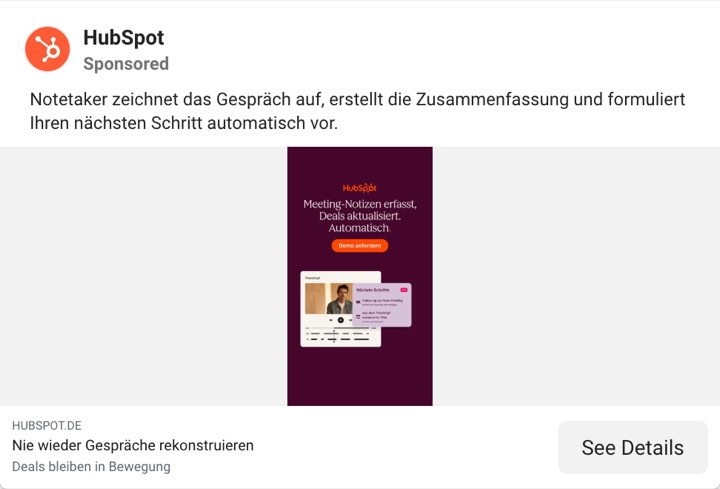
One Meta ad, read part by part, shows how the six parts differ. HubSpot ran it from 22 October 2026 (see the ad). These labels are our reading.
| Part | Question it answers | In this ad |
|---|---|---|
| Angle | Why should this role say yes, and what does it risk? | The sales rep stops writing up calls by hand, so deals keep moving |
| Hook | What does the viewer meet first? | The line above the picture: "Notetaker zeichnet das Gespräch auf, erstellt die Zusammenfassung und formuliert Ihren nächsten Schritt automatisch vor." (Notetaker records the call, writes the summary and drafts your next step.) |
| Concept | Which idea carries it? | A call transcript with a next-steps panel, shown as a mock-up on a dark plum card. The headline under the picture reads "Nie wieder Gespräche rekonstruieren" (never again reconstruct conversations). |
| Format | Which container? | Static image on Meta |
| Offer | What does the ad ask for? | A demo: the picture carries a "Demo anfordern" (request a demo) button, and the Meta button reads "See Details" |
| Proof | What backs the reason? | Nothing in the ad |
Change one part and keep the reason, and you have a new version of the same ad. Change the reason, and you have a new angle, even when the picture stays the same. The iteration test below turns this into a check. Hooks have their own guide: B2B ad hooks.
Why is a B2B angle a buyer's risk as much as a benefit?
Because a B2B buyer answers to colleagues for the choice. Three sources point the same way. A paper from the B2B Institute at LinkedIn says the buyer is also a professional with "their own desires and ambitions too, such as making a splash to help get promoted, demonstrating skills, or even just not getting fired". LinkedIn's Buyability study, as The Drum reports it, ranked the ability to defend the decision first among five emotional factors. Gartner found unhealthy conflict in 74 percent of the buyer teams in its survey.
Here is what each source is.
- The paper is by Jenni Romaniuk of the Ehrenberg-Bass Institute and dates from June 2022 (Category entry points in a B2B world). It is a framework paper, not an ad test.
- The Buyability figures come from LinkedIn, which sells B2B ads. We read The Drum's coverage and not the study. The Drum says LinkedIn surveyed 750 senior B2B buyers, and it quotes LinkedIn: "Slightly more buyers cared about being able to explain themselves after a failure than about whether the thing worked in the first place" (The Drum, 18 June 2025).
- Gartner surveyed 632 B2B buyers in August and September 2024. It calls conflict unhealthy when team members "have conflicting objectives, disagree on the best course of action, or are overruled by external decision-makers" (Gartner, 7 May 2025).
A buying group is not one person. Gartner says buying groups range "from five to 16 people across as many as four functions. Each member may have differing priorities and opinions." The same release holds a warning for angle work. Content tailored to the buying group raised consensus by 20 percent. Content built around one individual's relevance had "a 59% negative impact on buying group consensus". A role is not an individual, and Gartner tested content, not ads. Our reading: write the angle for one role's risk, and pick a reason that role can repeat to the others. Peter Weinberg of Evidenza argues against "100 different campaigns that target 100 different personas" and asks for shared ground: "What are the common needs of every account and every decision maker?" (MediaVillage, 21 May 2024).
The paper lists who a buyer thinks about: senior management, peers, junior staff and their own customers. Challenger's research on buying groups names the people inside one. Its Go-Getter wants to "champion ideas that generate business results". Its Climber "backs out at the first sign of reputational risk". Its Blocker "believes stability is the goal and casts a wary eye at any change" (Challenger). These are labels from sales research. The four roles in the table are our grouping, not Challenger's, and so are the risk and the fitting angle for each role.
| Role in the buying group | What it risks by saying yes (our reading) | Angle that fits (our reading) |
|---|---|---|
| Champion | Its name is on the idea. A failed rollout fails in public. | A win it can show, and words it can repeat |
| Approver | Spending budget on something the board questions | A result it can defend. The paper's example: "A company that the board would respect" |
| Reviewer or blocker (security, legal, IT) | Signing off a tool that fails review | The objection answered before the reviewer raises it |
| User | Extra work, or a tool that gets in the way | Ease. The paper's example: "Junior staff would find it easy to use" |
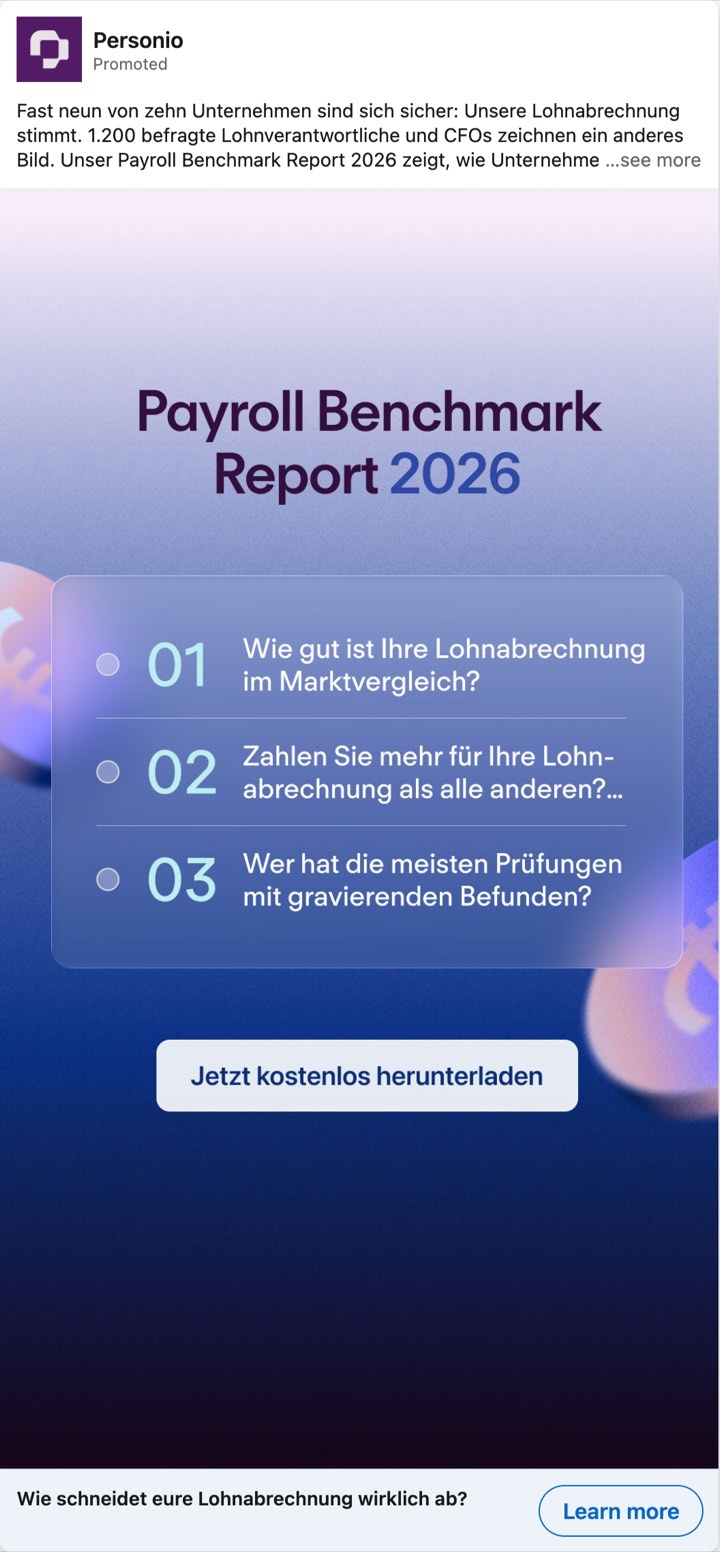
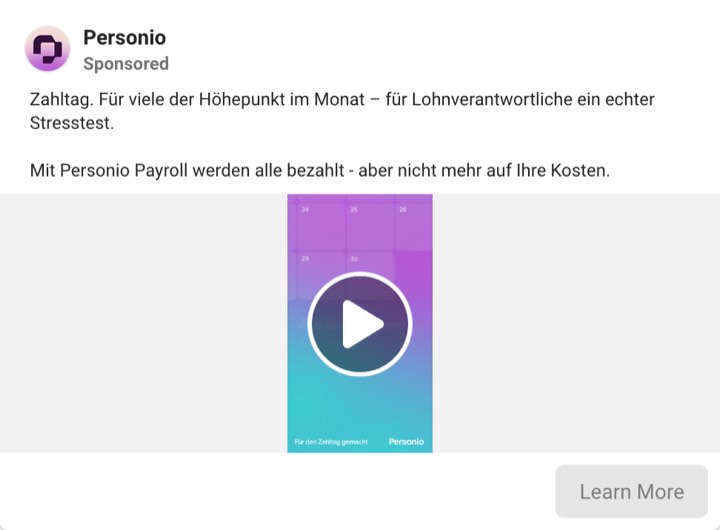
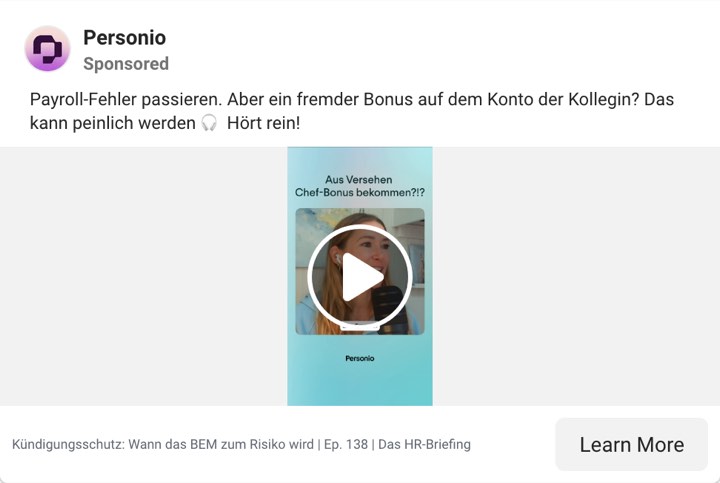
Other pages already name this fear. SaaS Hero's buyer tension map lists "Fear of looking wrong internally", and the page shows no real ad that uses it (SaaS Hero). Real ads show the fear at work. In our reading, Personio ran one fear in four ads on two platforms. The fear is a payroll error with your name on it. The routes differ: two ads for a benchmark report, one product line and one podcast.
| Format | Card line (our English translation) | Fear it plays on (our reading) |
|---|---|---|
| LinkedIn single image | "Fast neun von zehn Unternehmen sind sich sicher: Unsere Lohnabrechnung stimmt." (Nearly nine in ten companies are sure their payroll is right.) Then: "1.200 befragte Lohnverantwortliche und CFOs zeichnen ein anderes Bild." (1,200 payroll owners and chief financial officers surveyed paint another picture.) | Being sure and being wrong. The figures are Personio's own claim. |
| Meta video | Payday is "für Lohnverantwortliche ein echter Stresstest" (for payroll owners a real stress test). | Stress that lands on one person |
| Meta video for the report | "wenn der Zahltag schon wieder zur Fehlersuche im System wird" (when payday turns into another error hunt in the system). The ad also claims a payroll error rate of "19 %" in Germany, from Personio's own report. | Hunting for errors |
| Meta podcast promo | "Ein fremder Bonus auf dem Konto der Kollegin? Das kann peinlich werden" (A stranger's bonus on a colleague's account? That can get embarrassing.) The linked episode title is about dismissal protection. | Embarrassment in front of colleagues |

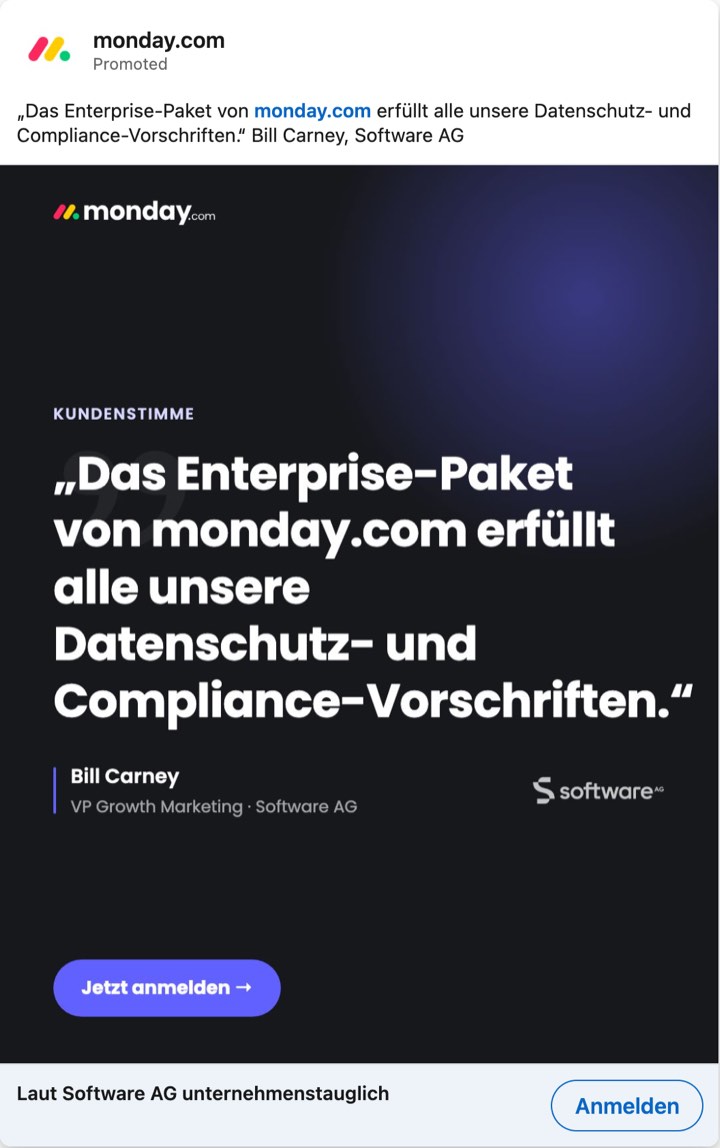
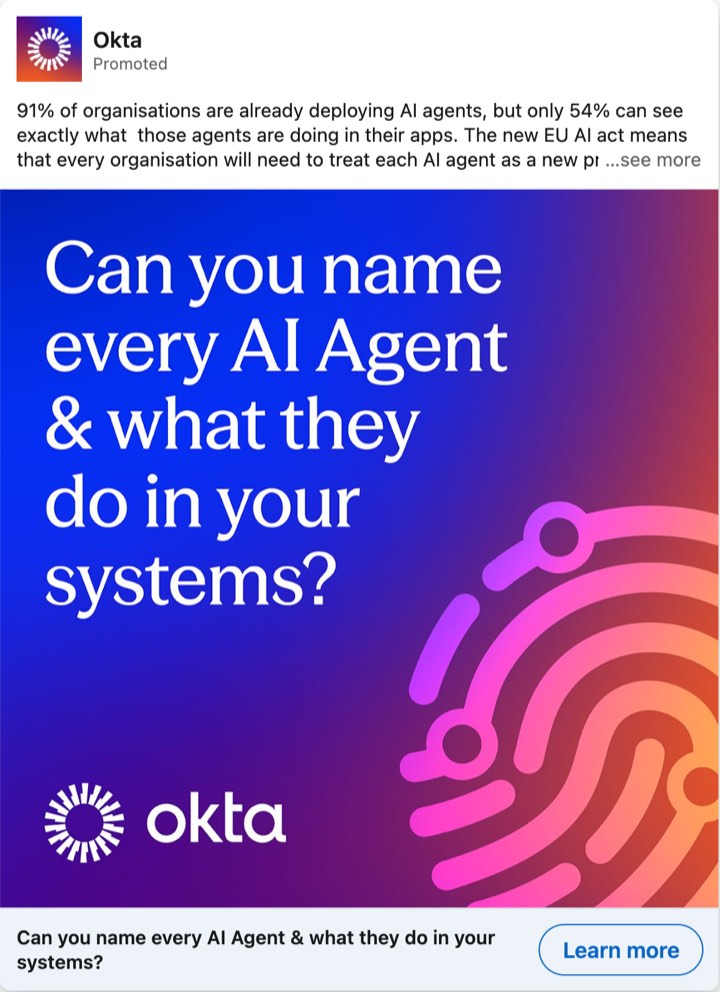
Two more ads show the reviewer's side. A monday.com ad on LinkedIn (see the ad) is a customer quote: "Das Enterprise-Paket von monday.com erfüllt alle unsere Datenschutz- und Compliance-Vorschriften." (The enterprise plan meets all our data protection and compliance rules.) The quote answers the objection of the person who signs off data protection. An Okta ad about artificial intelligence (AI) agents (see the ad) asks "Can you name every AI Agent & what they do in your systems?" and says every organisation must "be ready to prove it". Its figures, 91% and 54%, are Okta's own claim, with no source in the ad.
Risk is not the only engine. The paper's own examples include gains, such as "To feel like I am excelling at my job". A gain angle sells a win the role can show. It still needs the role.
Where do angles come from?
Angles come from the words buyers use, the situations in which they buy, the ads of your competitors, the gaps in your own ads and the claims in your own documents. Start with buyer words, because they hold the risk in the buyer's own voice. Then check the other sources against them.
| Source | What it gives you | Watch out |
|---|---|---|
| Reviews, sales calls, support tickets | The buyer's own words for gains, pains and fears | A review is wording, never a testimonial. |
| Buying situations | When, where and why the category comes up | A situation is where the angle lands. It is not the angle. |
| Competitor ads in the libraries | What competitors say, and which reasons nobody uses | The libraries show no spend or results. |
| Your own ads | The reasons you already run, and the reasons you never run | A losing layout is not a losing idea. |
| Your documents | Claims you can prove, and objections your team hears | Documents shape an angle. The ad never quotes them. |
Buyer words
Search inside the text of each review, call or ticket. Do not stop at the top results. The block below holds our search words by goal. The first six goals come from our batch playbook. The last line is our addition for B2B.
REVIEW AND CALL SEARCH WORDS BY GOAL
Where to look: reviews of your product and of two or three competitors (G2, Capterra, Trustpilot, Reddit, app stores, Google reviews), support tickets, call transcripts.
How: search inside the text for each word. Do not stop at the top results.
Rule: a review is a source of wording, never a testimonial.

Gains (what they love): love, lifesaver, it's like, best
Pains (what costs them time or nerves): frustrating, annoying, hard time, I can't, slow
Wishes (what is missing): I wish, if only, should add
Price (what they weigh): worth it, overpriced, expensive
Questions (what they cannot find out): does it, is there, anyone else
Personal life (what the job costs outside the task): kids, home, sleep, wife, husband
Risk, our addition for B2B (what falls on the person): blame, fired, audit, approval, security review, lock-in, switching, migration

For each hit, copy the line, the role if it shows, and the fear behind it.
Personal-life words show what the job costs the person outside work. That is where a risk gets a human voice. Our playbook also lists four buyer fears to test against any account. They are "it will not work for us", "no time to set it up", "we tried this before" and "we get locked in". The playbook lists them under a lens that comes from Alex Hormozi's value equation, which weighs the result a buyer wants and how sure they are to get it against the time and effort it costs. A fear your ads never answer is open space.
The prompt below sorts raw lines into concerns, roles, risks and angle sentences. It gives the reason only when your product description supports it, and it keeps proof empty until you have it.
You are a B2B creative strategist. Below are raw lines from [reviews / sales call notes / support tickets] about [product or category]. A review is a source of wording. It is never a testimonial, and you must never present a line as a customer quote in an ad.

Product: [one or two sentences on what it does]
Roles that buy, approve or use it: [list]

Step 1. Sort every line into a buyer concern: a thing a person worries about or wastes time on. Use 3 to 7 concerns. Put lines that fit none under "other". Do not drop a line.

Step 2. For each concern write:
- the role most likely to feel it (write "inferred" when no line names a role)
- the risk that falls on that role if it goes wrong
- the two or three lines that show it best, copied word for word

Step 3. For each concern write one angle sentence: For [role] who fears [risk], the reason to say yes is [reason], shown by [proof]. Take the reason only from what the product description above says the product does. If the description does not support a reason, write "reason not supported by the product description". Write "[proof needed]" for proof. Never invent proof, numbers or customers.

Step 4. For each angle write three first lines that give the same reason in different words, using the buyers' own words from step 2 where you can. Then write one first line that gives a different reason, so I can see the difference.

Lines:
[paste one line per row]
Here is what it returns on constructed input. The product is Fernmark and the six lines are made up. The output is shortened to two of four concerns. The other two are "one list I trust", which the product supports, and slow security approval, which comes back as "reason not supported by the product description". The output is illustrative, not a recorded run.
Constructed lines: "We found out about the renewal when the invoice landed. Nobody had flagged it." / "I spent two days in March finding out who owns each licence." / "Finance asked me to justify 40 seats nobody uses. I could not." / "I just want one list I trust." / "Our security team took six weeks to approve the last tool." / "Every quarter someone asks what we can cut."
Concern: surprise renewal. Role: IT asset manager. Risk: blamed for a bill nobody chose. Best line: "We found out about the renewal when the invoice landed. Nobody had flagged it."
Angle: For IT asset managers who fear being blamed for a renewal nobody chose, the reason to say yes is that the contract owner gets a warning before the cancel date, shown by [proof needed].
Same reason, new words: "The cancel date was last week. Nobody told you." / "Get the warning before the invoice." / "Every renewal flagged before it renews." Different reason: "See which seats nobody has used."
Concern: cannot justify spend. Role: IT asset manager. Risk: cannot defend the licence bill when finance asks. Best lines: "Finance asked me to justify 40 seats nobody uses. I could not." / "Every quarter someone asks what we can cut."
Angle: For IT asset managers who fear being unable to defend the licence bill when finance asks, the reason to say yes is that every seat shows when it was last used, shown by [proof needed].
Same reason, new words: "Finance asks which seats nobody uses. Have the answer." / "Every seat, with its last use." / "Know what to cut before finance asks." Different reason: "Get the renewal warning before the invoice."
Buying situations
The B2B Institute paper gives a ready list of questions for buying situations. It calls a situation a category entry point (CEP): a cue that buyers use to pull a brand from memory. Ask each question twice, once for the business and once for the professional, the person with their own ambitions and fears. The examples are the paper's own.
| Question | Example buying situation from the paper |
|---|---|
| When | "To achieve a quick resolution" |
| Where | "For staff that are working at home" |
| While | "To use during a digital transformation" |
| with What | "To integrate easily with our financial reporting software" |
| Why | "To increase productivity" |
| how Feeling | "To give confidence to someone feeling a bit anxious" |
| with/for Whom | "A company that the board would respect" |
The paper tests the idea in US business insurance. Across 17 products, the more situations a customer linked to a brand, the lower that customer's stated chance of switching at the next renewal. The link was significant at p<0.05 in 16 of the 17 products, which means chance alone is an unlikely cause. Travel insurance was "just failing to meet the threshold p=0.10". The average slope was -0.2 per extra situation on the paper's 0 to 10 scale, against a baseline of 4.4 for buyers with up to two situations. The paper reads that as about 5 percent lower chance of switching per extra situation. We found no sample size for the 17-product test in the paper. Its first chart, which compares big and small insurance brands, uses n=606.
The paper also shows a worked survey of 311 US online advertising decision-makers (n=311), run for LinkedIn Marketing Solutions. It scores nine brands on 11 situations. Two of the 11 are about risk: "The board/senior management would approve" and "When the stakes are high, and someone is nervous".
The paper does not show that an ad with a given angle sells more. It measures stated intention, not switching, and memory links, not ads. It covers insurance, and it cites earlier work in telecoms and banking. We use it for the question list and for one rule. A single, clear message is easier to remember, so "we need to focus on one CEP per execution". Our reading: one angle per ad follows from that.
Competitor ads and your own ads
The LinkedIn help page lists what its library holds (LinkedIn Ad Library help). That is the preview, the format, the advertiser and the payer. For ads aimed at the European Union it adds impressions, targeting and run dates. Spend and results are not on the list. The Meta library showed an estimated reach for these ads and no spend or results (observed 22 October 2026). So a competitor ad shows what the competitor says, never what works. Some ad tool guides treat long-running competitor ads as validated angles. We read run length as a weak hint. The method for both libraries is in LinkedIn Ad Library.
For your own ads, tag each ad with the reason it gives. Add up spend per reason. The reasons with almost no spend are open space. Then read your worst ads. Ask what the reason was for, and write the same reason in a new layout.
How do you write an angle down so a team can use it?
Write it as one sentence with four slots: role, risk, reason and proof. The sentence is: for [role] who fears [risk], the reason to say yes is [reason], shown by [proof]. Use "say yes" because the buyer may be switching, starting, renewing or adding. The card below holds the sentence and six checks. Fill one card per angle.
ANGLE CARD
Name: [two to four words the team can say aloud]

Angle sentence:
For [one buying role] who fears [one risk that falls on that person],
the reason to say yes is [one reason, no "and"],
shown by [proof you can source, or "no proof yet"].

Checks (write yes or no):
1. One role, named as a job or a job to be done, not "marketers" or "decision makers": [ ]
2. The risk is something that happens to that person (blame, a bill, a failed rollout, a rebuke), not a missing feature: [ ]
3. The reason has no "and". If it needs "and", write two cards: [ ]
4. The role could repeat the reason to a colleague in one breath: [ ]
5. The proof exists, with source and date, or the card says "no proof yet": [ ]
6. A competitor could not run this unchanged: [ ]

Buying situation (when, where, while, with what, why, how feeling, with whom):
[one line, for example "when a renewal notice arrives and nobody owns the contract"]
Awareness stage it assumes: [unaware / problem-aware / solution-aware / product-aware / most-aware]
Source of the wording: [reviews / sales calls / support tickets / competitor ads / our documents]
Running now as: [ad names, or "not yet"]
Iterations (same reason, new words): [first lines]
A bad sentence fails the checks fast. Here is one for Fernmark, with the failures marked: "For marketers who want better results, the reason to say yes is our powerful all-in-one platform, shown by happy customers." The role is too wide (check 1). A wish is not a risk (check 2). "Powerful all-in-one platform" describes the product and gives no reason (check 3). "Happy customers" is not proof (check 5). The repaired sentence: "For IT asset managers who fear being blamed for a renewal nobody chose, the reason to say yes is that the notice date reaches the contract owner before the cancel date, shown by [a named customer's cancelled renewal, with source and date]."
Real ads read the same way. We wrote three as sentences. These sentences are our reading, and none of the three ads states its sentence.
- A monday.com ad (see the ad): For the reviewer who signs off data protection, who fears approving a tool that breaks the company's compliance rules, the reason to say yes is that the enterprise plan meets those rules, shown by a quote from a named customer contact.
- An Okta ad (see the ad): For security leads who fear being unable to prove control of AI agents they cannot list, the reason to say yes is to treat each agent as an identity you govern, shown by two percentage figures with no source in the ad.
- A Personio ad (see the ad): For payroll owners who fear a payday that goes wrong and lands on them, the reason to say yes is that everyone gets paid and it no longer costs you, shown by nothing in the ad.
The third sentence has an empty proof slot. In other ads Personio fills the slot with its own report figures, such as the benchmark report in the table above. An empty slot is not a fault in the ad. It is a question for the brief: where does the proof sit? The proof guide has the answer: proof points in B2B ads. Levers such as loss and authority have their own guide: the psychology of B2B ads.
How do you map angles against buying roles and awareness?
Put buyer concerns in rows and the five awareness stages in columns. Each cell holds the angle that answers that concern at that stage. Mark it W if you run it, C if a competitor runs it, and leave it empty if nobody does. A row with no W is a concern you never address. A column with no W is a stage you never reach. A cell with three or more Cs is crowded. A cell that is empty for everyone is open, and it is worth filling only if you can back the angle.
A concern is what falls on a role if the choice goes wrong. An angle is a reason that answers it. One concern can have many angles, so the rows are concerns and the cells hold angles.
The five stages come from Eugene Schwartz's 1966 book Breakthrough Advertising. A stage belongs to the reader, not to the product. One product meets all five stages at once, and one reader can sit at different stages for different concerns. An ad shows its stage by what it assumes the reader knows. Each ad below is our reading.
| Stage | What the reader knows | Example ad | Why we place it here |
|---|---|---|---|
| Unaware | No problem in mind yet | A Celonis-promoted post on LinkedIn (see the ad): "Picture this: you bring in a temp through a staffing agency..." | It opens with a story from another world. The AI topic comes later. |
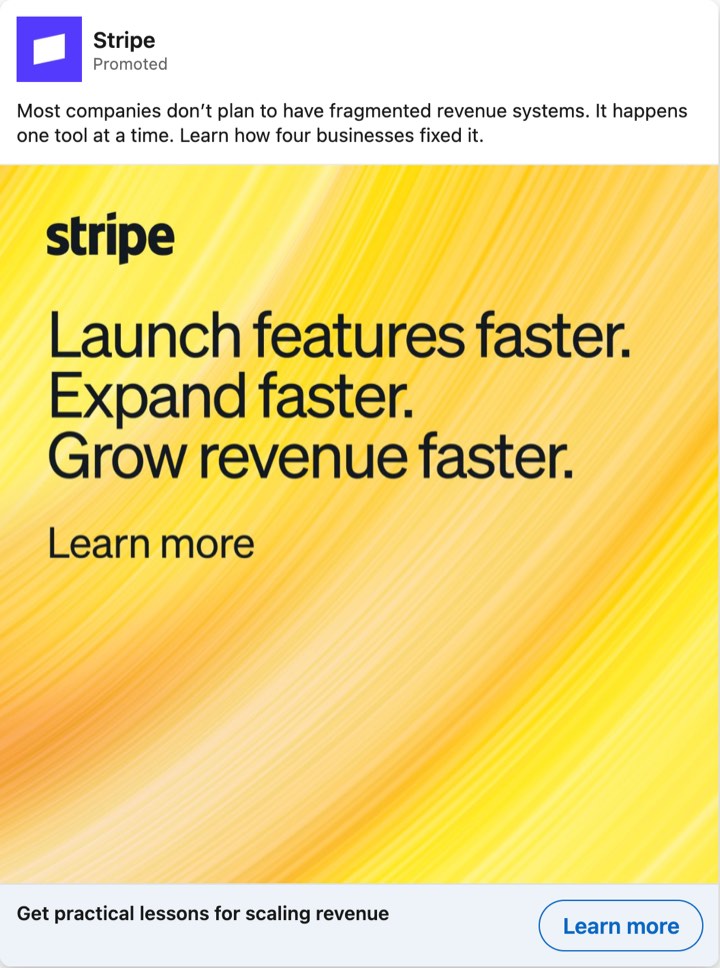
| Problem-aware | Feels the pain, sees no solution | Stripe on LinkedIn (see the ad): "Most companies don't plan to have fragmented revenue systems. It happens one tool at a time." | It names the pain and offers lessons, not a product. |
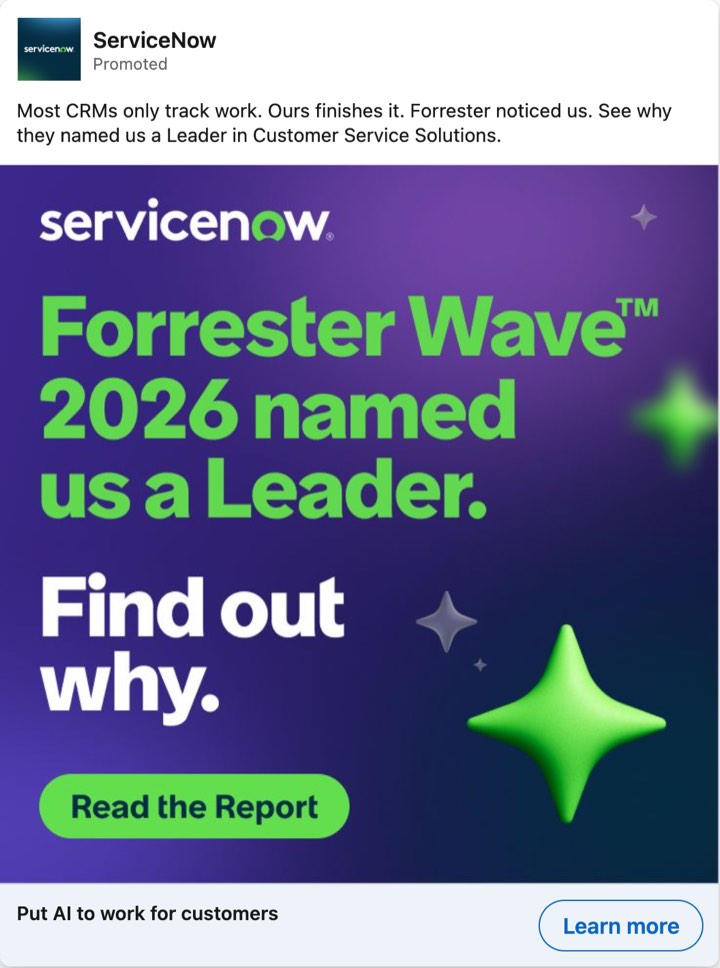
| Solution-aware | Compares categories of solutions | ServiceNow on LinkedIn (see the ad): "Most CRMs only track work. Ours finishes it." (A CRM is a customer relationship management system.) | It sets one category against another. |
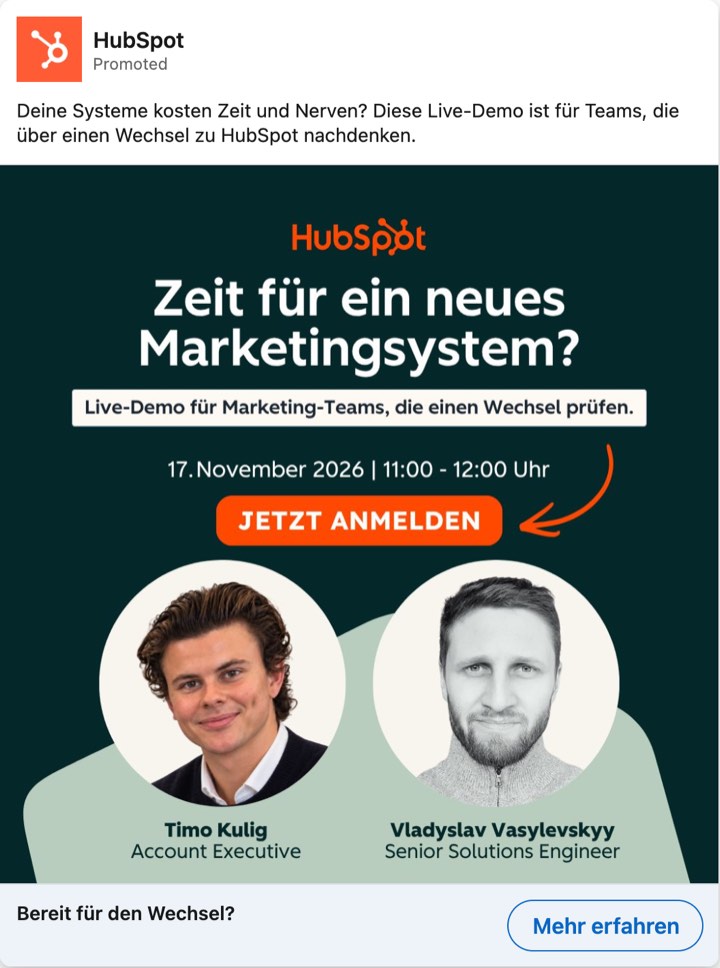
| Product-aware | Knows your product, unsure it fits | HubSpot on LinkedIn (see the ad): "Diese Live-Demo ist für Teams, die über einen Wechsel zu HubSpot nachdenken." (This live demo is for teams that are thinking about switching to HubSpot.) | It speaks to people who already know the product. |
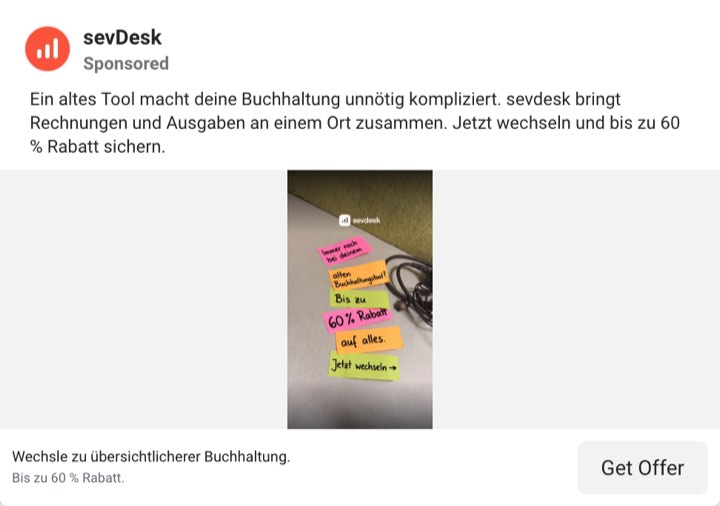
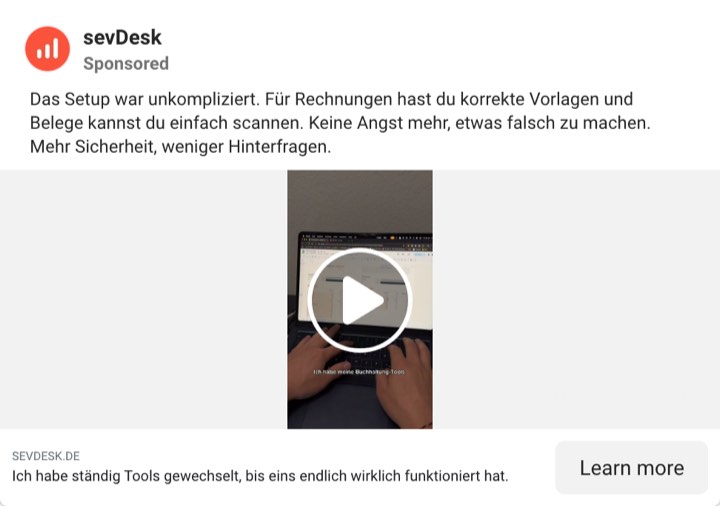
| Most-aware | Ready, waiting for a reason | sevDesk on Meta (see the ad): "Jetzt wechseln und bis zu 60 % Rabatt sichern." (Switch now and secure up to 60 percent off.) | The reason is a price offer. |

Rows come from real concerns. One advertiser holds many. This is what the rows of a competitor's map look like.
| Advertiser and platform | Card line (our English translation) | Concern (our reading) |
|---|---|---|
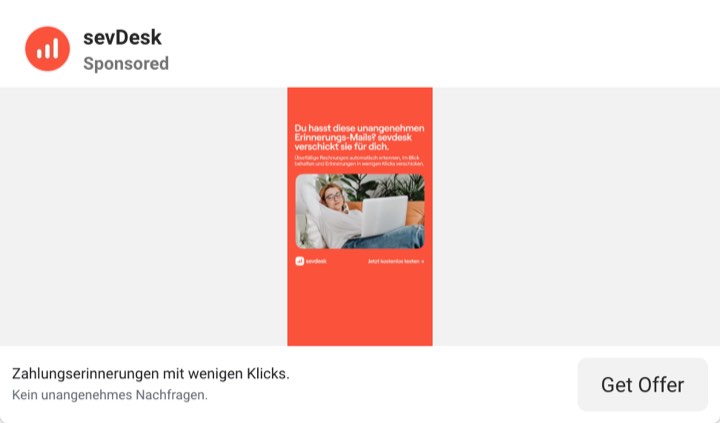
| sevDesk, Meta | "Zahlungserinnerungen mit wenigen Klicks. Kein unangenehmes Nachfragen." (Payment reminders in a few clicks. No awkward chasing.) | Chasing a customer for money |
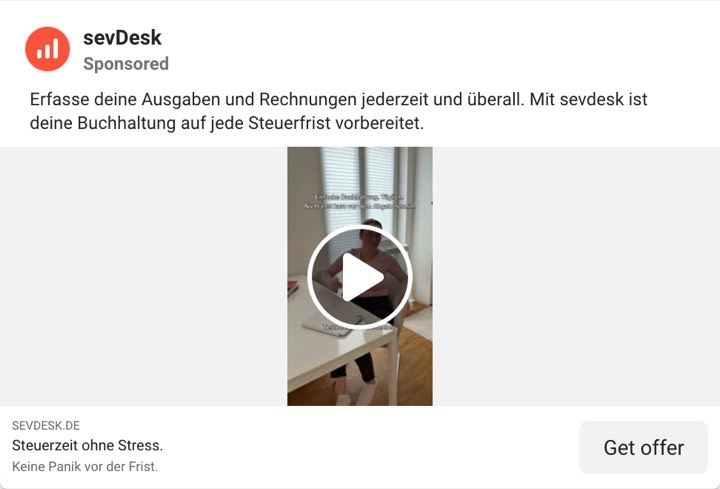
| sevDesk, Meta | "Steuerzeit ohne Stress. Keine Panik vor der Frist." (Tax time without stress. No panic before the deadline.) | A missed deadline |
| sevDesk, Meta | "Keine Angst mehr, etwas falsch zu machen." (No more fear of doing something wrong.) | Making a mistake |
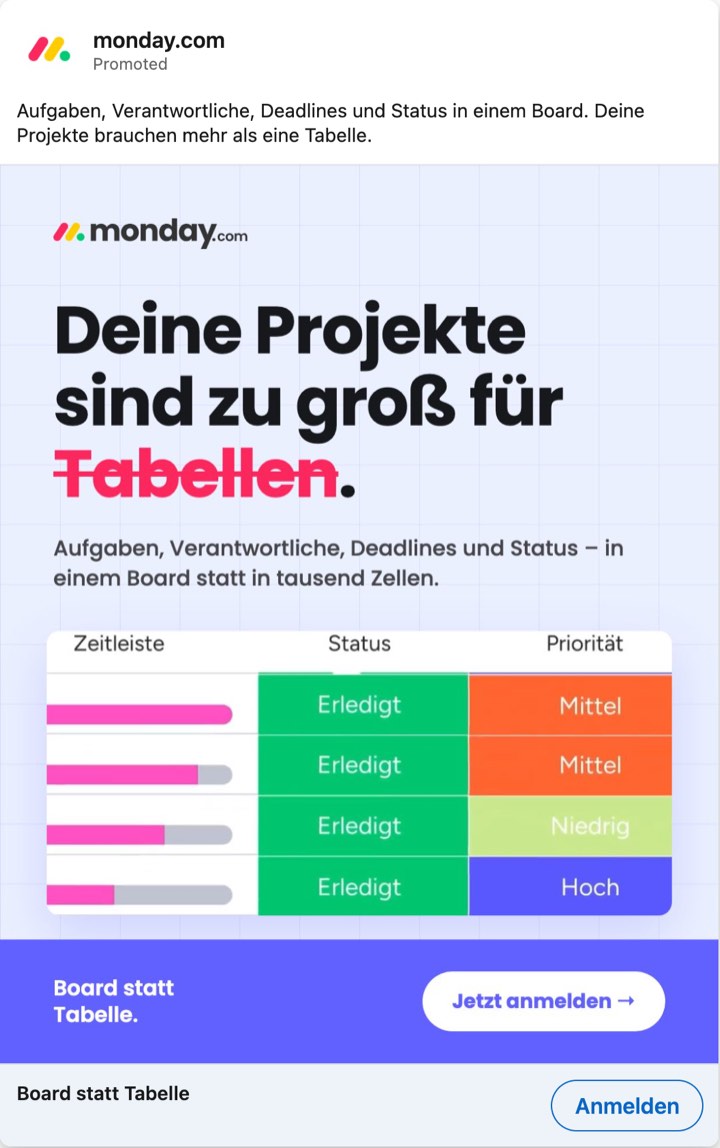
| monday.com, LinkedIn | "Das Enterprise-Paket von monday.com erfüllt alle unsere Datenschutz- und Compliance-Vorschriften." (The enterprise plan meets all our data protection and compliance rules.) | Failing a compliance review |
| monday.com, LinkedIn | "Board statt Tabelle" (Board instead of spreadsheet) | Work that outgrew a spreadsheet |
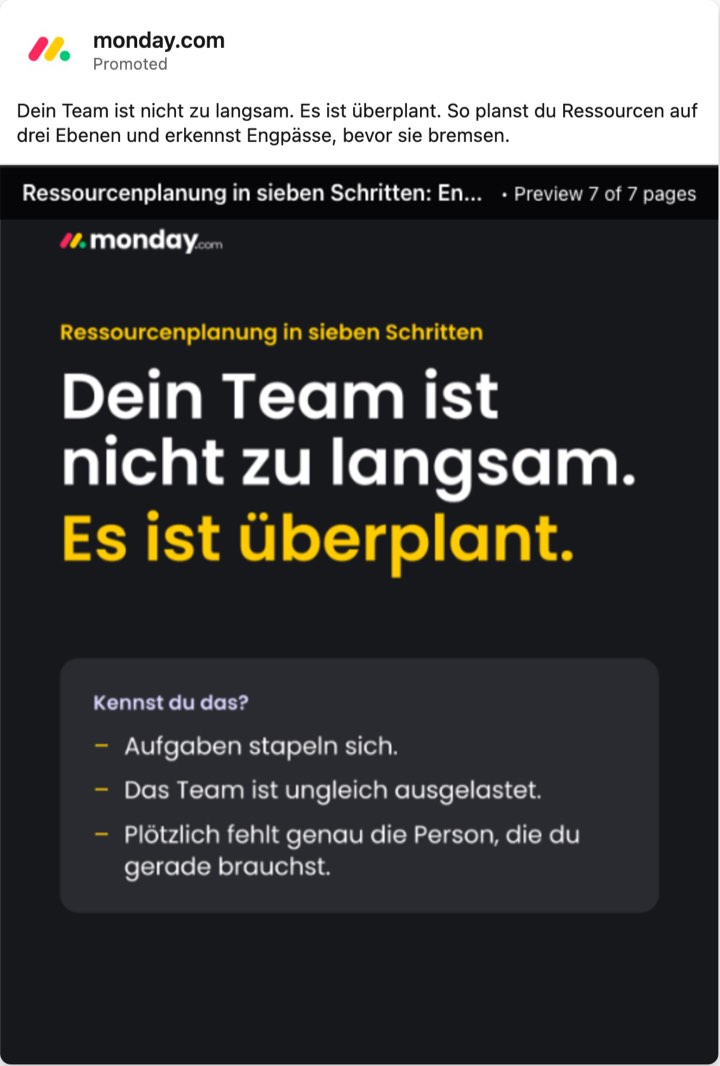
| monday.com, LinkedIn | "Dein Team ist nicht zu langsam. Es ist überplant." (Your team is not too slow. It is overplanned.) | A team that looks slow |
Below is a filled map for Fernmark. Every cell is constructed. The "A" and "B" stand for two invented competitors.
| Concern, role and risk | Unaware | Problem-aware | Solution-aware | Product-aware | Most-aware |
|---|---|---|---|---|---|
| Surprise renewal. IT asset manager. Blamed for a bill nobody chose. | W | C (A, B) | W | ||
| Unused seats. IT asset manager. Cannot defend the bill when finance asks. | W | ||||
| No single list. Procurement lead. Cannot answer an audit question. | C (A) | C (B) | |||
| Tool approval. Security reviewer. Signs off a tool that fails review. | |||||
| Weeks to set up. IT asset manager as champion. A stalled rollout looks bad. | C (B) |
Three findings come out of this map. In the first row, both competitors run the solution-aware cell, where Fernmark has no ad. The fourth row is empty: nobody addresses the reviewer who can stop the deal, so it is open, and Fernmark should fill it only with proof. Our own ads sit in the problem-aware and product-aware columns only, so the unaware, solution-aware and most-aware readers never meet them.
Copy the sheet below into Google Sheets or Excel. Each tab becomes a cell. Write W with the ad name, or C with the competitor and a link.
Concern	Role	Risk if it goes wrong	Unaware	Problem-aware	Solution-aware	Product-aware	Most-aware
[concern 1]	[role]	[what falls on that person]	[W: our ad / C: competitor / empty]
[concern 2]	[role]	[what falls on that person]
[concern 3]	[role]	[what falls on that person]
[concern 4]	[role]	[what falls on that person]
[concern 5]	[role]	[what falls on that person]
The prompt below fills the map from pasted ads. Paste the text of your own ads and of competitor ads from the libraries. It marks guesses as inferred, and it never judges an ad by its run length.
You are a B2B creative strategist. I will paste the text of some ads. Some are ours and some are competitors'. You see text only. If a picture may carry the angle, write "picture not read" for that ad.

Product we sell: [one sentence]
Buying roles for this product: [for example IT asset manager, finance lead, procurement lead, security reviewer]

Ad libraries show no spend and no results. Never say an ad works, wins or is a winner. Never judge an ad by how long it has run.

Step 1. For each ad, fill one row of a table:
- Ad ID (use my label)
- Owner (ours, or the competitor's name)
- Role it speaks to (pick from my list; add "(inferred)" if the text does not name the role)
- Risk that falls on that role if the choice goes wrong (add "(inferred)" if the text does not say it)
- Reason to say yes, in one clause with no "and", in the ad's own words where you can
- Proof in the ad (quote it; write "none" if there is none; write "claim" next to any number)
- Awareness stage the ad assumes: unaware, problem-aware, solution-aware, product-aware or most-aware
- First line (quote)
If a cell cannot be filled from the text, write "unknown". Do not invent.

Step 2. Group the ads by the reason. Two ads are the same angle when the words differ and the reason means the same. Two ads with different reasons are different angles, even when they share a picture. Name each group in 3 to 5 words and list its ad IDs.

Step 3. Write one sentence per group: For [role] who fears [risk], the reason to say yes is [reason], shown by [proof]. Write "[proof needed]" when no ad in the group shows proof.

Step 4. Build the map. Rows are buyer concerns, which means the risk that falls on a role. Put two groups in one row when they answer the same risk. Columns are the five awareness stages. In each cell write the group name and "ours", "competitor: name", or both. Leave a cell empty when no ad sits there. Then list: concerns none of our ads covers; stages where we have no ad; cells with three or more competitor ads.

Ads (one per line: ID | owner | intro text | headline | button):
[paste the ads here]
Here is what it returns on four constructed ads. The output is shortened and illustrative.
Constructed ads: F1 (ours): "The renewal notice came last week. The cancel date was in March." / "Know the date before it costs you" / Learn more. F2 (ours): "Finance asked which licences nobody uses. You had no list." / "One list of every licence" / Sign up. R1 (competitor A): "Auto-renewals cost companies money every year. Get the cancel date before the invoice." / "Stop paying for software you forgot" / Book a demo. R2 (competitor B): "Compare us with your spreadsheet. Free 30-day trial." / "Switch from spreadsheets today" / Start free.
Groups: A, "Know the date first": F1 and R1. Reason: you learn the cancel date before the renewal. Stage: problem-aware. B, "One list of licences": F2. Stage: problem-aware. C, "Leave the spreadsheet": R2. Stage: solution-aware. R2 shows "free 30-day trial" as a claim.
Angle A: For IT asset managers (inferred) who fear a bill for a renewal nobody chose (inferred), the reason to say yes is that you learn the cancel date before the renewal, shown by [proof needed].
Map: Group A, row "surprise renewal", is run by us and by competitor A in the problem-aware column. Group B, row "no single list", is ours alone, also problem-aware. Group C, row "leave the spreadsheet", is run by competitor B alone in the solution-aware column. We have no ad in the unaware, solution-aware, product-aware or most-aware columns. No cell has three competitor ads.
How do you check an angle before you spend on it?
Run seven checks before you write the brief. An angle that fails one goes back to its card.
- Check the sentence. Role, risk, reason and proof are all filled, and the reason has no "and".
- Say it as the buyer. Finish "We are looking for a supplier that..." with the reason. The B2B Institute paper uses the same test for buying situations: "Looking for a brand that..." followed by the situation. If the buyer would not say it, the reason is yours and not theirs.
- Apply the paper's three Cs. Credibility: can you deliver it, and would buyers believe it from you? Competitiveness: how many competitors already advertise it? Commonality: how often does the situation come up, and how big is the deal? The paper says that choosing is "a process of elimination".
- Check that the group can repeat it. Could the role say the reason to colleagues in one breath? The Gartner survey quoted above ties group-level relevance to consensus.
- Check that a competitor could not run it unchanged. If one could, add the detail only you can claim. This test is in our batch playbook.
- Check the proof. It needs a source, a date and wording that matches the claim.
- Open the landing page. Its first screen must repeat the reason in words the ad uses. If the page sells another reason, fix the page before you buy traffic. Creative cannot fix a wrong destination.
The paper's own shortlist for a whole brand is "5-8 CEPs" to message over time. That is a list of buying situations across years, not a count of ads in one test.
The iteration test
Finish this sentence for each ad: "This ad gets a yes because ____." Use one clause with no "and". If two ads finish it with the same clause, or with words that mean the same, they are iterations of one angle. If the clause changes, you have a new angle. When you cannot decide, ask what proof each ad would need. A different proof means a different angle.
No public source we read prints this as a test. Faceplant Creative holds the angle fixed and varies the hook, which is the same idea. It gives no check for two ads. The test is ours.
HubSpot started eight ads on Meta on 22 October 2026, each with its own card line. The library marks all eight "This ad has multiple versions". We do not know why HubSpot runs them or which works, because the library shows no spend or results. We wrote down the reason each card gives. The result is eight ads and five angles.
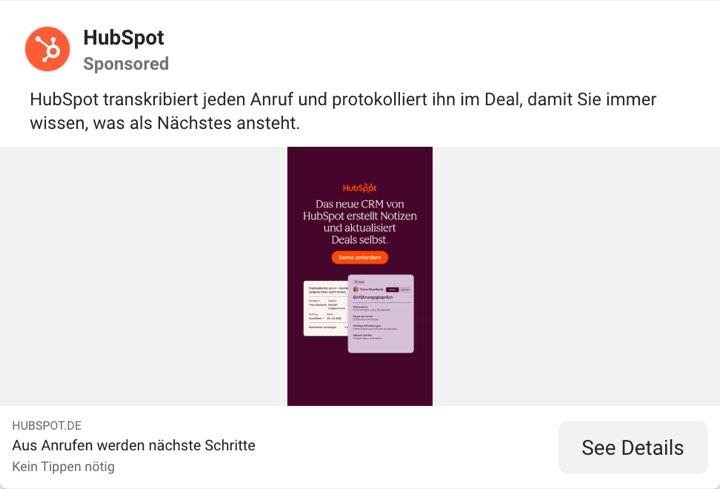
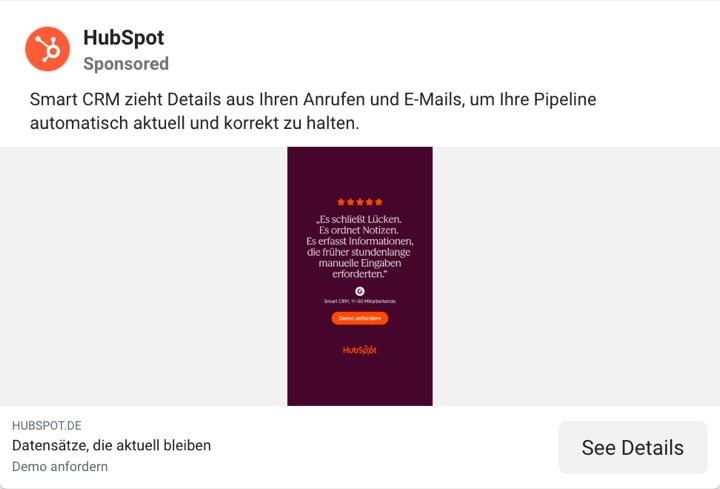
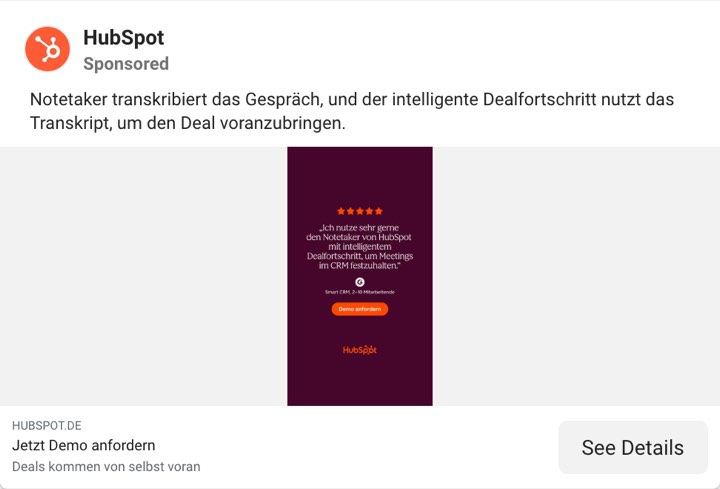

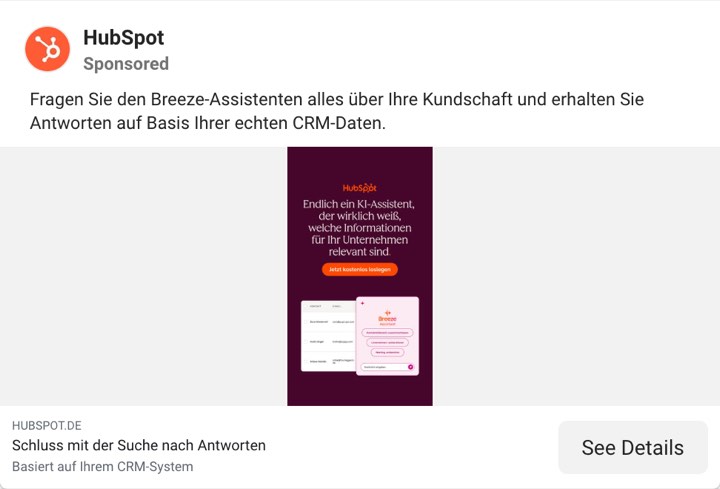
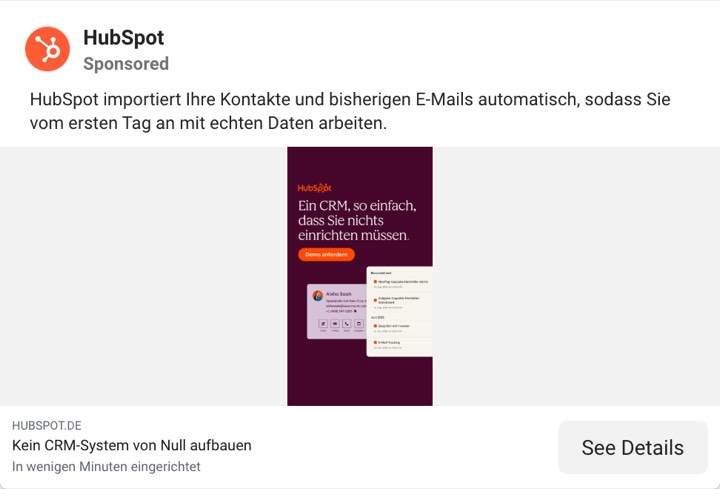
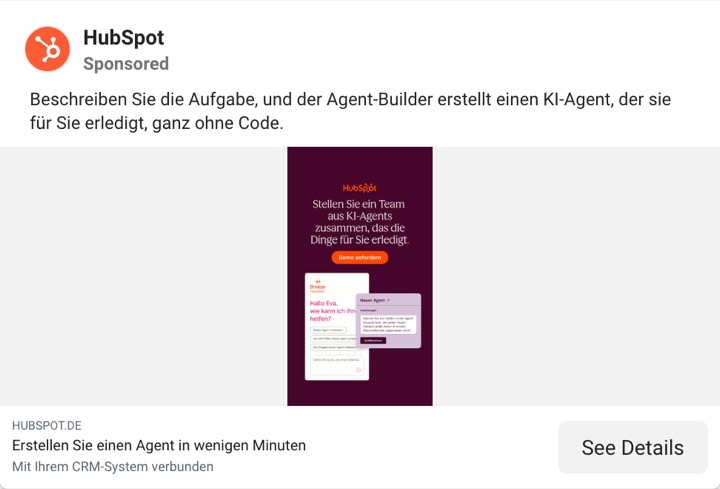
Four ads give one reason in four wordings. That is the cheap kind of variation, and hooks are the right tool for it. The other four ads each argue something else, so each would need its own proof. Two calls are close. We put the transcript ad in angle A, and another reader could make it a fifth angle. We put the data-gap ad in its own angle B, and another reader could merge it with A. The test gives you a rule for the decision. It does not remove the judgment.
Faceplant Creative gives an order for testing: "Test fundamentally different concepts first", then "Test angles inside the winning concept", then "Test hook variations inside the winning angle". Test iterations only inside an angle that has already delivered the result its campaign was bought for.
How do you test angles on a small budget?
Test whole angles against each other, not copy tweaks. Give each angle its own ad set with the same audience, format, offer, button, landing page and budget. Run each platform's minimum time. Then compare the results the campaign was bought for. With few results, only a large gap counts.
Both platforms ask for one variable. LinkedIn's A/B test "compares the performance of two ad sets with separate budgets that differ by one variable". Meta says the ad sets should be "identical except for the variable that you're testing". An angle test fits if you treat the angle as the one variable. Hold the audience, placement, format, offer, button and page fixed. The angle changes, and the words and picture that carry it change with it. This is our suggestion.
On LinkedIn we also suggest that angle tests use whole ads that argue different things, because copy tweaks make differences too small to see at B2B result counts. That is our practice and not a measured result. The arithmetic further down shows why.
The platform rules set a floor.
| Platform | What the help page says |
|---|---|
| LinkedIn A/B testing best practices | At least 14 days, $700 lifetime and $20 daily as the minimum. It recommends 21 days. One ad per ad set unless the test needs more. In the European Economic Area and Switzerland, cost per paid conversion and cost per qualified lead include only members who gave explicit consent. |
| Meta best practices for A/B testing | It recommends at least 7 days, and a test can run 30 days at most. Test only one variable. Run longer if your buyers take more than 7 days to convert. |
| Meta, about A/B testing | Use the same budget for both versions. "We do not recommend testing informally, such as by turning ad sets or campaigns on and off manually." |
Now the arithmetic. If both angles were equally good and got equal spend, each result is as likely to come from one angle as the other. The split then follows a binomial distribution, a property of two Poisson counts (see the section on related distributions in Poisson distribution). The table gives the smallest winning count that luck alone would produce in at most 1 test in 20 when the two angles are equal. It counts a split that lopsided, or more, in either direction (binomial test, two-sided). We computed each row from the exact probabilities. The table assumes that each result stands alone. Three leads from one company are closer to one signal, so the real bar is higher.
| Total results across both angles | Winner needs at least | The other angle has at most | Winner's share |
|---|---|---|---|
| 10 | 9 | 1 | 90 percent |
| 20 | 15 | 5 | 75 percent |
| 30 | 21 | 9 | 70 percent |
| 40 | 27 | 13 | 68 percent |
| 50 | 33 | 17 | 66 percent |
| 60 | 39 | 21 | 65 percent |
| 80 | 50 | 30 | 63 percent |
| 100 | 61 | 39 | 61 percent |
| 150 | 88 | 62 | 59 percent |
A worked example, with made-up numbers. Say you spend EUR 3,000 on each of two angles and a result costs about EUR 150. Each angle buys about 20 results, so the test holds about 40. The table says the better angle needs 27 of them. A 26 to 14 split looks clear at 65 percent, and it is still not enough. A small budget can find a large difference between angles and cannot find a small one. If the test ends without a winner, you learned that any gap is too small to see at this budget. Keep the angle that is cheaper to produce, and test a bigger contrast next.
The table holds for two angles, one planned look at the end and equal spend. Checking every day until one angle leads, or adding more angles, raises the chance of a false winner (multiple comparisons problem). With more than two angles, test two at a time, and know that each extra pair adds another chance for luck to look like a win. The budget also decides how many angles you can test. Take the results each angle needs, which is half of the total in the table. Multiply that by the cost per result to get the budget per angle, and divide your budget by it. A win means one angle beat the other in this test, with this audience and offer. It does not mean the angle is best.
Fill the card below before launch, and decide the actions before you see the data.
ANGLE TEST CARD
Question: Which reason makes [role] say yes more often: [angle A] or [angle B]?
Platform: [LinkedIn / Meta]. Built with the platform's A/B test tool: [yes / no, because ...]
Angle A: For [role] who fears [risk], the reason to say yes is [reason], shown by [proof].
Angle B: For [role] who fears [risk], the reason to say yes is [reason], shown by [proof].
Held the same in both: audience [ ], placement [ ], format [ ], offer [ ], button text [ ], landing page [ ], start and end date [ ], budget [ ]
What differs: the angle, and the words and picture that carry it. Nothing else.
Result we count: [the result this campaign is bought for, for example leads from the form]
Cost per result we expect: [amount from this account's recent ads, or "unknown"]
Budget per angle: [amount]
Expected results per angle: budget per angle / cost per result = [number]
Minimum run: [days; LinkedIn asks for at least 14, Meta recommends at least 7]
A win needs: at least [number] of [total] results for one angle. Two angles with equal spend: 15 of 20, 21 of 30, 27 of 40, 33 of 50, 50 of 80, 61 of 100.
If A wins: [action]
If B wins: [action]
If neither wins: [action, for example keep the cheaper one to produce and test a bigger contrast]
Decided before launch by [name] on [date]. We do not stop early.
If the budget cannot buy enough results for any test, filter the angles first. We suggest you read the angle sentences to people in the role and ask which one they would forward. That is a filter and not a test. Then take the best angle through the checks above and into the brief: B2B creative brief template. Your next ad starts at the empty cell of the map where the risk is highest and you can show proof.
Frequently asked questions
What is the difference between an angle and a hook?
An angle is the reason to say yes. A hook is the first line or frame that gets the reason noticed. One angle can carry many hooks: the angle stays fixed while the hooks change. See B2B ad hooks for the hook types.
Is an angle the same as a persona?
No. A persona describes a person. An angle gives that person's reason and risk. One persona can hold several angles. Our role is not a persona either. It is the job the person does in the buying group, such as champion, approver, reviewer or user.
How many angles should I test at once?
As many as your budget can read. Take the results each angle needs, which is half of a total in the table. Multiply by the cost per result to get the budget per angle, and divide your budget by it. With EUR 12,000 and EUR 3,000 per angle (20 results at EUR 150), that is four angles. The table covers two angles, so run them as two pairs. We found no study that gives a number of angles to test. The 5 to 8 in the B2B Institute paper is a list of buying situations for a whole brand over time.
Can I run an angle a competitor already runs?
You can answer the same concern. Give it a reason or a proof that only you can claim. The paper warns about "cluttered mental spaces with lots of competitors advertising that message", and it treats them as weaker choices. The ad libraries do not show what works, so a competitor's long run does not prove its angle.
Do the same angles work on LinkedIn and Meta?
The concern can travel. The role words may not. Personio ran its payroll fear on both platforms, as the table above shows. In our batch playbooks we write a LinkedIn ad as one read with a name and job title attached, so a role such as "IT asset manager" can sit in the first line. We write a Meta ad as one a stranger meets at leisure. There, a line that needs the job title to land does not belong, so say the situation and keep the role in the card. We found no public data that compares one angle across the two platforms.
Can an AI find my angles?
It can sort the words you give it. The two prompts above do that. It cannot know fears you did not collect. Paste real lines, check each quote against its source, and keep proof as "[proof needed]" until you have it. See AI prompts to analyze B2B ads and write B2B ads with Claude or ChatGPT.
Can I put a customer review in an ad?
Use a review as wording, not as a testimonial. If you want a customer's voice in an ad, ask that customer for a quote you may publish. Then put it in the proof slot with its source and date.
Can Nimblet find my angles?
Nimblet does the reading. It reads each of your LinkedIn and Meta ads with recent spend for its core message, hook, offer and proof. An account report groups the ads that share a message and compares the groups on the goal the ads were bought for. Nimblet reads the ads of competitors you track in the same way, on plans that include competitor tracking, and it shows what they run and never how they perform. It does not store an angle label on every ad by itself. Nib, the chat assistant in Nimblet, tags ads by angle when you ask, and you can add your own tags. The map and the sentence stay a human call. Nimblet only reads your ad accounts and never changes a campaign. See creative intelligence and pricing.