
LinkedIn thought leader ads: who should post, what to write before see more, and how to read the result
Nimblet teamUpdated 32 min read
Short answer
A thought leader ad is a post from one person's own profile that your company pays to show to more people. It works when the buyer believes the poster knows the work and puts a name on the claim, so choose the poster before you polish the words. In the largest study we found, from a LinkedIn ads agency, the author explained more of the engagement than hook style, length or links, and a post wore out by how often the same people saw it, not by its age.
On this page8 sections
- 01What is a thought leader ad, and why does a person's post work on a buyer?
- 02Which posts can run as a thought leader ad, and which cannot?
- 03Who should post: executive, specialist, salesperson, customer or creator?
- 04What should the first lines say before see more?
- 05How do you brief and approve a post you did not write?
- 06How do you read the result when the objective is awareness or engagement?
- 07How long does a thought leader ad last before it wears out?
- 08Frequently asked questions
We read the LinkedIn help pages and every other page linked below in October 2026. We read the five example ads in the LinkedIn Ad Library on 22 and 23 October 2026. When a number comes from one vendor's study, the same sentence names the vendor.
What is a thought leader ad, and why does a person's post work on a buyer?
A thought leader ad is a post from one person's own LinkedIn profile that a company pays to show to more people. The ad shows the poster's name and headline and a label. A post from an employee reads "Promoted by" and the company name. For a post from anyone else, LinkedIn's help page says the label names a partnership with the company (LinkedIn help). The buyer knows it is an ad. What changes is who speaks: a person puts a name on a claim, and a logo does not.
A buyer who sees the post asks, without saying it, whether this person knows the work and whether they would say this if nobody paid them. The post gets read only when the first lines answer both. This is our reading. Three sources bear on it.
- Buyers say they trust expert content more than marketing material. The 2025 Edelman and LinkedIn survey of business-to-business (B2B) buyers reached 1,934 executives through LinkedIn. Each figure here is for its US respondents. The survey splits buyers into groups. Hidden decision-makers help make the final choice for a function such as finance, operations or legal, and they do not need deep knowledge of the product. Target decision-makers make the final choice and know the product well. 64 percent of hidden decision-makers said they trust thought leadership content more than marketing materials and product sheets when they judge what a vendor can do. For target decision-makers the figure is 65 percent (Edelman and LinkedIn). LinkedIn co-wrote the study and fielded it to its own members. The report defines thought leadership as free content such as articles, social posts and videos. It did not test promoted posts against organic ones, so it supports the idea and does not test the ad.
- The person counts for more than the words. Kiin, a London LinkedIn ads agency, studied 464 accounts and $8.4 million of thought leader ad spend over one year. Most accounts are B2B technology advertisers, US first and Europe second. Among 47 authors, the author explained 67 percent of the variation in engagement across accounts, and 20 percent inside one company (Kiin). Kiin says it cannot yet tell whether the cause is the audience's trust in the person or the feed spreading the person's organic reach.
- The buyer has a career to protect. The B2B Institute's paper on buying situations lists the buyer's own motives: "making a splash to help get promoted, demonstrating skills, or even just not getting fired" (Romaniuk, B2B Institute). A like or a comment on LinkedIn shows under the buyer's name. We read this as a reason why a sharp view from a credible person is safer to react to than a vendor's pitch. We found no study that tests it.
Most readers are not buying now. The Edelman and LinkedIn 2024 report page says that at any given moment 95 percent of business clients say they are not actively seeking goods or services. It cites the Ehrenberg-Bass Institute for that figure (Edelman). The B2B Institute paper quotes Professor John Dawes: advertising "mainly works by building and refreshing memory links to the brand", and these links "activate when buyers do come into the market". So we read the aim of a post as a reader who remembers the idea and the person, with the company attached by the label.
The Edelman survey also says what these readers want. 86 percent of hidden decision-makers said they want ideas that challenge their assumptions instead of ideas that only confirm their view. 91 percent of hidden decision-makers (81 percent of target decision-makers) said that helping them see a need they had missed marks above-average thought leadership. We read that as a job for the first three lines: show the reader something they have not yet put into words. The levers behind this are in the psychology of B2B ads.
Which posts can run as a thought leader ad, and which cannot?
Public text, single image, video, article and newsletter posts can run, and so can event posts. Celebrations, documents, polls, multi-image posts and reposts cannot (LinkedIn help). The table shows the ad format, the objectives and the button for each post type.
| Post type | Can it run? | Ad format | Objectives | Button |
|---|---|---|---|---|
| Public text post | Yes | Single image | Brand awareness, engagement | None |
| Single image post | Yes | Single image | Brand awareness, engagement | None |
| Video post | Yes | Video | Brand awareness, engagement, video views | None |
| Article or newsletter on LinkedIn | Yes | Article and newsletter | Brand awareness, engagement | Not stated |
| Post by an attendee of your LinkedIn Live Event, with the event link | Yes | Event | Brand awareness, engagement | Yes |
| Celebration, document, poll or multi-image post | No | Not available | Not available | Not available |
| Repost | No | Not available | Not available | Not available |
LinkedIn's help page also lists eligible collaborative posts as supported. LinkedIn lists no lead generation objective for the format, so we read that a thought leader ad cannot carry a lead form. If your best post is a document, run it as a regular document ad (formats guide).
These rules shape the plan:
- You need the poster's permission before you sponsor a post. The poster's profile must show a full name, and the post must be public.
- You need super admin, content admin or Sponsored Content poster access on the company Page of the ad account, and creative manager access or higher on the ad account (LinkedIn help).
- You cannot add a headline or introductory text. Only the original author can edit the post (LinkedIn specs).
- Single image and video posts have no call to action (CTA) button. A link goes into the post text, which the poster writes. Event posts have a button (LinkedIn help).
- You cannot duplicate a thought leader ad.
- The poster can revoke permission at any time, and the ad stops at once (LinkedIn help).
- You find posts of employees and of 1st and 2nd degree connections in Campaign Manager. You find posts of 3rd degree connections and beyond only in Creator Marketplace (LinkedIn help, Creator Marketplace).
- The ads can run in the feed and on the LinkedIn Audience Network, LinkedIn's network of partner apps and sites (LinkedIn help). The poster's combined paid and organic totals do not count Audience Network delivery (LinkedIn help). Kiin's figures leave the network out, so check the setting before launch.
For European posters, LinkedIn's pages carry one more rule. Because of the Digital Markets Act (DMA), Creator Marketplace does not show content from authors and creators who are located in DMA countries (Creator Marketplace help). The page for authors says that content "cannot be sponsored as thought leader ads" (LinkedIn help). Thought leader ads with German targeting still run: the five posts further down all ran in October 2026. The library does not show where each poster lives, and LinkedIn's pages do not say how the rule treats employees. Search for your poster's post in Campaign Manager before you plan a campaign around it.
The rules changed over time. Social Media Today reported on 13 March 2024 that LinkedIn opened the format to posts from any member, with single image and video posts only (2024 report). On 30 October 2025 it reported discovery of 3rd degree posts and a "Partnerships" tab. The same report says LinkedIn added event posts "in August", which we read as August 2025 (2025 report). A LinkedIn news post of 10 June 2026 describes Creator Marketplace in Campaign Manager (LinkedIn news). A Social Media Today recap of 14 September 2026 dates the any-member change to March 2025 (recap). We use the 2024 date, because that report ran when the change happened.
Some guides still list only employees and 1st and 2nd degree connections as posters (RevBoss, and the requirements table of Valley). LinkedIn's help page now covers more. When sources differ, the LinkedIn help page wins, and Campaign Manager wins over both.
Who should post: executive, specialist, salesperson, customer or creator?
Pick the person the buyer already believes knows the work in the post, and who writes about it without being asked. A senior title does not prove that. In Kiin's data the author explained more of the engagement than any other factor Kiin measured. Kiin's dataset holds no field for the poster's role, and we found no other study, so we cannot say whether an executive beats a specialist. What follows is our reading. It rests on three questions the buyer asks:
- Does this person know the work in this post?
- Does this person put their name behind the claim?
- Does the buyer see a reason for the post other than a sale?
| Poster | Knows the work | Name on the line | Reason other than a sale | Fits when |
|---|---|---|---|---|
| Executive | Partly | Strong | Weak | The post states a view on the market, or a hard call the executive made |
| Specialist (engineer, product lead, analyst) | Strong | Partly | Partly | The reader does the same work and wants the detail |
| Salesperson | Partly | Partly | Weak | The post answers a question that buyers ask in meetings, with no product in it |
| Customer | Strong | Strong | Partly | The post says what changed in the customer's own work |
| Outside creator | Strong | Strong | Partly | The creator already writes on the topic and you want an audience you do not have |
We rated the table ourselves. Nobody measured it. Customers and creators rate "Partly" on the last question because LinkedIn's help page says a post from someone who is not your employee is labeled as a partnership (LinkedIn help). LinkedIn also asks the poster to disclose the relationship, for example with a hashtag such as #SponsoredPost (LinkedIn help).
Here is what we found for each poster type:
- Executive. Understory, an agency, writes that sponsoring posts from executives who post once a quarter "undermines the authenticity the format depends on" (Understory).
- Specialist. Some guides argue that the voice must match the reader: a CEO talks to CEOs, and a head of product talks to product managers. We found no test of it.
- Salesperson. We found no study. LinkedIn lets any employee with approval be the poster. One of the five ads further down came from a country lead whose headline names a sales career.
- Customer. We found no study. If you reward a customer for a post, the disclosure rule matters more.
- Outside creator. LinkedIn cites a YouGov survey of 1,299 B2B marketers in five countries (January and February 2026) in which 82 percent said creators raise credibility with decision-makers. Those are marketers' opinions, not buyers' behavior (LinkedIn news).
Choose in this order. Write down the one problem the post covers. List the people who handled that problem themselves in the last year. Keep those who already write on LinkedIn. Then test two or three of them instead of arguing about titles. Give each candidate the same objective and an equal share of the same audience. Split the audience in two, or run the candidates in turn and swap the order in the next round. Run each for about one pass of the audience (the wear-out section explains a pass). Kiin found that an author's first few posts predict the later ones (a correlation of 0.82), so a few posts per candidate show a gap early. Kiin's top tenth of authors got 8.6 times the engagement of its bottom tenth (47 authors), so a gap between two posters can be large. If two candidates are close, call it a tie and take the one who answers comments.
In the five Ad Library posts further down, the posters were a sales leader, an outside poster, the head of a business unit (two posts) and a regional leader. The outside poster's headline names no role at the advertiser. The other three posters worked for the advertiser of their post. None was a specialist or a customer. Five posts are a handful, not a pattern.
What should the first lines say before see more?
Say one thing the reader has not yet put into words, and say it inside the first three lines. The feed shows the start of the post, cuts it and adds "see more". The reader decides on those lines whether to read on.
LinkedIn gives one number for this. For a single image ad it tells advertisers to use up to 150 characters of introductory text "to avoid truncation", with a maximum of 3,000 (LinkedIn help). A thought leader ad has no introductory text field, because the post is the text. We found no LinkedIn figure for the cut of a post.
What we saw: each of the five Ad Library previews below showed three lines, and a blank line counted as a line. The text that showed before the cut ran from 91 to 220 characters. In the 91 character case, the blank line after the first paragraph took the third line, so the second paragraph stayed hidden. A preview is not your phone feed, and the library page itself says that versions can look different at other screen sizes. So treat 150 characters as the safe length, and put the turn (the point of the post) before your first blank line. Count the characters of your own post, and look at where it breaks into lines.
Here are five ways to open. Each is one pattern we saw on a real public post that ran as a thought leader ad. We quote the first lines from the LinkedIn Ad Library, and each link opens a screenshot of the ad. We do not name the posters. The screenshots blur the poster's name and photo and keep the "Promoted by" line. The library has no thought leader label: look for a person's name above the text and "Promoted by" under it (how to use the library). The library shows no results. Its impression band is delivery for the whole run, and the length of a run does not tell you whether an ad worked. None of the five is shown to have won or lost.
A size contrast
Die KI-Investitionen deutscher Unternehmen sind inzwischen ungefähr so hoch wie der Berliner Fernsehturm. Die messbaren Ergebnisse davon passen locker in den Fahrstuhl.
Our translation: German companies' AI investments are now about as tall as the Berlin TV tower. The measurable results fit easily in the elevator. A sales leader at a software company posted this (see the ad). A local picture carries a claim about spend without results. Our reading: a joke is safe for a buyer to like in public. Both sentences show in 168 characters. The opening lines give no source for the claim, so it is the advertiser's own. The post goes on to invite the reader to the advertiser's own event, so the hook leads to an invitation.

A scene that starts with "Picture this"
Picture this: you bring in a temp through a staffing agency, and over two years they learn exactly how your business runs (which suppliers you've banned, which customers get special terms, and which rules have exceptions that only your buddy in accounting knows about). Then you read the fine print and find out the agency owns everything that temp learned about how your company operates. #ad
We left out one emoji at the start. A software company promoted this post (see the ad), and the poster's headline names no role at that company. We read the scene as vendor lock-in, and it plays on the fear of losing what you built. The point arrives in the second sentence, after character 270, and the preview cut the text at about 220. Whether that cost anything, we cannot say. The post carries #ad. LinkedIn asks every poster to disclose the relationship, and for a poster who is not an employee it also says to add any extra disclosure, such as hashtags (LinkedIn help). The help page says a partner post shows "Promoted - Partnership with" the company. The library card reads "Promoted by" and the advertiser's name, so do not use the library label to tell employee posts from partner posts.

A contrarian line
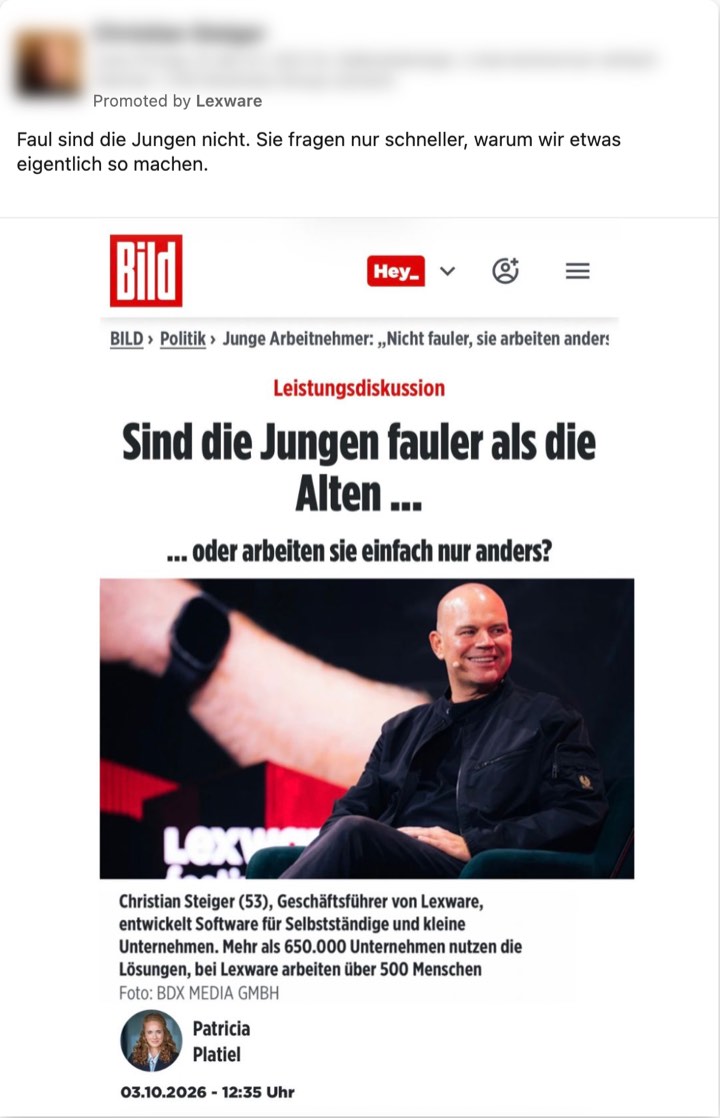
Faul sind die Jungen nicht. Sie fragen nur schneller, warum wir etwas eigentlich so machen.
Our translation: The young are not lazy. They only ask faster why we do things the way we do. The head of a business unit at a software company posted this (see the ad). The opening lines have no product in them. They take one side of an argument that many teams have, and a reader who agrees feels seen. The next lines, which the preview cuts, read "Das nervt manchmal. Meistens haben sie recht." (Our translation: That is annoying sometimes. Most of the time they are right.)
A surprising number
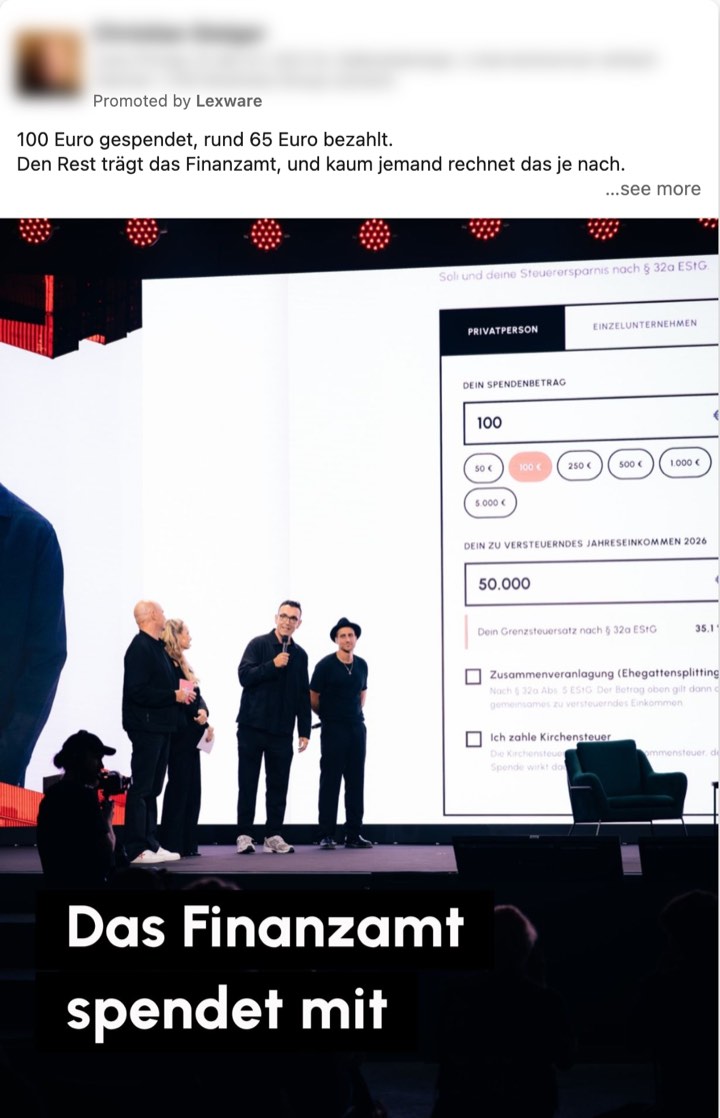
100 Euro gespendet, rund 65 Euro bezahlt.
Den Rest trägt das Finanzamt, und kaum jemand rechnet das je nach.
Our translation: 100 euro donated, about 65 euro paid. The tax office carries the rest, and hardly anyone checks the sum. The same executive posted this one (see the ad). The first line is a gap between what you give and what you pay, in 41 characters. Both lines fit before "see more". The 65 euro is the advertiser's own figure, and the opening lines show no source. The post gives its basis (a single person with 50,000 euro of taxable income) only behind the cut.
A question about the reader's own job
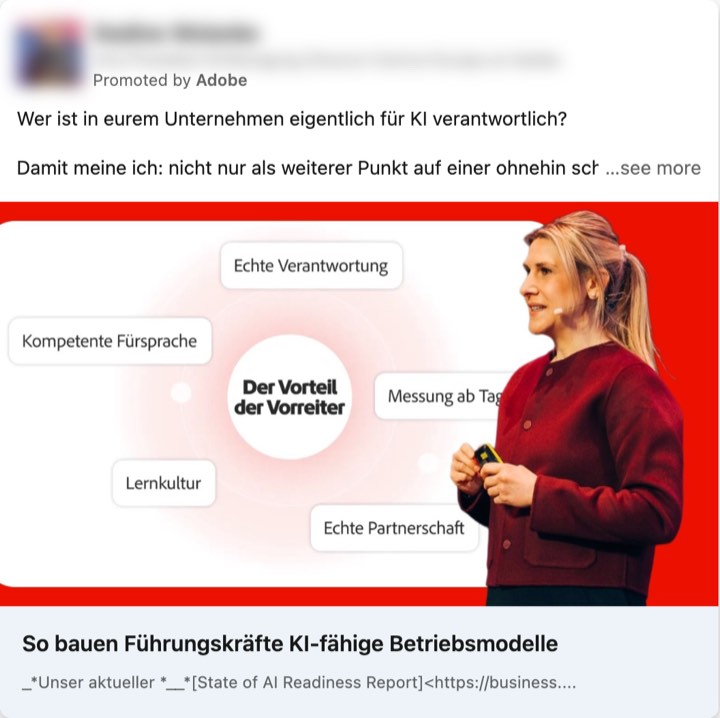
Wer ist in eurem Unternehmen eigentlich für KI verantwortlich?
Damit meine ich: nicht nur als weiterer Punkt auf einer ohnehin schon vollgepackten Tagesordnung, sondern mit einem klaren Auftrag, einem eigenen Budget und der Befugnis, Entscheidungen über mehrere Abteilung hinweg zu treffen.
Our translation: Who in your company is actually responsible for AI? I mean a role with a clear mandate, its own budget and the authority to decide across several departments, and not one more item on an already full agenda. A regional leader at a software company posted this, as a LinkedIn Article ad (see the ad). The question tests the reader's own organization chart. The preview shows the question, a blank line and the start of the second paragraph, which the cut interrupts. A later paragraph points to the advertiser's own report, so that proof is the advertiser's claim and not independent evidence.
Does the pattern matter?
It matters less than the poster. Kiin tested short first lines, the word "you", question openers and first person. None of them held up once Kiin compared posts of the same author. Kiin found no link between post length and engagement (a correlation of 0.05). The most engaging tenth and the least engaging tenth averaged 1,167 and 1,122 characters. A link in the post made no difference inside 32 accounts either (Kiin). One vendor guide advises first person, 1,000 to 1,500 characters and a link in the bottom quarter of the text. Its source is its own analysis of 119 ads, and it defines a top performer by a total click rate of 2 percent or more, which counts reactions. We do not recommend a length.
So use the five patterns as a clarity checklist. The template below puts the reason to read into the first three lines and the proof after them. That order is our suggestion, and no study we found tests it. For hook types beyond a single post, see B2B ad hooks. For the proof inside the post, see proof points in B2B ads.
POST ANATOMY: THE LINES BEFORE "SEE MORE"
Write the first three lines first. Read them alone. Then write the rest.

Reader: [role] at [company type] who [situation they face this month]
What the reader believes now: [belief]
What the poster saw that says otherwise: [first-hand detail]

LINES 1 TO 3 (about 150 characters; a blank line counts as a line)
Pattern, pick one: size contrast (a big thing next to a small result) / scene (a short story the reader knows, such as "Picture this") / contrarian line (one side of a debate the reader knows) / surprising number (a gap between two numbers) / question about the reader's own job
Line 1, the hook: [words]
Line 2, the turn: [words]
Line 3, the reason to tap "see more": [words]

AFTER THE FOLD
The proof: [one first-hand detail, or a number with its source]
What leaving it as it is costs the reader: [consequence]
What the poster would do instead: [action]
The close: [one question the poster wants answered, or one link]

CHECK
- Do the first 150 characters stand alone as a claim or a scene?
- Does the turn arrive before the cut?
- Could a competitor's poster sign this? If yes, add the detail only this poster has.
- Does any number or name lack a source? Add the source or cut it.
Use this prompt when you have an interview and want drafts that stay inside what the poster said.
You help [poster name], [poster role] at [company], write a LinkedIn post that the company may later sponsor as a thought leader ad.

Reader: [role] at [company type] who [situation they face].
Topic: [one sentence].
Hook pattern: [size contrast / scene / contrarian line / surprising number / question about the reader's own job / choose for me, and name it].
The patterns: size contrast is a big thing next to a small result. A scene is a short story the reader knows. A contrarian line takes one side of a debate the reader knows. A surprising number is a gap between two numbers. A question about the reader's own job tests how the reader's team is set up.

Use only what is in the interview notes below. Do not add any fact, number, name, customer or story that is not in the notes. If a good post needs something the notes do not hold, list it under MISSING and do not invent it.

Match the voice of the sample posts below: sentence length, the way they open and close, and the words the poster uses. Do not use words the poster never uses.

Write three different drafts. For each draft:
1. The first three lines, at most 150 characters in total. A blank line counts as a line. Print your character count in brackets after them, and count spaces. The point of the post must show in these lines.
2. The rest of the post in first person, in short paragraphs.
3. One line that names the fact from the notes that carries the post.

No emoji. No hashtags, except the disclosure tag the poster uses. Do not sell a product. End with one question or one link, not both.

After the drafts, write MISSING: the facts a reader would ask for that the notes do not hold.

INTERVIEW NOTES:
[paste notes or transcript]

SAMPLE POSTS BY THE POSTER:
[paste three past posts]
How do you brief and approve a post you did not write?
The poster owns the post. Your team can interview the poster, write a draft and check the facts. The poster then reads the final text, defends each claim and publishes it on their own profile. You search for existing posts in Campaign Manager, so the request comes after that. Only the original author can edit the post, so nothing changes after approval unless the poster changes it.
In Kiin's data, a post does not need an organic track record first. Kiin compared thought leader ads that boosted an existing organic post with purpose-built ads across 86 accounts. Engagement differed by 3 percent, which is not statistically significant, and Kiin says a post's organic record does not carry over to paid (Kiin).
This is how the approval runs in LinkedIn (create, manage requests):
- You pick the published post in Campaign Manager and send a sponsorship request. You can copy the request link and send it to the poster as a message.
- The poster gets an email with the post and the terms, and chooses approve or decline.
- Only after approval can you use the post as the ad.
- The poster sees the combined paid and organic impressions and reach on the post, and Campaign Manager reports the ad (LinkedIn help).
- The poster can revoke approval at any time. The ad stops at once.
The poster can also turn on auto-approval for one company. LinkedIn says to do that only for advertisers the poster trusts (LinkedIn help). We suggest that the poster leaves it off for the first posts, so that each post gets a fresh look.
If you are the poster, expect four things. Your name, photo and headline reach people you do not know, with a promotion label. Comments appear under your post, and you answer them. You see the impressions. You can stop the ad whenever you want.
LinkedIn does not document how a team writes in a poster's voice. We found two practitioner write-ups and no data, so treat the next steps as practice. Forgo, a LinkedIn content tool, and one ghostwriter's guide to doing the same work with AI both put the interview before the draft and the poster's sign-off last (Forgo, Fardeen). First interview the poster about a recent decision or event, because asking "what do you want to post about?" gives the busiest person your job. Then write down the poster's habits: Forgo names sentence length, how they open and which claims they refuse to make. Draft from the interview only. Trace every factual claim to a source or a named person who can confirm it. Send one clean draft with the doubtful points flagged. Do not expect executives to write the posts themselves. The test from Forgo is simple: the poster can read the post aloud, defend every claim and recognize the thought as their own. If not, the draft is not finished.
Copy this sheet once per post. It holds the checks from the sections above, the interview questions and the plan for reading the result.
THOUGHT LEADER AD PLANNING SHEET
One sheet per post. Fill it in before you send the sponsor request.

1. THE JOB
Objective: [brand awareness / engagement / video views]
Reader (role, company type, country): [description]
Audience size shown in Campaign Manager: [number of members]
After the post, the reader should think: [one sentence]

2. THE POSTER
Poster and role: [name, role]
Relationship to us: [employee / customer / outside creator]
(Customer or creator: the poster discloses the relationship. LinkedIn's help page says the ad is labeled as a partnership.)
Does this person know the work in this post? [strong / partly / weak] because [reason]
Do they put their name behind the claim? [strong / partly / weak] because [reason]
Can the reader see a reason other than a sale? [strong / partly / weak] because [reason]
Does the poster already write about this topic? [yes / no]

3. THE INTERVIEW (15 minutes, recorded with permission)
- When did you last see [the problem] in your own work?
- What did you expect, and what happened?
- What did you decide, and what was the other choice?
- What do most [reader role] get wrong about this?
- Which detail or number would only you know, because you were there?

4. THE POST
Organic post link: [URL]
Published on: [date] (LinkedIn advises sponsoring posts under 30 days old)
Type: [text / single image / video / article / newsletter / event]
(Not eligible: celebration, document, poll, multi-image post, repost.)
Public, with the poster's full name on the profile: [yes / no]
First 150 characters, pasted: [text]
The turn arrives at character: [number]
First-hand detail: [detail]
Link in the post text (text, image and video posts have no button; event posts do): [none / URL]
Every claim, its source and who checked it: [claim, source, name]

5. APPROVAL
Draft written by: [poster / team]
The poster read the final text aloud and can defend each claim: [yes / no]
Approval in LinkedIn: [per request / auto-approval stays off]
Who answers comments within one working day: [the poster]
The poster knows they can revoke approval, and the ad stops at once: [yes]

6. THE READ
Poster's organic numbers, saved before launch on [date]: [impressions, reactions, comments]
Audience size: [members]
Impressions of this post in every campaign that targets this audience: [number]
Passes (impressions of this post divided by audience size): [number]
Clicks from your best-fit roles divided by all clicks, one facet in Professional Demographics: [share]
Follows and clicks to profile: [number, number]
Three comments from target roles, quoted: [text]
Next post ready by: [date, or the pass count at which you swap]
Run this check on every draft before the poster approves it.
You are an editor. Check a draft LinkedIn post that a company will sponsor as a thought leader ad. Do not rewrite the post. Report problems and suggest one fix for each.

Poster: [name and role]. Reader: [role] at [company type].
Facts the poster has confirmed: [list them, or write "none"].

Run these seven checks. For each one, answer PASS or FIX, quote the words, and give the reason in one sentence.
1. First 150 characters: do they stand alone as a claim or a scene about the reader's situation? A product name, a launch or "excited to share" is a FIX.
2. Turn: does the point of the post arrive inside the first three lines? A blank line counts as a line.
3. Reader: does the post name a situation the reader knows from their own week?
4. First-hand detail: does the post hold one thing that only this poster could know?
5. Claims: list every number, name and fact. Mark each CONFIRMED (it is in the facts above) or UNCHECKED.
6. Voice: compare the draft with the sample posts. Quote any sentence that does not sound like the poster. If no sample posts are given, write NOT CHECKED.
7. Pitch: quote any sentence that sells a product, and any sentence that a competitor's poster could also sign.

End with a verdict (SEND, FIX THEN SEND or REWRITE) and a short list of questions to ask the poster.

DRAFT:
[paste the draft]

SAMPLE POSTS BY THE POSTER:
[paste two or three past posts, or write "none"]
Here is what the check should return for a constructed draft, with no confirmed facts and no sample posts. Tidewell is an invented product that checks supplier invoices against contract prices. The draft and the audit below are illustrative.
We launched Tidewell Match this week. It checks every supplier invoice against the contract price and flags the lines that differ.
Last month it found a supplier who billed 4% above contract for six months. The invoice totals looked normal, so nobody noticed.
Finance teams lose money to small price drift every year. If your team still checks invoices by hand, you are probably losing it too.
| Check | Result | Quote | Reason |
|---|---|---|---|
| 1. First 150 characters | FIX | "We launched Tidewell Match this week. It checks every supplier invoice against the contract price and flags the lines that differ." | It opens with a launch and a product name. The reader's situation is missing. |
| 2. Turn in three lines | FIX | "Last month it found a supplier who billed 4% above contract for six months." | The finding starts after the blank line, so it probably sits behind "see more". |
| 3. Reader's situation | FIX | "Finance teams lose money to small price drift every year." | It names a group and a general claim, not a moment the reader knows. |
| 4. First-hand detail | PASS | "billed 4% above contract for six months" | It is specific. Ask the poster who found it and how. |
| 5. Claims | FIX | "launched Tidewell Match this week", "found a supplier", "4% above contract", "six months", "every year" | All are UNCHECKED, because no facts were confirmed. "Every year" has no source and should go. |
| 6. Voice | NOT CHECKED | None | No sample posts were given. |
| 7. Pitch | FIX | "We launched Tidewell Match this week", "you are probably losing it too" | The post sells the product, and any competitor's poster could sign the last line. |
Verdict: REWRITE. Questions for the poster: Who found the 4 percent, and how? What did the supplier say? What did you change afterwards?
How do you read the result when the objective is awareness or engagement?
Read what the target buyers wrote and did before you read any click rate. Start with the comments. A sentence from a buyer in your target audience shows what the buyer made of the post, which no rate can show, and it gives the poster the next post.
- Comments and replies. Open the post and quote three comments from people in your target roles. Note every question and objection.
- Who reacted. The Professional Demographics report in Campaign Manager shows impressions and clicks by job function, seniority, company and other facets. Its data can take 24 to 48 hours to appear, the figures are approximate, and a member with two roles counts in both rows (LinkedIn help). So compare shares inside one facet, not exact counts. Set the mix of who clicked next to the mix of who saw the ad. Our reading: a role with many impressions and few clicks was not moved by the post.
- Follows and profile clicks. LinkedIn reports member follows and clicks to the member profile for thought leader ads (LinkedIn help). They show that the reader wanted more of the person.
- Passes. Add the impressions of this post in every campaign that targets the audience, and divide by the audience size (the wear-out section shows how).
- The poster's organic baseline. LinkedIn tells advertisers to ask the poster to save the organic numbers before the campaign (LinkedIn two-pager). The gap shows what the paid push added.
- Landing page clicks, only if the post holds a link.
The click rate that Campaign Manager reports for a thought leader ad misleads because it counts reactions. On the engagement objective, LinkedIn counts these as chargeable clicks for single image, article and event ads: a click on "see more", a like, a comment, a share and a click to the member page (LinkedIn help). Kiin found that 91 percent of the clicks LinkedIn reports on thought leader ads never reach a landing page. Its benchmark of 212 accounts has a median total click rate of 4.56 percent and a median landing page click rate of 0.46 percent (one heading on the page says 0.43 percent). One creative analytics vendor reports a median landing page click rate of 0.29 percent for its 119 ads, and a median of 2.68 percent for all clicks from a sample it does not name. The same vendor says that setting a thought leader ad's 2.68 percent against a single image ad's 0.42 percent is not a fair comparison, because the single image rate counts landing page clicks only.
If the visit is the job, buy it with a format made for clicks. On the same objective, Kiin found thought leader ads cheaper per landing page click than sponsored content: 22 percent cheaper on engagement and 47 percent on brand awareness (n = 106 and 32). Sponsored content on the traffic objective beat both. Inside the same accounts, a landing page click from a thought leader ad cost 52 to 59 percent more than one from that sponsored content (119 to 127 paired comparisons). The landing page click rates were the same (0.449 and 0.441 percent). The thought leader ads paid more for each impression. Kiin also found that on the engagement objective, video thought leader ads cost $32.34 per landing page click against $13.51 for single image ones, a median across accounts and not a paired test. Buy thought leader ads to be read.
The choice of objective depends on the audience. Brand awareness buys reach and engagement buys reactions. Kiin paired 36 accounts that ran both and found that the landing page click cost the same: $17.24 for brand awareness against $17.22 for engagement. Its rule is brand awareness for cold audiences of 30,000 members or more, and engagement for audiences under 10,000, uploaded lists, retargeting pools and video. Practitioner guides do not agree on the objective. Some suggest starting with engagement, then testing awareness on the same posts.
LinkedIn's product page for the format carries no benchmark. Its two-pager carries one claim with a method line. These are the numbers people will quote at you, and what each rests on:
| Number | Said by | What it rests on | Our advice |
|---|---|---|---|
| 1.7 times the click rate and 1.6 times the engagement rate of other single image campaigns | LinkedIn two-pager | Early pilot testers from 8 February to 25 April 2023. LinkedIn notes early adopter bias and calls it "directional". | Quote it with that label. |
| 2 times the click rate | Social Media Today, 30 October 2025, quoting LinkedIn | No method on the page | Do not quote it. |
| 71 percent of decision-makers say thought leadership is more effective than conventional marketing | Edelman and LinkedIn 2025, and a 2026 recap | 71 percent of hidden decision-makers (73 percent of target decision-makers), US respondents of a survey of 1,934 business executives on LinkedIn, about thought leadership in general, with no test of promoted posts | Quote it with "hidden decision-makers". Do not say it tests the ad. |
| 2.68 percent median click rate against 0.42 percent for single image | A creative analytics vendor | A vendor article that does not say which sample gives each number. The vendor calls the comparison unfair. | Drop it. |
| 91 percent of thought leader ad clicks never reach a landing page | Kiin | 212 accounts, one year, a vendor study | Quote it with the source. LinkedIn's click definition agrees. |
| Median engagement rate 4.46 percent | Kiin | Every reaction, comment, share, follow and click, including "see more" and profile visits, divided by impressions. 212 accounts | Use it for scale only. |
How long does a thought leader ad last before it wears out?
In Kiin's data, a thought leader ad did not wear out with time. It wore out with the number of times the same people saw it. Kiin measured each ad against its own launch. Cost per click, cost per thousand impressions and dwell time stayed flat for eight weeks, so the cost lines would not have warned you. Engagement was 9 percent lower once the ad had delivered as many impressions as the audience has members (one pass), and 22 percent lower after five passes (Kiin). Kiin's data is a vendor study, its method is on the page, and it leaves out the LinkedIn Audience Network.
Measure a pass the same way Kiin does: the impressions of one ad divided by the audience size. Here is a constructed example. Your audience has 8,000 members. The same post runs in three campaigns aimed at that audience. They delivered 6,000, 5,000 and 7,000 impressions in four weeks. That is 18,000 impressions, and 18,000 divided by 8,000 is 2.25 passes. Add the post's impressions from every campaign, because each campaign report shows only its own share. Across all campaigns, Kiin found a reported frequency of 3.45 over 90 days where the account delivered 9.48 per person (154 windows, 71 accounts). Kiin says it cannot yet test whether that account figure predicts wear-out better.
The time to one pass depends on the audience. Kiin's medians: 14 days for an audience under 10,000 members, and 53 days for one of 100,000 or more. Three in four campaigns on small audiences reach one pass, and one in ten on large ones. So a small audience needs a new post in the plan from the first day, and a large audience can carry one post for weeks. A new post does not buy a better ad. Kiin found that a freshly added creative beat the running ones only 42 percent of the time. Campaigns that kept adding creative held engagement flat, and campaigns that did not lost 8 percent a month.
LinkedIn's own advice is about the age of the post: sponsor posts under 30 days old and review the results every quarter (LinkedIn two-pager). Two practitioners quoted in a vendor guide disagree on the limit. One swaps the post at a frequency of 3, and the other sees a post start to die at 2. The guide shows no data for either. We suggest this: write the swap date on the planning sheet from the audience size, then check the passes every week. From outside you cannot see wear-out. The Ad Library shows run dates and an impression band, and no results. For the general decision to pause an ad, see when to pause an ad.
Frequently asked questions
Should the CEO post the thought leader ad?
Not by default. A CEO's public text, single image, video, article or newsletter post can run once the CEO approves the request in LinkedIn. Whether the CEO is the best choice depends on the topic. Choose the person who knows the work in the post and already writes about it. Test the CEO against a specialist on the same topic and audience, and compare the comments from target roles, the follows and the clicks from your best-fit roles.
Can a salesperson, a customer or an outside creator post one?
Yes. LinkedIn allows any eligible member with approval. LinkedIn asks every poster to disclose the relationship, and its help page says a post from someone who is not your employee is labeled as a partnership. We found no study that compares these posters, so test before you commit.
Can I run a document, poll or carousel post as a thought leader ad?
No. LinkedIn lists documents, polls, celebrations, multi-image posts and reposts as not eligible. Run a regular document ad or carousel ad instead (formats guide).
Can a thought leader ad have a button or a lead form?
Single image and video thought leader ads have no button, and event ones do. The objectives are brand awareness, engagement and video views, and LinkedIn lists no lead generation objective for the format. The poster can write a link into the post text.
Which objective should I choose?
Kiin's data suggests brand awareness for cold audiences of 30,000 members or more, and engagement for small audiences, uploaded lists, retargeting and video. The landing page click cost the same on both in Kiin's paired accounts.
What happens if the poster changes their mind or leaves the company?
If the poster revokes approval, the ad stops at once. The LinkedIn pages we read do not say what happens when a poster leaves the company, so settle it in writing with the poster before the first post.
Does Nimblet read thought leader ads?
Nimblet reads your LinkedIn ad account and never changes a campaign. It marks thought leader ads as their own type, records the hook of the post and lists that read next to the results for the goal each ad was bought for. Some posts stay unresolved when LinkedIn blocks them. See LinkedIn creative analytics.