
Facebook and Instagram ads for B2B: let the creative do the targeting, then run it as a test system
Nimblet teamUpdated 30 min read
Short answer
Facebook and Instagram ads fit B2B when many people can say yes to a small first step. Meta's help pages say its system can reach beyond the interests you pick, so the first three seconds of the ad have to select the buyer. Run one testing campaign and one scaling campaign, and move a concept to scale only when you can say in one sentence why it won.
On this page8 sections
- 01When does Meta fit a B2B company, and when does LinkedIn fit better?
- 02Why does the creative have to do the targeting on Meta?
- 03Which objective and conversion event fit a B2B offer?
- 04How do you split testing from scaling?
- 05When is a test ad a winner in B2B?
- 06How do you move a winner into scale without resetting it?
- 07What do you do when the winner stops winning?
- 08Frequently asked questions
When does Meta fit a B2B company, and when does LinkedIn fit better?
In our reading, Meta fits a business-to-business (B2B) company when many people can say yes to a small first step, such as a trial, a sign-up, a guide or a webinar. LinkedIn fits better when you must reach named roles at named companies, or when the first step is a call with sales. Give Meta its own test budget before you move any LinkedIn money.
Five questions decide it. Answer them for one offer at a time. The table is our reading and not a tested rule.
| Question | Leans to Meta | Leans to LinkedIn |
|---|---|---|
| What is the first step? | A trial, sign-up, guide or webinar that one person can start alone | A demo or a call with sales |
| How big is the buyer group? | Thousands of people in a country or region | A list of dozens of named companies |
| Who decides? | One person, such as a founder, an owner or a team lead at a small or mid-size firm (our reading) | A committee, or a buyer picked by exact job title |
| How often can you ship a new concept? | Every week | A few polished ads each quarter |
| Can the test budget feed the learning rule? | Yes, see the budget table in the testing section | No |
No source we opened sets a tested line between the two channels. Searchlab's 2026 comparison uses deal-size cutoffs of 5,000, 10,000 and 25,000 euros in different places, and its cost figures name no publisher. SaaSrise says a 50 dollar click is a rounding error on a 20,000 or 30,000 dollar contract, and that the same click "will bury you" if you sell a 1,000 dollar a year product. Both are marketing posts with no published method. So this guide prints no deal-size line.
A list of dozens of named accounts is the clearest poor fit. SaaSrise says manual targeting still makes sense for a list of about 25 companies. Kalungi (June 2026) argues that a niche market works on Meta if you build a list of exact buyers, enrich it with their personal email addresses and upload it as a custom audience. SaaSrise agrees that personal emails and mobile numbers match better than business emails. Neither shows a match rate or a result. Meta says the more identifiers you supply, the better the match rate. And under Advantage+ audience, a custom audience you include is only a suggestion until you choose Further limit your audience (Meta). For named accounts, we would test LinkedIn first. That is our reading.
What do real B2B ads on Meta ask for? On 22 October 2026 we searched the Meta Ad Library with the Germany filter and read 20 ads from seven software brands: HubSpot, Personio, Lexware, sevDesk, Zendesk, Pipedrive and Salesforce. We picked the brands ourselves, so the pull shows what these seven do and not what B2B does on Meta. Every brand sells software that teams use every day, such as human resources (HR), payroll, bookkeeping, sales and support tools. Only two of the 20 ads ask for a step with a person: a HubSpot demo request and a Personio offer that adds a personal expert call. The other 18 ask for a click, a sign-up, a trial, a download, a webinar seat, a podcast play or a discount. The library shows no spend and no results, so none of this says which ad worked.
To turn a LinkedIn concept into a Meta concept, read LinkedIn ads against Facebook ads for B2B. To find out what a rival runs on both channels, read the guide to the ad libraries.
Why does the creative have to do the targeting on Meta?
Under Advantage+ audience, Meta treats most of the audience you pick as a hint, so the words and pictures of the ad decide who stays. Age, gender, detailed targeting and the custom audiences you include are suggestions, and "Suggestions don't always constrain your audience". Meta's example: if you suggest women, ads can also reach men when Meta's artificial intelligence (AI) finds them likely to respond. Only locations, minimum age, excluded custom audiences and languages are controls. You can turn a suggestion into a control with Further limit your audience, which Meta offers for the case where "reaching a specific audience is more important than getting best performance". Meta's page on Advantage+ detailed targeting says the same about interests: the system can reach "a broader group of people than you defined in your detailed targeting selections".
Meta also took away a lever. It began removing detailed targeting exclusions on 31 March 2025 and says "a recent advertiser test" found a median cost per conversion 22.6 percent lower without them (Meta, updates to detailed targeting). That is Meta's own number, and it shows no method. Jon Loomer quotes a Meta blog post from April 2025: "the focus has shifted from niche targeting to creative diversification as the best lever to find the most relevant audiences". We could not open the Meta post itself.
Agencies disagree. Directive's 2021 guide says the "spray and pray" approach "simply won't work" for B2B and that you need to "narrowly define a smaller, more engaged group of users". SaaSrise (July 2026) says "Variety in your ads is now a targeting input". Kalungi says "You are interrupting their personal feed, so your creative must be sharper." None of the three shows data for its claim. Meta's own pages side with the creative.
Our reading of why this works: at work, a person on LinkedIn expects business messages and weighs an ad against the job. The same person on Facebook or Instagram is off duty, between photos from friends. The ad has to win a thumb-scroll before anyone weighs anything. It wins when the person thinks "that is my Tuesday". A role, a task or a moment makes that thought. A product name or a promise does not. Meta says 46 percent of online purchase conversions with Reels happen within the first 2 seconds of attention on its video ads. That is Meta's own figure, it counts purchases and not B2B sign-ups, and it points the same way.
Run this check on every ad before it enters a test. Read the ad on a phone with the sound off and give it three seconds. Point 5 uses the Meta Ads Guide, which recommends 50 to 150 characters of primary text and a 27-character headline for a Facebook Feed image ad.
THREE-SECOND CHECK FOR ONE META AD
Ad name: [angle | hook | offer | format]
Look at the ad on a phone, sound off, for three seconds. Then answer.

1. WHO. Which role, team or situation do the first words or the first frame name, in the words that person uses at work?
   Words I saw: "[quote]"
   Pass: a stranger in that role can say "this is for me". Fail: nothing names anyone.

2. MOMENT. Which one work moment or pain does the ad show?
   The moment: [one moment]
   Pass: one moment. Fail: a list of features, or a promise with no scene.

3. NEXT. What happens if the person taps? Write it in one plain sentence: [for example "A two-minute sign-up, no card."]
   Pass: the next step is small and clear in the ad itself. Fail: the ad does not say.

4. POLICY. Does the copy state or imply a fact about the person (health, money trouble, age) or about their company's finances?
   Pass: it describes the role, the task or the product only. Fail: it says something about the reader.

5. FIT. Do the role and the moment both show in the first line of the primary text, or in the first frame? (Meta's Ads Guide recommends 50 to 150 characters of primary text and a 27-character headline for a Facebook Feed image ad.) For video: does the idea still work with the sound off?
   Pass: yes to both.

Score: [number] of 5.
Fix the failed points, point 1 first. Do not launch an ad that fails point 1 or point 2.
Here are seven real ads, read with points 1 to 3 of the check. We picked them to show the range, so the split says nothing about how common each style is. The table gives no pass or fail, because we see neither the campaign goal nor the results. The library shows run dates, and run time is not a result. We read the ads on 22 October 2026. The copy is German, and the English in parentheses is our translation.
| Ad | First words | Who and which moment | First step |
|---|---|---|---|
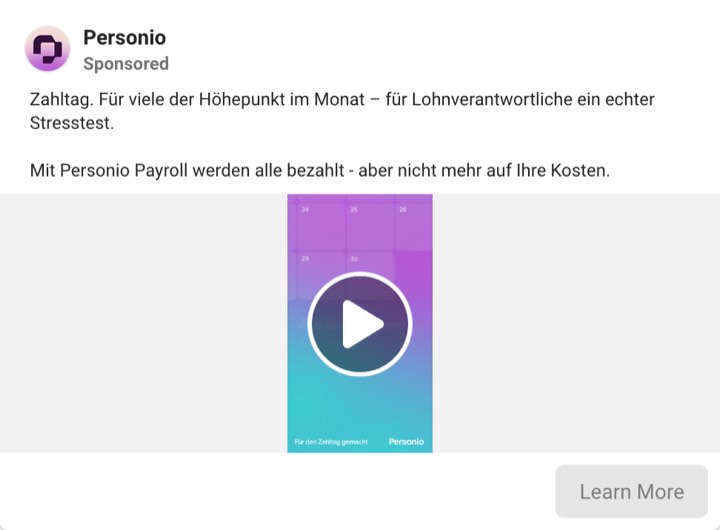
| Personio, payday video | "Zahltag. Für viele der Höhepunkt im Monat" (Payday. For many, the high point of the month.) The text goes on to call payday "ein echter Stresstest" for "Lohnverantwortliche" (a real stress test for payroll owners). | Payroll owners; payday | Learn more button |
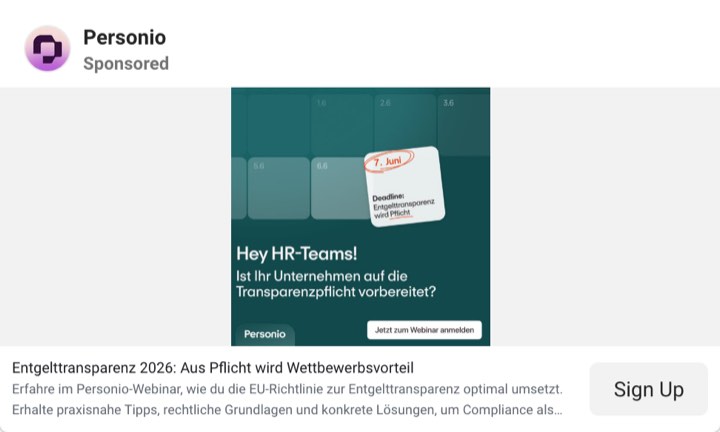
| Personio, pay transparency webinar | "Entgelttransparenz 2026: Aus Pflicht wird Wettbewerbsvorteil" (Pay transparency 2026: duty becomes competitive advantage). The image says "Hey HR-Teams!" | HR teams; a new European Union (EU) pay duty | Sign up for a webinar |
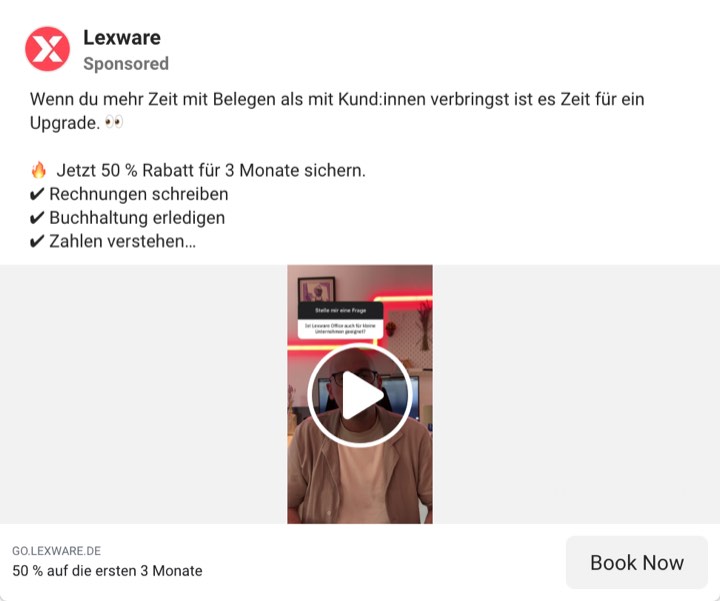
| Lexware, receipts video | "Wenn du mehr Zeit mit Belegen als mit Kund:innen verbringst ist es Zeit für ein Upgrade." (If you spend more time on receipts than on customers, it is time for an upgrade.) | Anyone who spends time on receipts instead of customers; receipts | 50 percent off for three months |
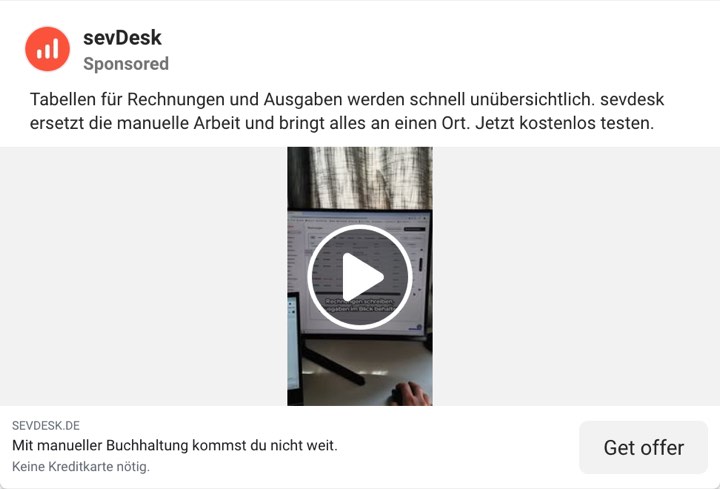
| sevDesk, spreadsheets video | "Tabellen für Rechnungen und Ausgaben werden schnell unübersichtlich." (Spreadsheets for invoices and expenses get messy fast.) | People who track invoices in spreadsheets; the mess | Free trial, "Keine Kreditkarte nötig" (no credit card needed) |
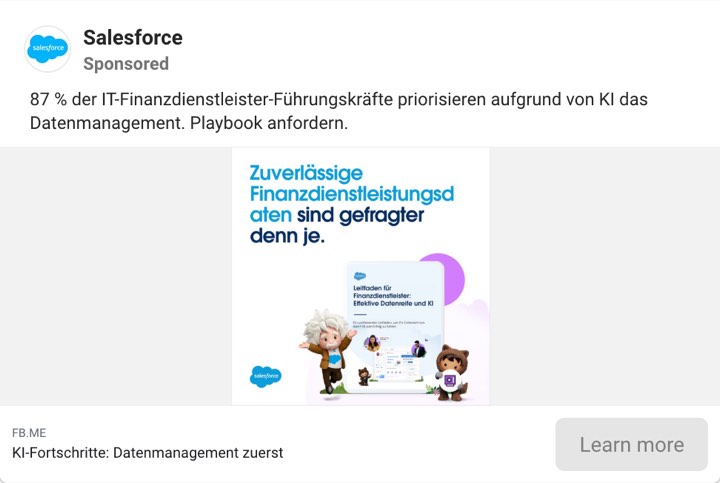
| Salesforce, 87 percent image | "87 % der IT-Finanzdienstleister-Führungskräfte priorisieren aufgrund von KI das Datenmanagement." (Loose translation: 87 percent of financial services information technology (IT) executives put data management first because of AI.) | A named executive group; AI and data management. The 87 percent is the advertiser's own claim, with no source in the ad. | Request a playbook |
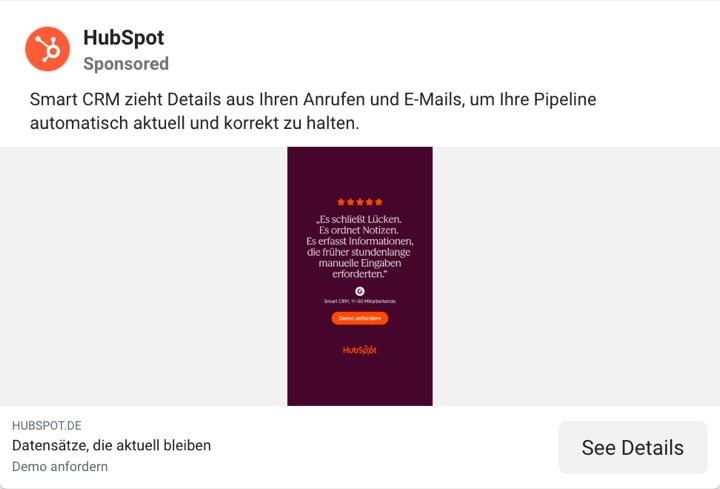
| HubSpot, records image | "Datensätze, die aktuell bleiben" (Records that stay current) | Nobody named; stale records | "Demo anfordern" (request a demo), one of the two asks for a step with a person |
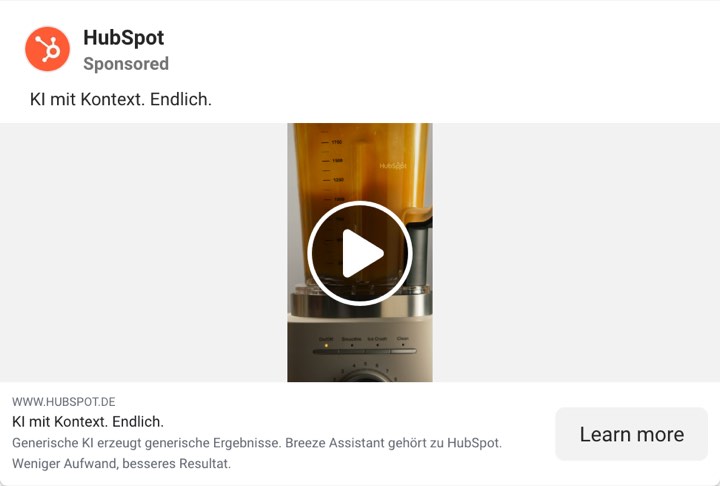
| HubSpot, generic AI video | "KI mit Kontext. Endlich." (AI with context. Finally.) and "Generische KI erzeugt generische Ergebnisse." (Generic AI produces generic results.) | Nobody named; a claim about AI and no work moment | Learn more button |
Now a constructed example for an invented invoice-approval tool. The first version reads "Smarter finance, powered by AI. Learn more." It fails points 1 and 2, because it names nobody and shows no moment. The second version reads "Finance leads: still chasing invoice approvals by email? Watch the 90 second walkthrough." It names a role and one task, and the next step is small. The product name can wait for the second line.
Point 4 has a source. Meta's advertising standard on personal attributes bans copy that asserts or implies attributes such as health, age or vulnerable financial status. It also bans copy that implies knowledge of "personal or organizational financial information". Its list of banned examples includes "Are you bankrupt?" The standard allows "you/your" language "without a personal attribute". Job titles are not on the list. So write about the role and the task, and not about the reader's condition or money. Meta's reviewers decide the edge cases.
For video, Meta names these counts: 2-second continuous video plays, 3-second video plays, ThruPlays (played to completion or for at least 15 seconds), video average play time, and plays at 25, 50, 75, 95 and 100 percent. Meta does not name a hook rate. Creative analytics tools commonly define it as 3-second video plays divided by impressions. Use it only to compare your own ads in the same placement. We print no benchmark.
Which objective and conversion event fit a B2B offer?
Pick the objective by the first step you ask for. Then optimize on the deepest event on your own page or form that still fires about 50 times a week in one ad set. The 50 is Meta's number: an ad set leaves the learning phase after about 50 results in the week after its last significant edit.
Meta's help page on conversion events for instant form lead ads gives the trade-off in two sentences: "If the event is too far down the funnel (with very few conversions), optimization may be less effective. If it's too high up, you may get volume but not quality." Use the table to pick, then read the people the ad brought. Your goal event must also reach Meta. Meta recommends the Conversions API (application programming interface) in addition to the Meta Pixel, with the same events shared through both and an event identifier so Meta counts each event once.
| Your first step | Objective and place (Meta's names) | Optimize on | Judge the ad by |
|---|---|---|---|
| Trial or sign-up | Leads, website | Completed sign-up | Cost per sign-up, plus ten sign-ups read by hand |
| Guide, report or webinar | Leads, website or instant form | Lead | Cost per lead, plus ten leads read by hand |
| Demo or call request | Leads, website | Demo request if it fires about 50 times a week per ad set, otherwise the step before it | Cost per demo request |
| Be known in a market | Awareness | Reach | Reach, and for video the 3-second plays per impression |
Meta's page on choosing an objective describes Leads as collecting leads "via messages, phone calls or signups". We would run retargeting in its own campaign. Meta says Advantage+ audience is not recommended for retargeting.
An instant form and a website page ask different things of a person. Meta's form types are More volume (the default), Higher intent and Rich creative. Higher intent adds a review screen and inline context under the contact fields. It delivers only to Facebook Feed and Instagram feed on mobile. Meta designs More volume to make a quick submit easy and to bring a larger number of leads. Meta says Higher intent keeps out people who are only marginally interested, so we expect weaker intent from More volume. Jon Loomer shows a Require Work Email quality filter on instant forms and warns that some small firms use no company address. The guide on low-quality leads from LinkedIn and Meta ads covers the lead mix in detail.
How do you split testing from scaling?
Run two campaigns. The testing campaign finds new concepts on a fixed budget. The scaling campaign holds only concepts that have won, and you change it only in one weekly batch. We suggest 30 to 40 percent of the Meta budget for testing. That share is our practice and not a Meta rule.
Three Meta rules explain the split. Meta lists adding a new ad to an ad set and any change to ad creative as significant edits, and a significant edit sends the ad set back into learning. Meta says too many ads at once make each ad deliver less often. And an ad set needs about 50 results a week to learn. If you add new ads to your proven ad set every few days, the proven ads never settle. The testing ad set pays that price on purpose. It is in learning most of the time, so compare its ads only with each other, inside one batch. We also use two campaigns and not two ad sets in one campaign. A shared campaign budget lets Meta decide how to split spend between the ad sets, and a new test ad set can get little. That is our reading and not Meta guidance.
The 50 results set the budget. Multiply your cost per result by 50 to get the weekly budget for one ad set.
| Cost per result | Weekly budget for 50 results in one ad set |
|---|---|
| 20 | 1,000 |
| 40 | 2,000 |
| 80 | 4,000 |
| 150 | 7,500 |
Take an example: a total Meta budget of 8,000 euros a month. That is about 1,850 euros a week. At 35 percent, testing gets about 650 euros. At 40 euros per result that gives about 16 results a week, a third of what one ad set needs. That budget cannot feed one ad set on a lead goal. Meta's learning limited page lists the fixes: combine ad sets, widen the audience, raise the budget, or pick an event that happens more often. So use one testing ad set, keep the audience broad, and if the numbers still fall short, optimize on the closest earlier event and judge on that event too.
What goes into the ad set matters as much as the budget. Test concepts and not variants. Two ads are two concepts when they differ in the work moment, the buyer role, the proof or the first step. A new background colour or a reworded headline over the same picture is not a new concept. Jon Loomer's Andromeda lesson says the same: creative diversification is "not about pumping out near-duplicates with minor tweaks". He writes that going from four or five ads in an ad set to 20 or more is "a huge adjustment". He says he tried 20, 30 and even 50 ads in one ad set and found it counterproductive. For most advertisers he calls higher ad volumes "unnecessary and unlikely to provide a benefit". That is one expert's practice, not a rule. Meta's page on managing ad volume gives this advice: "Decrease ads per ad set, but maintain diverse creative assets per ad set." The guide on B2B ad angles lists the angles to draw concepts from.
The two-campaign model has a known cost: overlap. Both campaigns reach the same broad audience, because a winner has to work on the audience you scale to. Meta says that when two or more ads from one advertiser enter the same auction, it picks the ad with the highest total value, and that overlap "can prevent an ad set from spending its full budget". A proven ad can crowd out a test ad. So check each week whether the test ad set spends its budget. If it does not for two weeks, test in a separate slice of your market, such as one country, and accept that the winner then meets a new audience. That fix is our reading and not Meta guidance.
META B2B OPERATING MODEL, ONE PAGE
Company: [name]    Offer (the first step): [for example "14-day trial, no card"]    Date: [yyyy-mm-dd]

GOAL EVENT (the one number every ad is judged on)
Event on our page or form: [for example "trial started"]
Cost per result we expect: [amount]
Weekly testing budget: [amount]. Divided by cost per result: [number] results a week.
If that number is under 50: use ONE testing ad set, keep the audience broad, and optimize on the closest earlier event that fires at least 50 times a week. Judge ads on that same event, and read ten people per ad.

CAMPAIGN 1: TESTING
Share of the Meta budget: [30 to 40 percent]
Objective, place, event: [Leads / website / goal event]
Audience: [country list], age [range], broad. No interest stacks.
Structure: [1] ad set, fixed budget of [amount] a week, [3 to 5] ads in it.
What goes in: concepts that differ in buyer role, work moment, proof or first step. A new colour on the same idea is not a concept.
Weekly rhythm: on [day], add [number] new concepts in one batch. Do not edit running ads. Compare ads only inside one batch.
Build: create each test ad from a Page post (Use existing post), so the post is in the list when the ad graduates.
Ad names: [angle | hook | offer | format | date]
Overlap check, every week: the test ad set spent [percent] of its budget. If under [your limit, for example 80 percent] for two weeks, test in a separate slice of the market.

CAMPAIGN 2: SCALING
Share of the Meta budget: [60 to 70 percent]
Same objective, place, event and audience as testing.
What goes in: concepts with a completed graduation card, added as the same post (Use existing post), in one batch a week.
Budget: raise in small steps, on a day when no ad is added.
Weekly review: cost per result [value], frequency [value], for video 3-second plays divided by impressions [value].

EVERY CONCEPT HAS A CARD
Graduation card: filled in before a concept moves. Stop rule: written before the test starts.
When is a test ad a winner in B2B?
A test ad is a winner when three things hold. It beats the next ad on the goal event by more than chance would give. The people it brought look like your buyers. And you can state in one sentence why it won. A win without a cause is hard to repeat in the next concept.
Chance is the first problem, because B2B tests often end with few results per ad. A count of results varies by chance by about 1 divided by the square root of the count. With 10 results that is about 32 percent, with 25 about 20 percent, with 50 about 14 percent and with 100 about 10 percent. The table below turns that into a floor. It shows how much cheaper the better ad must be, per result, before the gap is bigger than chance would give about once in 20 tests. Use the result count of the weaker of the two ads.
| Results of the weaker ad | The cheaper ad must be cheaper by at least |
|---|---|
| 10 | 59 percent |
| 25 | 43 percent |
| 50 | 33 percent |
| 100 | 25 percent |
We built the floor with a standard rule for counts. The ratio of two costs per result varies by chance by about the square root of (1 divided by the first count plus 1 divided by the second), as a share of the ratio. The floor asks for a gap of two times that variation. For two ads with about n results each, the variation is the square root of 2 divided by n. Meta's delivery system picks different people for each ad, and days differ, so a gap that clears the floor is still not proof. The more ads in a test, the more likely one wins by luck, so a test of ten ads needs a bigger gap.
Here is the sum on two constructed pairs. Ad A has 31 results at 38 euros. Ad B has 12 results at 97 euros. The smaller count is 12, the floor is about 56 percent, and the gap is 1 minus 38 divided by 97, which is 61 percent. It clears. Now Ad C has 26 results at 41 euros and Ad D has 19 results at 52 euros. The floor for 19 results is about 48 percent and the gap is 21 percent. There is no clear winner.
There are two ways out when counts stay low. First, judge on a goal event that fires more often, as in the section on events. Second, pool ads that share a cause and compare the groups. Two ads with 15 results each become one group with 30. Define the groups from the ad names before the test starts, so you do not sort ads into groups after you see who won. The guide on when to pause an ad owns the stop rule.
Three more checks keep the comparison fair. Compare ads in the same ad set, on the same dates, under one attribution setting. Meta announced a new meaning of a click on 3 March 2026. Click-through attribution for website and in-store conversions now counts link clicks only, and conversions from shares, saves and other non-link clicks move to engage-through attribution. Meta said the change would begin later that month and reach advertisers at different points. A test that began before your account got the change and ended after it mixes two definitions. Next, read ten submissions from the leading ad and mark how many look like your buyers. Last, write the cause. Fill in one card per concept before it moves.
GRADUATION CARD, ONE PER CONCEPT
Concept (ad name): [angle | hook | offer | format | date]
Test: [start date] to [end date]. Ad set: [name]. Goal event: [event]. Attribution setting: [setting].

1. SAME GROUND. Did every ad I compare run in the same ad set, on the same dates, under the same attribution setting? [yes / no]
   If no, stop. The comparison is not valid.
2. COUNTS. Best ad: [n] results at [cost per result]. Next best ad: [n] results at [cost per result].
3. GAP. The best ad is cheaper by [percent]. (Gap = 1 minus best cost divided by next cost.)
   Floor for the smaller count n: 1 minus 1 divided by e to the power of (2 times the square root of 2 divided by n). With 10 results, 59 percent; 25, 43 percent; 50, 33 percent; 100, 25 percent.
   Clears the floor? [yes / no]. If no, write "no clear winner" and go to DECISION.
4. PEOPLE. I read [10] submissions or sign-ups from this ad. [number] look like our buyers (work email, fitting role or company).
5. CAUSE. It won because [cause in one sentence], which the other ads lack.
   Proof: [quote the words or describe the frame] against [what the other ads did].
6. OTHER EXPLANATIONS that fit the same numbers: [explanation 1]; [explanation 2].
   The test that would separate them: [test].
7. REPEAT. The next three concepts keep [the cause] and change [the surface: picture, format or words].
8. MOVE. Date [date]. Same post, into scaling ad set [name], in the batch with [other concepts]. Review on [date].

DECISION: [graduate / test again / drop]. Reason in one line: [reason]
An assistant can do steps 3, 5, 6 and 7 for you if you paste in the numbers and the words of each ad. Paste the prompt below into Claude, ChatGPT or any other assistant. To pull the numbers with an assistant connected to your account, read the guide to Meta ads over the Model Context Protocol (MCP).
You are a paid social analyst for a business-to-business (B2B) company. Read the test below and name the likely cause of the result. Use only what is in the test. Do not invent numbers, audiences or reasons you cannot see in the copy or the descriptions.

Goal event: [for example "trial started"]
Ad set and dates: [ad set name, start date to end date. If the ads ran in different ad sets or on different dates, say so.]
Audience: [country, age range]
Attribution setting: [for example "7-day click, 1-day view"]

Ads in the test, one block per ad:
Ad 1. First words (primary text or on screen): "[exact words]". First frame or picture, described: [description]. Offer and button: [offer]. Results: [number] at [cost per result]. For video only: 3-second plays divided by impressions: [percent].
Ad 2. [same fields]
Ad 3. [same fields]

Do this in order.
1. Check the ground. If the ads ran in different ad sets, on different dates or under different attribution settings, write "comparison not valid", say why, and stop.
2. Compare the best ad with the next best ad. The best ad is the one with the lowest cost per result. Ignore any ad with 0 results and say so. Let n be the smaller of their two result counts. The cheaper ad must be cheaper by at least 1 minus 1 divided by e to the power of (2 times the square root of 2 divided by n). Reference points: n = 10 gives 59 percent, n = 25 gives 43 percent, n = 50 gives 33 percent, n = 100 gives 25 percent. Show the sum. If the gap is smaller than the floor, write "no clear winner" and skip to step 5.
3. List every difference between the best ad and the others in these five things: who the first words name, the work moment, the proof, the offer and the format. Quote the words.
4. Pick the one difference that best explains the result. Write it as: "It won because [cause], which the other ads lack." Then give two other explanations that fit the same numbers, and say which test would separate them.
5. Write three next concepts. If you named a cause, keep it and change the surface (picture, format or words). If the answer was "no clear winner", make each concept differ from the others in buyer role, work moment, proof or first step. One line each. Each line must name a buyer role and a work moment in its first words. Do not state facts about the reader's health, money or age.

Use short sentences. No hype words.
Here is an illustrative output. It uses constructed inputs for an invented invoice-approval tool, so the numbers are not real. All three ads ran in one ad set, on the same dates, under one attribution setting. Ad 1 opens with "Finance leads: still chasing invoice approvals by email?" over a picture of a full inbox and offers a 90 second walkthrough, with 31 results at 38 euros. Ad 2 opens with "[Product] is the invoice tool for modern finance teams" over a product screen and offers a free trial, with 12 results at 97 euros. Ad 3 opens with "Faster invoice approvals, fewer steps" over a dashboard and offers a free trial, with 9 results at 110 euros.
- Ground. All three ads ran in one ad set, on the same dates, under one attribution setting. The comparison is valid.
- Gap. Ad 1 has 31 results at 38 euros. Ad 2 has 12 results at 97 euros. The smaller count is 12, so the floor is about 56 percent. The gap is 1 minus 38 divided by 97, which is 61 percent. It clears the floor.
- Differences. Ad 1 names a role ("Finance leads") and one task ("chasing invoice approvals by email"). Ads 2 and 3 open with the product or a benefit and name nobody. Ad 1 shows an inbox. The others show product screens. Ad 1 offers a walkthrough. The others offer a trial.
- Cause. It won because the first words name a role and one daily task, which the other two ads lack. Two other explanations fit the same numbers: the walkthrough is a smaller ask than a trial, and the inbox picture stops the scroll. To test the offer, keep the words and swap the offer. To test the picture, keep the words and swap the picture.
- Next concepts. "Controllers: is month-end close stuck on one missing approval?" "Founders: signing off invoices late at night between other jobs?" "Office managers: an approval request that sits in an inbox for a week?"
How do you move a winner into scale without resetting it?
You cannot move the learning, and you can reuse the post. Learning belongs to the ad set. Meta says the learning phase starts when you "create a new ad or ad set or make a significant edit", so an ad that enters a scaling ad set starts learning there. What you can keep is the post, and the audience and event the ad already worked with. What you control is how often the scaling ad set takes a hit.
Here is what is settled and what is disputed. Settled: Meta's current help page lists "Adding a new ad to your ad set" and "Any change to ad creative" as significant edits. It says a budget change from $100 to $101 is not likely to send an ad set back into learning, and a change from $100 to $1000 may. It gives no figure in between. Disputed: Jon Loomer added one ad to an ad set of 22 ads, saw it go live at once with the ad set staying active, and wrote "Do new ads restart the learning phase? Things might be changing." He does not report what the delivery status showed. He bets that 22 new ads in a one-ad set would send it back into learning. That is one test on one account, and the Meta page still says otherwise. Plan with Meta's page.
- Check that the graduation card is complete. A winner with no stated cause stays in testing.
- In the scaling campaign, create the ad with Use existing post in the ad setup and pick the winner's post. Meta's steps say to use the post identifier (ID) from the ID column of your Page posts and not an ID copied from a web address. Practitioners use this move to keep the likes, comments and shares on the post. We found no Meta page that states that effect, so compare the reaction count on the new ad with the original.
- Change nothing after you pick the post. Meta warns that editing details on the ad also changes the existing post.
- Add winners once a week, in one batch. Each new ad is a significant edit to that ad set. One batch restarts learning once, and five single adds spread over the week keep it restarting.
- Raise the scaling budget in small steps, on a day when you add no ad.
- When the ad in scale delivers, turn the test ad off. Two ad sets that reach the same people overlap, and Meta lists high auction overlap among the causes of learning limited.
- Write the date, the post and the reason in the operating model. You need them at the next review.
What do you do when the winner stops winning?
Check in this order. First, is the drop real? Apply the same floor to two periods of one ad. With 25 results in each period, the cheaper period must sit 43 percent or more below the dearer one before the gap is outside chance. A cost per result that moves from 40 to 60 euros is inside chance, and one that moves from 40 to 75 euros is outside it. Second, what changed? Meta's learning page names a Last significant edit column in Ads Manager. Look there, and at budget jumps, new ads in the ad set and the attribution setting.
Third, has the audience seen the ad too often? Meta defines two statuses. When cost per result is more than for your past ads but less than twice as much, the status reads Creative limited. At twice as much or more, it reads Creative fatigue. Meta's page says this works only for ad sets with one creative, so a scaling ad set with several winners shows no status. Look at frequency and at the trend of cost per result yourself.
Fourth, read the first moment. For video, compare 3-second plays divided by impressions with last month. If it fell, the opening wore out. If it held and results fell, look at the offer, the landing page or a wider audience. For a static ad, watch link clicks per impression in the same way, as a check on one ad over time and not as a way to rank ads. Fifth, if you tested in a separate slice of the market, compare that slice with the audience you scale to. A wider audience responds differently.
If the ad fails a fair check, put the concept back into testing and do not delete the card. Meta's own advice is to create another ad "materially different from the original creative", and it adds that keeping the original active "may maximize results". Then repeat the cause on a new surface: the same role and moment, a new picture, format or opening line. If you stop testing once you have one winner, nothing is ready when it tires. The guide on when to pause an ad gives the decision tree and the stop rule, and the guide on sharing creative learnings covers the note for your team.
Frequently asked questions
Do Facebook ads work for B2B?
They can. In our reading, they work best for offers with a small first step and a wide buyer group, and when the ad names the buyer's work moment in the first three seconds. We found no public study that compares B2B results on Meta and LinkedIn with a stated method. The pages that claim a gap are marketing posts that do not publish their data. Test with a separate budget and judge on your own goal event.
Should B2B use instant forms or a landing page?
Test both on the same offer and read ten leads from each. Meta designs its default More volume form for a larger number of leads, and says the Higher intent type keeps out people who are only marginally interested. Higher intent adds a review screen and delivers only to mobile feed placements. A landing page asks for more effort, so we expect it to filter more. That is our reading, so test it. Add a work-email requirement if free email addresses fill your list.
How much budget does a B2B Meta test need?
Enough for about 50 results a week in each ad set, which is Meta's figure for leaving the learning phase. Multiply your cost per result by 50. At 40 euros per result, that is 2,000 euros a week per ad set. With less, use one testing ad set and optimize on an earlier event.
How long should a test run?
For at least a week, and until the weaker ad has the results the floor table asks for. Pick the gap you care about and read its result count in the floor table: a gap of 33 percent needs about 50 results on the weaker ad. Divide that count by the results you expect each week to get the end date, and write it on the operating model. If the date comes and no ad clears the floor, call the test inconclusive and run new concepts. Do not extend it by habit.
How many ads belong in one ad set?
Meta says to avoid high ad volumes and to keep creative assets diverse. Jon Loomer found that 20 to 50 ads in one ad set was counterproductive. We suggest three to five concepts in the testing ad set. Each one must differ in role, moment, proof or first step.
Do founder-led or customer-style videos work for B2B on Meta?
Kalungi recommends user-generated content, founder talking-head videos and raw formats. SaaSrise recommends founder videos and customer testimonial videos for retargeting. Neither shows data. A creative analytics vendor's page on a December 2025 talk lists "Creator-led ads can boost efficiency by up to 32%" as a claim by the speaker. The page attributes the figure to Meta. It gives no link to the study, no sample and no method. Treat the style as one concept type and run it in your testing campaign.
Can I run B2B ads on Instagram too?
Yes. Facebook and Instagram run in the same Meta campaigns. Meta's help page on multiple conversion locations for lead ads says you can break results down by platform, placement, demographics and time. Read ten leads from each placement before you keep them all.
Can I see what my competitors run on Meta?
Yes. The Meta Ad Library lists their active ads with start dates. For ads that deliver in the EU, Meta offers more information and keeps the ad for one year after its last impression. On 22 October 2026 the details of the ads we read showed location, age and gender targeting and an estimated reach. The library shows no spend, clicks or results, so a long run time is a weak hint at best. The guide on reading both ad libraries has the method, and the page on Meta ads for B2B shows how Nimblet reads your own.