
LinkedIn ads vs Facebook ads for B2B: how the same concept has to change between the two feeds
Nimblet teamUpdated 32 min read
Short answer
In our reading, a LinkedIn ad fails on Meta because the reader changes: a named professional who reacts in public at work becomes a stranger in leisure time with no job title attached. Read every concept twice, once per reader, and rewrite the first line, picture, jargon, proof, humor and ask with the change table below. Compare the two channels by each ad's rank among its peers on its own channel, never by one blended cost.
On this page9 sections
- 01Why does a LinkedIn ad fail when you run it unchanged on Meta?
- 02How does a buyer read an ad on LinkedIn?
- 03How does the same buyer read an ad on Meta?
- 04What changes in the ad, element by element?
- 05Which concepts travel, and which stay on one channel?
- 06How do you rewrite a LinkedIn winner for Meta?
- 07How do you rewrite a Meta winner for LinkedIn?
- 08How do you compare results across the two channels?
- 09Frequently asked questions
Someone asks in the briefing thread whether the LinkedIn winner can run on Facebook. This guide gives you the test that answers it, the list of what to change, and a fair way to read the result. It covers business-to-business (B2B) ads on LinkedIn and on Meta, which runs Facebook and Instagram.
Why does a LinkedIn ad fail when you run it unchanged on Meta?
In our reading, the ad fails because it was written for one reader and meets another. On LinkedIn the reader is a named professional. A role in the first line, a sourced number and a customer's job title tell that reader the ad is for them and is safe to react to. On Meta the reader is a stranger in leisure time, with no job title in sight. The same three signals tell that stranger nothing.
Three parts break first.
- The call-out. A job title names a role, and a role is narrower than the work. A person who chases invoice approvals every week may not hold the title in your first line.
- The proof. A customer's title and an analyst badge work for a reader who checks them. A stranger reads them as more work talk.
- The ask. A long report or a demo suits someone at work. A stranger wants the next step to cost one tap.
We found no published test that runs the same B2B ad on both channels and reports results. The write-ups we opened give opinion, not test results. Kalungi, a B2B software marketing firm, describes a shift from LinkedIn to Meta for lead generation and writes: "You are interrupting their personal feed, so your creative must be sharper." SaaSrise, a community for SaaS founders that also sells consulting and ad services, writes: "Variety in your ads is now a targeting input, because the platform reads the copy and content to decide who should see it." Neither page describes a test design. SaaSrise quotes costs from its own clients, and the last section of this guide shows why such numbers do not travel.
The two measured studies below do not compare the feeds. The Magna study tests LinkedIn feed ads. The B2B Institute study tests aired video ads. So this guide is our reading. It comes from the rules Nimblet uses when it writes ad batches for the two channels, and from reading public ads on both. Where a claim is not a plain platform fact, the sentence says which kind it is: measured, a vendor's number, one expert's practice, or our reading.
How does a buyer read an ad on LinkedIn?
As a named professional who can be seen. Our reading: a LinkedIn reader has a name and a job title next to everything they do in the feed. Reacting to an ad is a visible act at work, in front of colleagues and a network that includes the reader's own buyers. So an ad earns attention by being specific, checkable and kind to the reader's craft. It can start with the reader's problem, because the platform already addressed the reader as that person. The reader follows a longer argument, so thought leader ads and document ads are native here. See LinkedIn thought leader ads and LinkedIn ad formats.
LinkedIn's own pages support the premise that the platform knows the reader's job. Its targeting page tells advertisers to use "real, member-generated professional demographic data, including job title, company, industry, seniority and more", and claims that members "have professional incentives to keep their profiles accurate and up to date". That is a vendor's claim about its own data. Its audience size page sets 300 member accounts as the minimum for an ad set, suggests 50,000 to drive results, and suggests 300,000 for Sponsored Content. So an ad set reaches a named segment, and the first line can name that segment.
A controlled study of LinkedIn feed ads comes from LinkedIn and the media agency Magna. The slides we opened and the MediaPost report describe a controlled copy of the LinkedIn feed. 1,773 LinkedIn users produced 3,024 exposures to 67 Sponsored Content ads, single image and video, from 26 brands. A public service announcement served as the control.
On human presence, the slides show modeled lifts for ads that had a person in them: 10 percent on unaided recall, 8 percent on "a brand that knows how to connect with me" and 5 percent on purchase consideration for the product. Each is marked significant at 90 percent confidence or higher. Ads with a celebrity showed no difference.
What the study does not test matters more. It does not test Meta or any other feed. Its outcomes are brand measures, not leads or sales. "Creative" means the viewer said so. The sources name no brands and do not say which industries the 26 brands come from. LinkedIn ran the study with Magna, and we read the slides and one news report, not a paper.
How does the same buyer read an ad on Meta?
As a stranger in leisure time who owes the ad nothing. Our reading: no job title sits next to the ad, the ad interrupts friends, family and entertainment, and scrolling past costs nothing. The ad competes with entertainment, not with other vendors. So the picture has to earn the stop alone, and the words have to sound like a person. Judge the picture at thumbnail size with the words covered. Name the situation, never the title: "Chasing approvals by email again?" names no title and still picks out the person who does the chasing. Jargon reads as noise, a joke lands harder, and a status play reads as pressure from a stranger.
A concept that needs a job title to land does not belong on Meta. Cut it, or rebuild it around the situation. For first-line types, see B2B ad hooks. For the levers behind status and fear, see the psychology of B2B ads.
Meta's own pages point the same way on delivery. Its help page on Advantage+ audience says the feature lets you use Meta's advanced artificial intelligence (AI) "to find the audience for your Meta ad campaign, instead of defining that audience yourself", and that it can help a campaign reach "people you may not have targeted manually". Jon Loomer, who teaches Meta advertising, reads Meta's statements about its Andromeda ad system as saying "to use creative to impact the people your ads will be shown to, rather than worrying about audience control levers in the ad set". That is one expert's reading, and his page does not mention B2B. He adds that diversifying creative means building ads for different people and contexts, not different versions of the same idea. A resized LinkedIn ad is the same idea in a new frame.
SQ Digital, a UK agency, uses the same two moods. It says LinkedIn users are typically in "work mode" while Meta users are more relaxed, and that this changes how you write the ad. It gives no data on either mood. We found no head-to-head test of identical B2B creative on the two channels, and no Meta equivalent of the human presence result above.
What changes in the ad, element by element?
Eight elements change. The table is our reading, and the subsections after it give the evidence we could check.
| Element | On LinkedIn | On Meta |
|---|---|---|
| First line | Names the work or the role, then the problem. | Names the situation in the reader's own words. A job title identifies no one. |
| Picture | May show the product, a diagram or a screen. Proof can sit in the picture. | Must argue alone. With the words covered, it still says what this is. |
| Jargon | The role's own words work as a handshake. | Jargon reads as noise. Say it as you would to a friend. |
| Proof | A named customer with a role, a sourced number or a product screen. A skeptical peer checks it. | One claim in a plain voice, or a product moment. A title does less work here. |
| Humor | Fine when the profession laughs at its own week. Never at the reader. | Lands harder. The joke must carry the product truth. |
| Status and fear | Works, because peers can see the reader. Never make the reader look careless. | Lands worse. It reads as pressure from a stranger. |
| Ask | A report, checklist, event or demo. The reader may forward it. | One tap or the shortest form. A bigger ask needs an offer that pays for it, such as a discount. |
| Text and container | A longer argument survives. Thought leader ads and document ads are native. | Short text. The picture carries the argument. Video works with the sound off. |
What do the platform pages say about format?
Both platforms recommend captions on video and a 4:5 image on mobile. The limits below come from the pages we opened in October 2026. Check them again before a launch, because platforms change them.
| Item | Meta | |
|---|---|---|
| Sound | Captions are "strongly recommended". Video ads autoplay in the feed with the sound muted by default. | The Facebook Feed video spec lists captions and sound as "optional, but recommended". An older Meta post on mobile video, which shows no date, says video ads should communicate clearly without sound. |
| Ratio and mobile | LinkedIn recommends vertical single image ads, with 4:5 the recommended vertical ratio. Vertical assets serve on mobile only. | Facebook Feed image ads: 4:5. Facebook Feed video ads: 4:5. |
| First text | Intro text: up to 150 characters to avoid truncation. Headline: up to 70. | Primary text: 50 to 150 characters. Headline: 27. |
| Words in the picture | The single image spec sets no limit for words in the picture. | Meta's text overlay advice: do not communicate too many messages, because ads usually carry one call to action. |
What do real ads on both feeds show?
On 22 October 2026 we read 41 LinkedIn ads and 20 Meta ads from B2B software and services advertisers, with a Germany filter, in the two public ad libraries. We coded each one for hook, proof and ask. The libraries show no spend, clicks or results, so we cannot say whether any ad worked. We read them for what they say. See the LinkedIn Ad Library guide for how to run the same search.
| In our pull | LinkedIn (41 ads) | Meta (20 ads) |
|---|---|---|
| Ads coded "proof: none" | 11 | 16 |
| Ads with a medium or large ask | 2 | 8 |
| Ads with a discount in the copy | 0 | 5 |
| Ads where the library lists Job as a targeted category | 33 | Not shown by the library |
The pull is small and not random. It has 24 LinkedIn advertiser names and 7 Meta pages, found through our own keyword searches. Proof and ask size are one reader's coding calls. Some calls sit on the border, such as a named expert on the image (proof) or a free event (ask size), so read the size of the gap and not the exact count. Read the table as a pattern in these ads, not as a rule.
One advertiser moves the Meta counts: Lexware supplies three of the five discounts. Five of the eight bigger Meta asks are discounts. Our reading: advertisers on Meta pair a bigger ask with an offer that pays for it. Without such an offer, keep the ask small.
Meta's library shows location, age and gender for the 19 Meta ads that show a targeting block, so it cannot tell you whether an advertiser also used lists or interests.
Six advertisers ran ads on both channels in our pull. We show HubSpot and Lexware from it. The Pipedrive pair comes from a second search on 23 October 2026, made to find one topic on both feeds, so it is not in the counts above. We cannot see any advertiser's brief, so we do not know whether one ad was a rewrite of the other. A number inside an ad is the advertiser's own claim. German text is quoted as it appears, and the translation is ours. We left out emoji and dash marks from the originals.
HubSpot: one argument, a person and a short claim
LinkedIn, a promoted post by HubSpot's country lead for Germany. It opens with a local joke: "Die KI-Investitionen deutscher Unternehmen sind inzwischen ungefähr so hoch wie der Berliner Fernsehturm. Die messbaren Ergebnisse davon passen locker in den Fahrstuhl." In English: German firms' AI spending is about as tall as the Berlin TV tower, and the measurable results fit in the elevator. The argument arrives in the third paragraph: "Für mich ist entscheidend, ob KI den richtigen Unternehmenskontext kennt". For the author, what matters is whether AI knows the right company context. The sentence goes on to reliable data. The ask is a sign-up to an event.

Meta, 15-second video. The text reads "KI mit Kontext. Endlich." and "Generische KI erzeugt generische Ergebnisse." That is: AI with context, finally. Generic AI produces generic results.
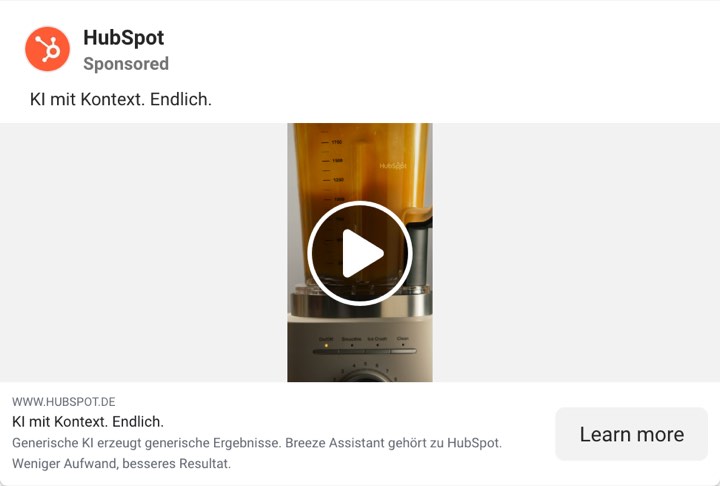
Our reading: the argument is the same, AI needs company context. On LinkedIn it is one person's opinion, with a joke. On Meta it shrinks to two short lines and the person leaves.
Lexware: two jobs, not one translated ad
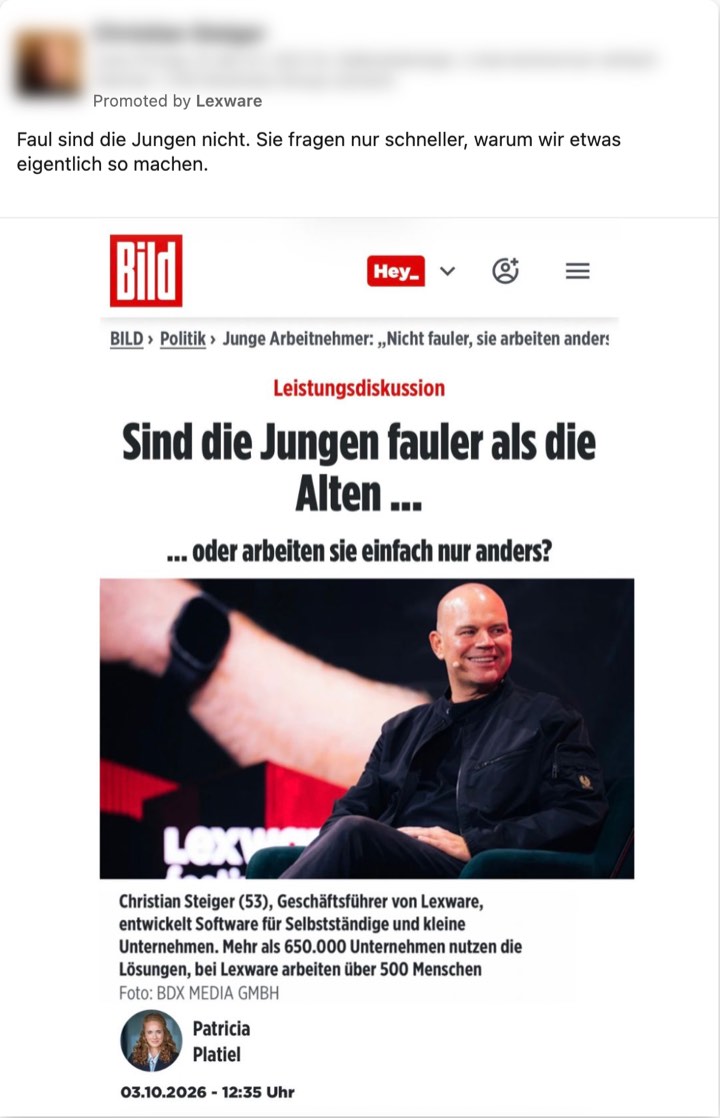
LinkedIn, a promoted post by the chief executive of Lexware's business group. It runs to 228 words, sells no product and makes no ask. It opens: "Faul sind die Jungen nicht. Sie fragen nur schneller, warum wir etwas eigentlich so machen." That is: young people are not lazy, they only ask faster why we do things this way. It ends with a question to the reader.
Meta, 27-second video. The text opens: "Wenn du mehr Zeit mit Belegen als mit Kund:innen verbringst ist es Zeit für ein Upgrade." That is: if you spend more time on receipts than on customers, it is time to upgrade. A line later: "Jetzt 50 % Rabatt für 3 Monate sichern", get 50 percent off for three months. The button says "Book Now".
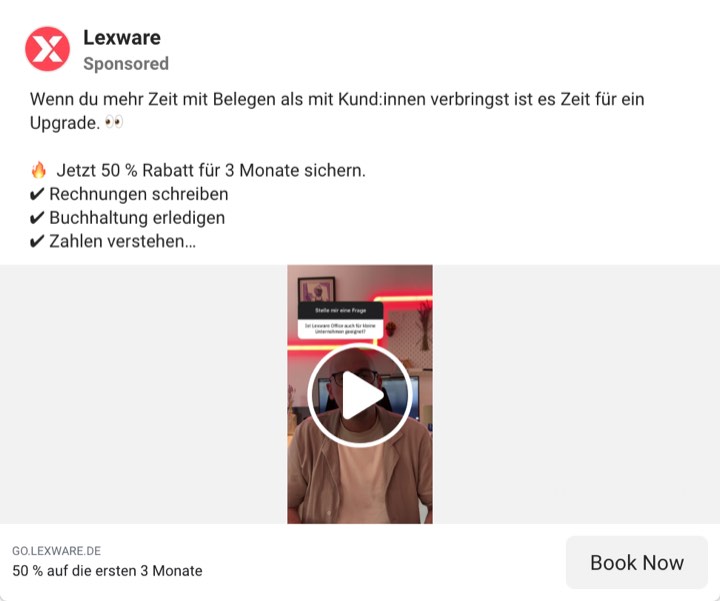
Our reading: Lexware does not translate one concept here. In these ads LinkedIn carries a leader's voice and Meta carries the sale. An advertiser can split the job between channels, and that is one answer to this guide's question.
Pipedrive: one post, pasted
Pipedrive, a sales software vendor, ran one masterclass video on both feeds. Both library entries start on 5 June 2025. On LinkedIn it is a video ad that ran to 11 November 2025 and shows 30,000 to 50,000 impressions. On Meta it is a 31-second video that ran to 31 October 2025.
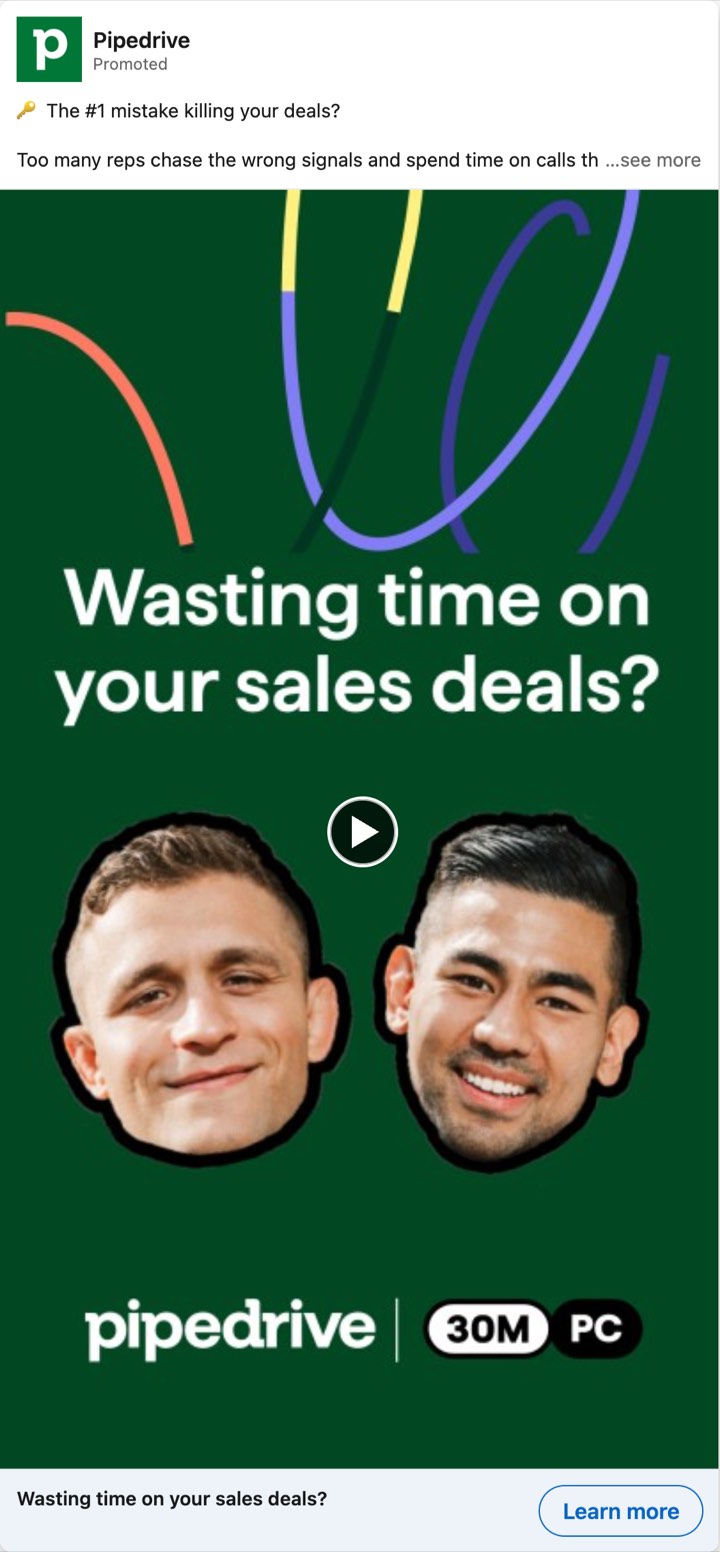
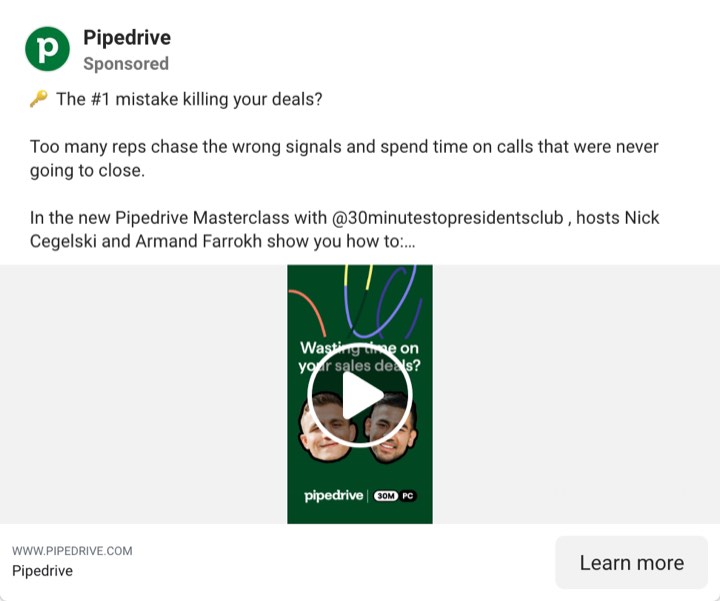
The text is the same on both. It opens: "The #1 mistake killing your deals? Too many reps chase the wrong signals and spend time on calls that were never going to close." It then promotes a masterclass with a sales podcast and lists three things the masterclass teaches. The hashtags, the video card ("Wasting time on your sales deals?") and the button ("Learn more") match. Two lines changed. LinkedIn ends with a link to the full session. Meta ends with "Link in bio" and tags the podcast by its handle.
The two ads did not reach the same people. The LinkedIn ad targeted Germany, the United States and two more places, and the library puts 86 percent of its impressions in the United States and under 1 percent in Germany. The Meta ad targeted Estonia, France and Germany, ages 21 and up, all genders.
Our reading: this is a paste, not a rewrite. The first line names a problem and no title, so it meets the first-line check of the Meta read. The second line names a role, reps, which fits the LinkedIn read. The libraries show no results, so we cannot say whether the paste worked. The Meta ad ran for about five months, and run length is a weak hint, not a result. Lexware split the job between feeds, and Pipedrive pasted. Advertisers do both.
What do the video studies say about statics?
Little that has been tested. The B2B Institute compendium studied 587 B2B technology video ads that aired in the US between November 2013 and April 2021, 71 percent of them 30 seconds long. System1 panels rated them under forced exposure. It tested no feed ad, no LinkedIn ad and no Meta ad.
| Finding in the compendium | Tested on | Carries to a static ad? |
|---|---|---|
| Ads with an everyday setting scored 32.8 percent higher on average positive emotion, the largest gap (p below 0.001). | Aired video | Our reading: yes. A picture of a moment the reader knows is the static version. |
| Ads with opening cards and watermarks scored 39.8 and 29.3 percent higher on brand recognition and 12.4 and 12.9 percent lower on positive emotion. | Aired video | Principle only. A static shows the brand at once. The open question is how large to make it. |
The compendium also rates voiceover and music. Both need sound, which a static lacks, so we leave them out. The authors' conclusion reads: "The less tangible the product, the more tangible the branding must be." They also say that no single element guarantees a result. The compendium gives no verdict on statics, and neither does anyone else we found.
Which concepts travel, and which stay on one channel?
A concept travels when it passes both reads. A concept that passes one read needs a rebuild or stays on its channel. Run the two-read test on every concept before you brief it, then use the table to see which type you hold.
Situation-led concepts travel best, in our reading. The B2B Institute's paper on category entry points gives a way to think about it. It defines them as the cues buyers use to recall a brand when they face a buying situation, such as a motive, an emotion, a place or a time of day. Its data comes from business insurance and banking, not from ads. A situation needs no job title, so it passes the Meta read.
| Concept built on | Where it runs first | Why | Public example |
|---|---|---|---|
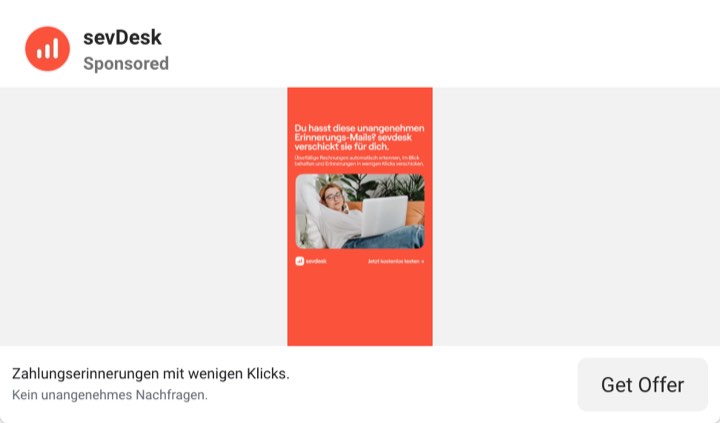
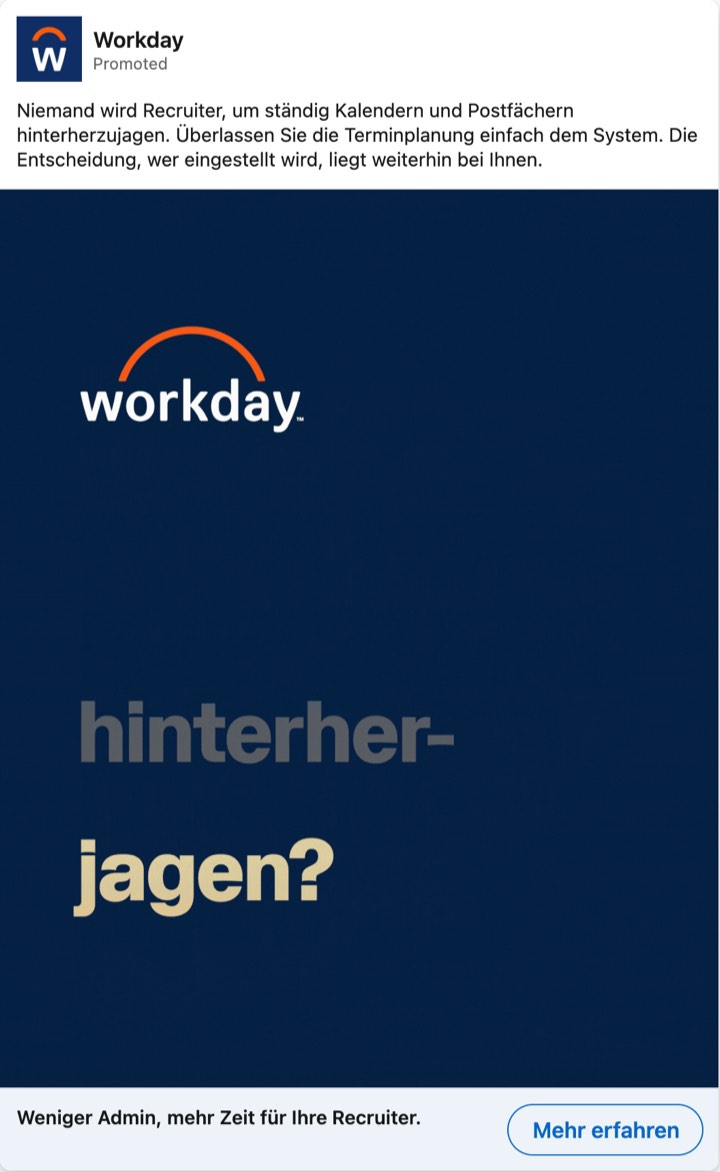
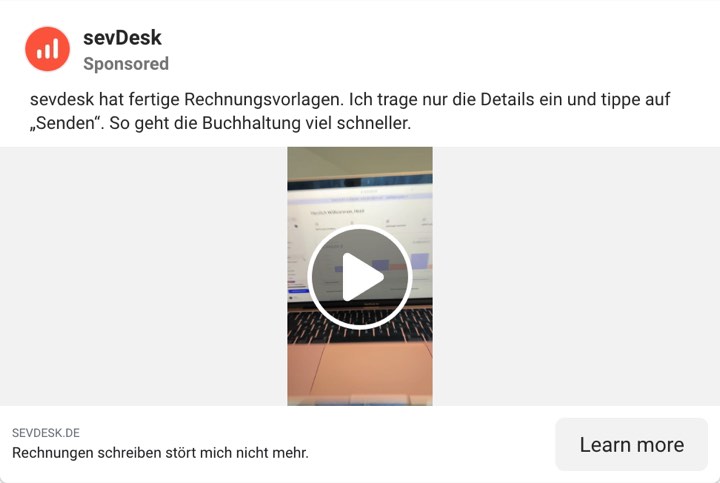
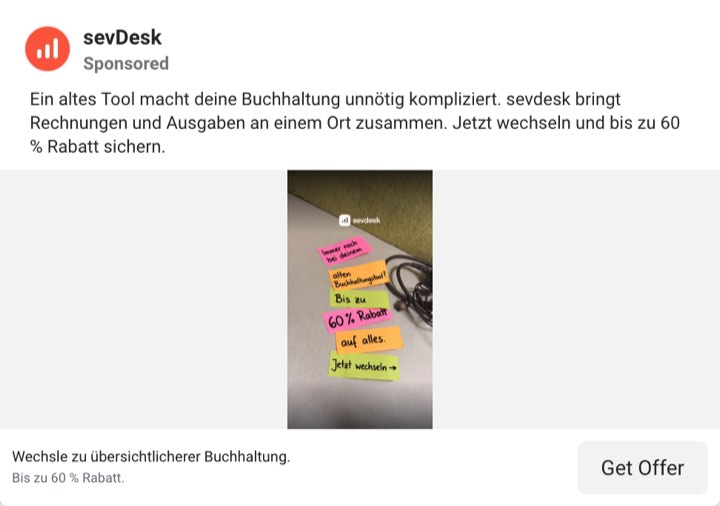
| A situation from the reader's week: receipts, a chased payment, a chased approval | Both. Write the first line as the situation. | It needs no title. | Lexware's receipts video and sevDesk's payment reminder image ("Kein unangenehmes Nachfragen", no awkward chasing), both on Meta. Workday's scheduling post on LinkedIn opens on the chore and names the role: "Niemand wird Recruiter, um ständig Kalendern und Postfächern hinterherzujagen." Pipedrive's masterclass video (LinkedIn, Meta) ran on both feeds with the same first line, which names a problem and no title. |
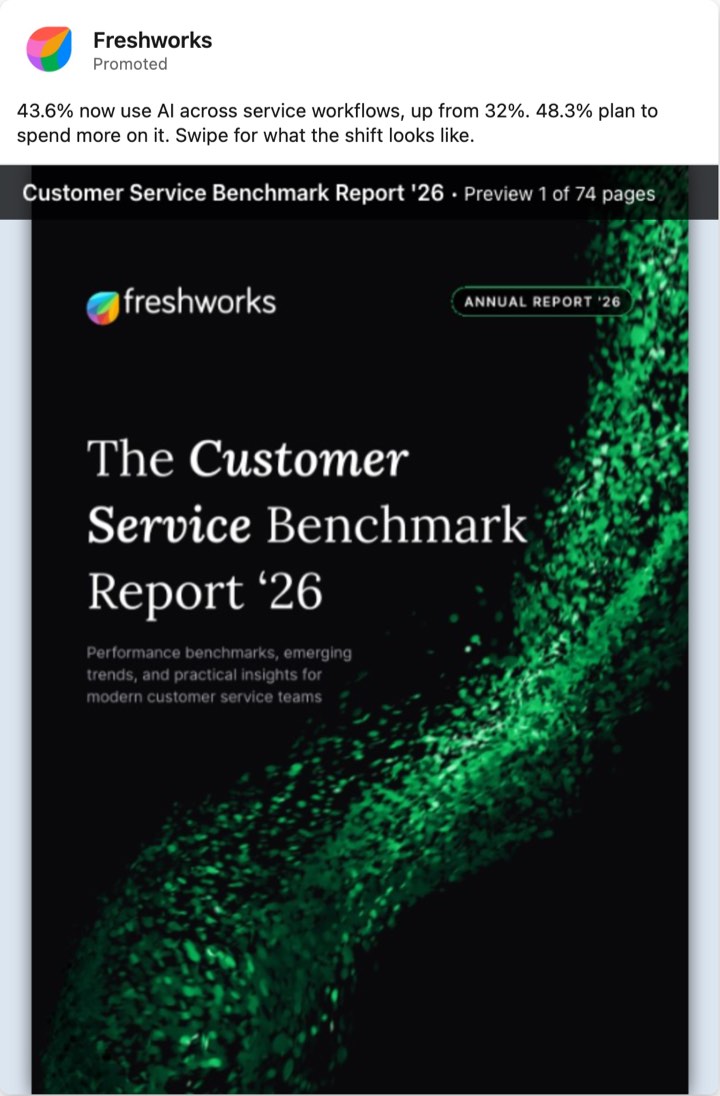
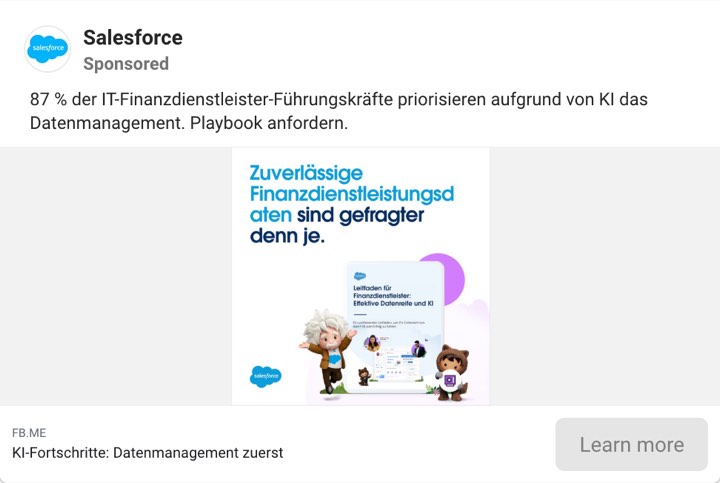
| A peer benchmark or a peer statistic | LinkedIn first | A benchmark invites the reader to compare with peers. That matters most where peers can see the reader. Test it on Meta too, because one Meta ad in our pull opens on a peer statistic. | Freshworks' benchmark report, a document ad. Salesforce's Meta ad opens: "87 % der IT-Finanzdienstleister-Führungskräfte priorisieren aufgrund von KI das Datenmanagement", that is, 87 percent of IT leaders in financial services put data management first because of AI. The number is Salesforce's own claim. |
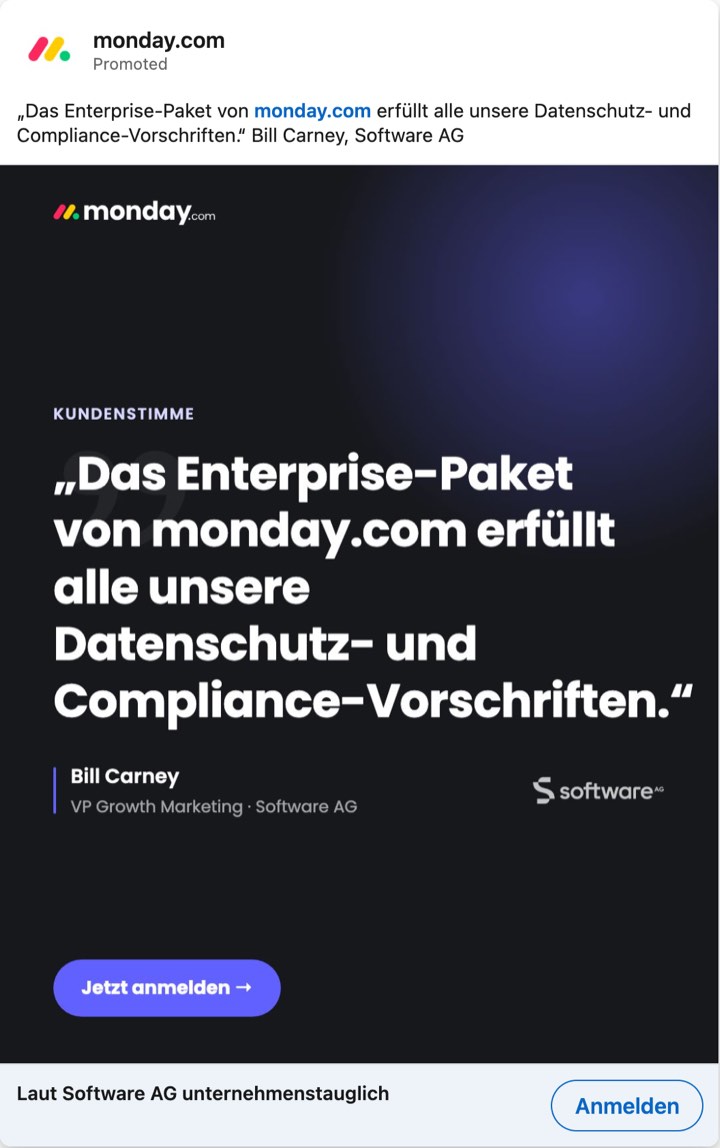
| A customer story with a name and a role | Rebuild for Meta | On LinkedIn the role is the proof. On Meta use a plain voice. | monday.com's customer quote ad on LinkedIn. Its headline names the customer: "Laut Software AG unternehmenstauglich", enterprise-ready according to Software AG. sevDesk's first-person line on Meta, a plain voice with no title: "Rechnungen schreiben stört mich nicht mehr", writing invoices no longer bothers me. |
| A leader's own opinion | The ad promotes a post from a member's profile, and LinkedIn requires the member's permission and a profile that shows their full name. Meta's nearest format is partnership ads, which run from a creator's or partner's handle. Its page names no employees and no B2B use. | The HubSpot and Lexware posts above. | |
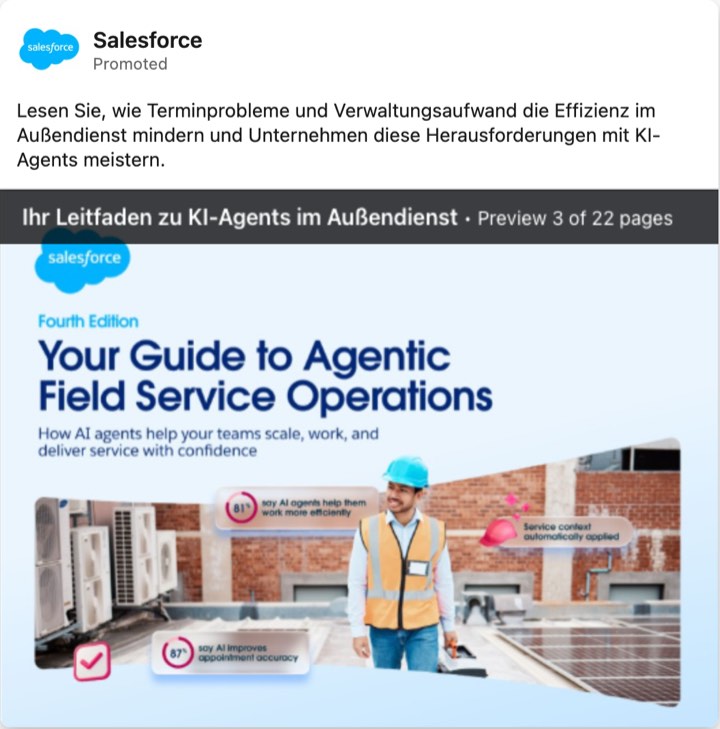
| A long document | LinkedIn container | Document ads are a LinkedIn format. On Meta, put the idea in one picture and the document behind a form. | Salesforce's field service guide, 22 pages. |
| A discount | Meta first, in our pull | Five of 20 Meta ads carried a discount. None of 41 LinkedIn ads did. | sevDesk's switch offer: "Jetzt wechseln und bis zu 60 % Rabatt sichern". |
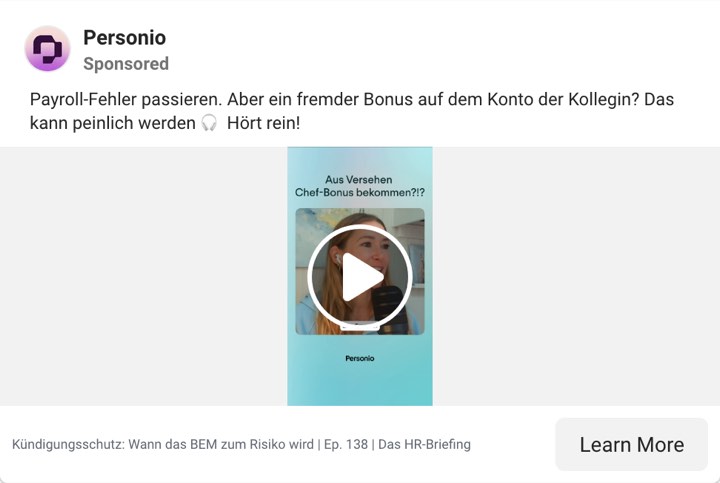
| A joke about a work situation, or an absurd alternative | Meta first | Humor lands harder in an entertainment feed. On LinkedIn, aim the joke at the profession's week. | Personio's podcast video on Meta: "Payroll-Fehler passieren. Aber ein fremder Bonus auf dem Konto der Kollegin?", that is, payroll mistakes happen, but a stranger's bonus on a colleague's account? The ad is in the Meta library. |
| Fear of how the reader looks to the boss or an auditor | LinkedIn only | The fear needs a work audience. | No clean example in our pull. |
How do you run the two-read test?
Read every concept twice. Fill in the card below with the people who write the ads and the person who buys the media. A read passes when at most one answer is no. This pass rule is our own and not a researched number. Paste the card into the briefing thread.
TWO-READ TEST AND CHANGE LIST
Concept: [short name]
Argument in one sentence a competitor could not sign: [argument]
Channel it runs on now: [LinkedIn or Meta]
Channel we want to add: [Meta or LinkedIn]
Format now: [single image, video, carousel, document or thought leader post]

READ 1. A named professional on LinkedIn.
Name and job title sit next to everything they do in the feed. Reacting to an ad is a visible act at work.
1. The first line names their work or role: yes or no, quote the line.
2. They can be seen reacting to it, and it never makes them look careless: yes or no.
3. A skeptical peer can check the proof (named customer, sourced number, product screen): yes or no.
4. Any joke is about the profession's week, never about the reader. If there is no joke, answer yes.
5. The ask suits someone at work who may forward it: yes or no.

READ 2. A stranger on Meta.
No job title is shown. It is leisure time. The ad interrupts friends, family and entertainment.
1. With the words covered, the picture still says what this is: yes or no.
2. The first line works with no job title and no jargon: yes or no, quote the line.
3. One plain line says what the product does: yes or no.
4. The ad does not depend on how the reader looks at work: yes or no.
5. The ask is small enough for a stranger: yes or no.

DECISION (a read passes when at most one answer is no)
Both reads pass: it travels. Adapt the picture ratio, the first line length and the ask for the other feed.
Read 1 passes, read 2 fails: keep it on LinkedIn, or rebuild it around the situation and drop any status play.
Read 2 passes, read 1 fails: keep it on Meta, or rebuild it with the work named, one checkable proof and an ask that suits someone at work.
Neither passes: cut it.

CHANGE LIST (what to rewrite when you rebuild)
First line: LinkedIn names the work or role. Meta names the situation.
Picture: LinkedIn may show a screen or a diagram. Meta needs a picture that argues alone.
Jargon: LinkedIn may use the role's words. Meta uses the reader's own words.
Proof: LinkedIn uses a named customer, a sourced number or a screen. Meta uses one claim in a plain voice.
Humor: LinkedIn jokes about the profession's week. Meta jokes must carry the product truth.
Status and fear: fine on LinkedIn when it respects the reader. Drop it on Meta.
Ask: LinkedIn offers a report, checklist, event or demo. Meta asks for one tap or the shortest form.
Text: LinkedIn lets the argument run longer. Meta keeps it short and lets the picture work.
Format: document ads and thought leader posts are LinkedIn formats. On Meta, put the idea in one picture or a short video.
Limits to check: LinkedIn intro text 150 characters, headline 70. Meta feed primary text 50 to 150 characters, headline 27.
You can also hand the test to Claude or ChatGPT. The prompt below carries its own definitions, so it works pasted alone. It refuses to invent proof, which is the usual way an assistant spoils a rewrite. See writing B2B ads with Claude or ChatGPT for the wider workflow.
You are a senior paid social strategist for business-to-business (B2B) advertisers on LinkedIn and Meta (Facebook and Instagram). Run the two-read test on the ad concept below. Then help me rewrite it for the other channel.

The two readers:
- Read 1, LinkedIn: a named professional. Their name and job title sit next to everything they do in the feed. Reacting to an ad is a visible act at work, in front of colleagues and customers. They read with care.
- Read 2, Meta: a stranger in leisure time. No job title is shown. The ad interrupts friends, family and entertainment. The picture must earn the stop on its own. Jargon reads as noise.

The concept:
- Product, one line: [what it does and for whom]
- Argument, one sentence a competitor could not sign: [argument]
- Channel the ad runs on now: [LinkedIn or Meta]
- Format now: [single image, video, carousel, document or thought leader post]
- First line: [text]
- Picture: [what it shows]
- Proof: [named customer, sourced number, product screen, or none]
- Ask and button: [text]
- Goal metric: [for example cost per lead form completion]
- Channel I want to add: [Meta or LinkedIn]

Rules:
- Use only the facts above. Do not invent customers, quotes, numbers or results. Where proof is missing, write [proof needed].
- For every answer, quote the line or name the picture element that decides it.
- If a field above is empty, name it and carry on with the rest.
- Write short sentences in plain English. Use no dashes.

Do this in order:
1. Read 1. Answer yes or no with one sentence of reason. (a) The first line names the reader's work or role. (b) The reader can be seen reacting to it and never looks careless. (c) A skeptical peer can check the proof. (d) Any joke is about the profession's week, never about the reader. If there is no joke, answer yes. (e) The ask suits someone at work who may forward it.
2. Read 2. Answer yes or no with one sentence of reason. (a) With the words covered, the picture still says what this is. (b) The first line works with no job title and no jargon. (c) One plain line says what the product does. (d) The ad does not depend on how the reader looks at work. (e) The ask is small enough for a stranger.
3. Verdict. A read passes when at most one answer is no. If both reads pass, write "travels" and list only the small adaptations. If only read 1 passes, write "keep on LinkedIn, or rebuild around the situation". If only read 2 passes, write "keep on Meta, or rebuild with the work named, one checkable proof and a fitting ask". If neither passes, write "cut" and say why in one sentence.
4. If the verdict is not "cut", write the version for the channel I want to add: three options for the first line, one picture direction, the proof to use or [proof needed], the ask (it must fit the goal metric), and the text. Name the format that suits the new channel, and say so if the current format has no equivalent there. Keep to these limits: LinkedIn intro text up to 150 characters and headline up to 70; Meta primary text up to 150 characters and headline up to 27.
5. List what changed against the current ad, element by element: first line, picture, jargon, proof, humor, status play, ask, text length, format.
How do you rewrite a LinkedIn winner for Meta?
Keep the argument, and rebuild the execution around the situation. Our reading: the winner won with a reader who saw a title, a checkable claim and a reason to read on. The Meta reader sees none of these, so each one needs a replacement.
- Write the argument as one sentence a competitor could not sign. Keep it word for word.
- Replace the call-out with the situation. Name the moment, not the title.
- Replace the picture. Cover the words, and check that the picture still argues.
- Swap jargon for the reader's own words.
- Cut the proof to one claim in a plain voice. A customer's title does less work here.
- Keep the offer and shrink the ask. Use the shortest form.
- Give the rewrite its own ad name and keep the concept ID. Then its result is read alone, not mixed into the original.
Here is the rewrite on a constructed example. Approvely is an invented product: invoice approvals in one place, so finance teams stop chasing managers by email. It is the same invented product as in the creative brief template. Both ads are constructed for this guide. Every proof field is a placeholder.
The two-read card for the LinkedIn ad gives this result. Read 1 passes: the first line names the role, nothing makes the reader look careless, and the ask is a checklist. It has one no, on proof, which is still empty. Read 2 fails: the first line starts with a job title, and the product screen does not say what it is with the words covered. That is two no answers. The verdict is to rebuild around the situation.
| Element | LinkedIn ad (constructed) | Meta rewrite (constructed) |
|---|---|---|
| First line | Head of accounts payable: reminder number four, same invoice. | Reminder number four. Same invoice. |
| Text | Approvely lets managers approve where they already work, so you stop chasing. | Managers approve in one tap, where they already work. Get the approval checklist. |
| Picture | A plain approval queue: one invoice per row, each with an approver's name and a date. | An inbox with four rows, each with the subject "Re: Re: Re: invoice approval". No other words. |
| Headline | Invoice approvals without the email chase | Approvals without the chase |
| Proof | [named customer, role, result in their words, source and date] | None claimed. If you add one: [customer first name, one plain sentence, source]. |
| Ask | Download the approval audit checklist behind a lead form. | The same checklist, behind the shortest form. |
The LinkedIn intro text (first line plus text) is 139 characters, inside the limit of 150, and its headline is 41 characters, inside 70. The Meta primary text is 117 characters, inside Meta's recommended 50 to 150, and its headline is 27 characters, which is Meta's recommended length for a Facebook Feed image. The claim "managers approve where they already work" is a product claim to confirm before design.
How do you rewrite a Meta winner for LinkedIn?
Add what the Meta ad leaves out, and keep what made it win. Our reading: the Meta winner won on a situation and the shape of a joke. The LinkedIn reader also needs the work named, a claim a peer can check and an ask that suits someone at work.
- Name the work in the first line, in the words of the role. Use the title only if the audience is built on titles.
- Keep the situation and the joke. Aim the joke at the situation, never at the reader.
- Add one checkable proof: a named customer, a sourced number or a product screen. If you have none, write [proof needed] and pick a concept that needs none. See proof points in B2B ads.
- Let the text carry one argument. Use a thought leader post if a person will stand behind it, or a document if the idea needs pages.
- Match the ask to a reader at work: a checklist, a report or a short demo.
- Run read 1 on the result. Does it make the reader look careless? If yes, rewrite it.
Suppose a second Meta ad for Approvely wins. It keeps the four-row inbox picture from the last section and opens with "Approved. Finally." Here is the LinkedIn version:
| Element | Meta winner (constructed) | LinkedIn rewrite (constructed) |
|---|---|---|
| First line | Approved. Finally. | Re: Re: Re: invoice approval. Every accounts payable team knows this thread. |
| Text | Managers approve in one tap, where they already work. | Approvely keeps each approval in one place, with a name and a date. |
| Picture | An inbox with four rows, each with the subject "Re: Re: Re: invoice approval". | Two panels side by side. On the left the inbox thread. On the right one list, each invoice with an approver's name and a date. |
| Headline | Approvals without the chase | One place for every invoice approval |
| Proof | None claimed. | [named customer, role, result in their words, source and date] |
| Ask | The checklist, behind the shortest form. | Download the approval audit checklist. |
The intro text (first line plus text) is 144 characters, inside the limit of 150. The joke still aims at the thread, not at the reader. The rewrite names the work, adds a precise claim (a name and a date on every approval) and opens a proof slot.
This rewrite does not return the original LinkedIn ad. That is expected. It starts from the situation and the picture that won on Meta, so it is a new ad. Log it as a rewrite of the Meta ad and read its result alone.
How do you compare results across the two channels?
Compare each ad with its peers on its own channel, and compare the concepts by their ranks, never by one blended cost. The two platforms count a conversion differently, charge different prices, and give each ad a different audience. A single pooled number describes neither channel. Facebook and Instagram ads for B2B covers how to run the Meta account itself.
Why can you not add the two numbers?
The attribution rules differ. A conversion window is the period after an ad view or click in which the platform credits a conversion to that ad. Meta's attribution page says its attribution model and settings are chosen at the ad set level. It warns that the campaign overview table cannot compare results across ad sets with different attribution models, because comparing them "will lead to inaccurate conclusions". LinkedIn's conversion window page lets you set the window per conversion.
| Setting | Meta | |
|---|---|---|
| Where you choose it | Per conversion | Per ad set |
| Click window | 1, 7, 30 or 90 days. Some Conversions API and file-upload conversions also allow 180 or 365. | 1 or 7 days after a link click, for website and in-store conversions |
| View window | Views count inside the window you pick: 1, 7, 30 or 90 days | View-through: 1 day after an impression. Engage-through: 1 day after a non-link click. |
| Default, as the page states it | For most conversions, 90-day click and 90-day view, which LinkedIn recommends and sets as the default in Campaign Manager | Chosen per ad set. The page names no single default. |
| Credit | Last touch for most conversion types | Standard, incremental or custom model |
In March 2026 Meta also announced a change to click attribution. Its announcement says click-through counts link clicks only for website and in-store conversions, and moves shares, saves and other non-link clicks to engage-through attribution. Meta's attribution page adds that some accounts may still use the earlier versions while the change rolls out. After a change like this, compare ads only over one period and one setting.
Price is the second reason. Dreamdata, a B2B analytics vendor, reports a LinkedIn cost per click (CPC) of 5.98 euros against 1.60 euros on Meta in its 2026 benchmark. That comes from its customers' aggregated data and is a vendor's number. The same page reverses the order on its cost per company influenced, 70.11 euros on LinkedIn against 128.70 on Meta, so the price of a click settles nothing. SaaSrise quotes about 50 US dollars a click on LinkedIn and 3 on Meta from its own clients, with no method. The two sources differ widely on LinkedIn alone, so treat any quoted price as a vendor's number. The channel sets part of the price, so a cheaper result on Meta says little about the ad.
The public ad libraries do not compare either. LinkedIn shows an impression band for the whole run. Meta shows an estimated reach as a number of accounts. Neither shows results.
What should you compare instead?
Use the pair log. Write the attribution basis next to every number. Rank each ad against its peers on its own channel and goal. Then read the pair of ranks.
CONCEPT PAIR LOG
One row per ad. A concept and its rewrite share a concept ID. Fill the first six columns before launch and the rest when the window you set in advance has closed.

Concept ID | Channel | Original or rewrite | Elements changed | Goal metric | Attribution basis | Results | Rank among peers on this channel and goal | Share (rank divided by total) | Our read
[ID] | LinkedIn | original | none | [metric] | [click window and view window] | [number] | [rank] of [total] | [rank / total] | [one sentence]
[ID] | Meta | rewrite | [first line, picture, jargon, proof, humor, ask, text] | [metric] | [attribution setting of the ad set] | [number] | [rank] of [total] | [rank / total] | [one sentence]

Rules
1. Rank each ad against its peers on its own channel and goal. Never pool the two channels into one cost or one rank.
2. Write the attribution basis next to every number.
3. Change only the elements the rewrite needs. List them in column four.
4. Do not read a rank until every ad in the comparison has at least [number of results you set in advance].
5. Compare shares, not raw ranks. 2 of 8 is a share of 0.25, and 2 of 30 is about 0.07. Call a share up to 0.33 top, a share of 0.67 or more low, and anything between middle. This cut is our convention for the log, not a researched number.
6. Read the pair, not the totals: top on both, top on one, low on both. A middle share gives no read. Then write the next test.
With few results, ranks flip from week to week. When to pause an ad shows how much noise a small result count carries. To code both ads with the same fields, use the reading card in AI prompts to analyze B2B ads.
How do you read a pair of ranks?
| Pair result | What we suspect first | Next test |
|---|---|---|
| Top on both | The argument travels. | Change one element on each channel. |
| Top on LinkedIn, low on Meta | The rewrite: first line, picture or ask. | Write a second Meta rewrite with a different picture. If it also lags, the concept needs the role or the status play and stays on LinkedIn. |
| Top on Meta, low on LinkedIn | Missing proof or no work call-out. | Add one checkable proof and name the work. If it also lags, the concept is a Meta concept. |
| Low on both | The argument or the offer. | Return to the brief. See the creative brief template. |
| Middle on either channel | No read yet. | Wait for more results, or change one element. |
This table is our reading, not a measured result. It sets the order in which to check causes, so you change one thing at a time.
Frequently asked questions
Can I run the same ad on LinkedIn and Facebook?
You can, but run the two-read test first. Most concepts need a new first line, picture and ask. One image ratio works for both feeds: Meta recommends 4:5 for Facebook Feed images, and LinkedIn recommends vertical single image ads with 4:5 as its vertical ratio. LinkedIn serves vertical assets on mobile only.
Is LinkedIn or Facebook better for B2B ads?
Neither wins in general. LinkedIn lets you pick people by the job title, company and seniority on their profiles, and an ad set must reach at least 300 member accounts. Meta can use its AI to find the audience when you turn on Advantage+ audience. One vendor's data shows a lower price per click on Meta, and the same vendor reports the reverse order on another cost measure, so click price settles nothing. The write-ups we read split: Kalungi describes shifting lead generation from LinkedIn to Meta, and SaaSrise suggests Meta for the average customer and LinkedIn for the enterprise slice. Both sell paid services, and neither describes a test design. Start from who must see the ad, then run the two-read test on each concept.
Should I name a job title in a Meta ad?
Name the work or the situation instead. A title identifies no one in a leisure feed. "Chasing approvals by email again?" picks out the person who chases and names no title. In our pull, two of sevDesk's Meta ads name a task or a moment and no title: "Rechnungen schreiben stört mich nicht mehr" (writing invoices no longer bothers me) and "Kein unangenehmes Nachfragen" (no awkward chasing).
Do thought leader ads work on Meta?
The format belongs to LinkedIn. It promotes a post from a member's profile with the member's permission. Meta's nearest format is partnership ads, which run from a creator's or partner's handle. Kalungi recommends founder talking-head videos on Meta, and SaaSrise recommends founder and customer videos for retargeting. Neither shows data. Test a person on camera as a new concept. See LinkedIn thought leader ads.
Does humor work in B2B ads?
In the Magna study, viewers named humorous scenarios and storytelling among the traits of ads they called creative. In the study's model of brand connection, "shared a unique perspective" ranked first, and the slide says it matters more than twice as much as being humorous. The study covers LinkedIn only. Our reading: on LinkedIn the profession laughs at its own week, and on Meta the joke carries the product truth. In both cases the joke aims at the situation, never at the reader.
How long should I run a rewrite before I judge it?
Set the number of results in advance, and read the rank only after every ad in the comparison reaches it. A rewrite with few results can rank high or low by luck. See when to pause an ad.
Can Claude or ChatGPT write the rewrite?
Yes. Paste the prompt above with your concept and the channel you want to add. It refuses to invent proof and gives three first lines to choose from. A person still decides which claim is true for your buyer. See AI prompts to analyze B2B ads for the analysis side.
What does Nimblet do with a concept and its rewrite?
Nimblet reads each ad on both channels with the same fields and ranks it against peers bought for the same goal. It does not pair a concept with its rewrite by itself. Put the concept ID in both ad names and a tag rule groups the pair. Its reports state the attribution basis next to blended conversion numbers, and say when too little data stands behind a rank. Nimblet drafts the next version in your brand. It only reads your ad accounts and never changes a campaign. See creative intelligence, the Nimblet MCP server and pricing.